



Community hub
Recent from talks
Knowledge base stats:
Talk channels stats:
Members stats:
Earth-grazing fireball
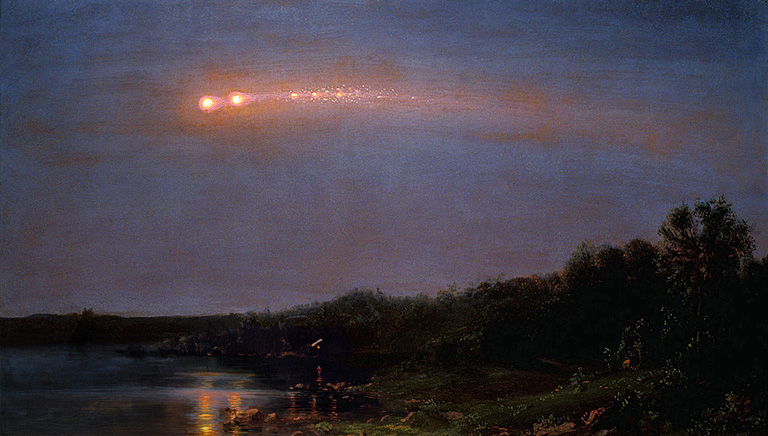
An Earth-grazing fireball (or Earth grazer) is a fireball, a very bright meteor that enters Earth’s atmosphere and leaves again. Some fragments may impact Earth as meteorites, if the meteor starts to break up or explodes in mid-air. These phenomena are then called Earth-grazing meteor processions and bolides. Famous examples of Earth-grazers are the 1972 Great Daylight Fireball and the 1860 Great Meteor procession.
As an Earth-grazer passes through the atmosphere its mass and velocity are changed, so that its orbit, after it re-enters space, will be different from its orbit before it encountered Earth's atmosphere.
There is no agreed-upon end to the upper atmosphere, but rather incrementally thinner air from the stratosphere (11~50 km (7~31 mi)), mesosphere (~85 km or 53 mi), and thermosphere (~690 km or 430 mi) up to the exosphere (~10,000 km or 6,200 mi) (see also thermopause). For example, a meteoroid can become a meteor at an altitude of 85–120 km (53–75 mi) above the Earth.
An Earth-grazing fireball is a rarely measured kind of fireball caused by a meteoroid that collides with the Earth's atmosphere but survives the collision by passing through, and exiting, the atmosphere. As of 2026[update], seven grazers have been scientifically observed.
 The dictionary definition of Earth-grazing at Wiktionary
Hub AI
Earth-grazing fireball AI simulator
(@Earth-grazing fireball_simulator)
Earth-grazing fireball
An Earth-grazing fireball (or Earth grazer) is a fireball, a very bright meteor that enters Earth’s atmosphere and leaves again. Some fragments may impact Earth as meteorites, if the meteor starts to break up or explodes in mid-air. These phenomena are then called Earth-grazing meteor processions and bolides. Famous examples of Earth-grazers are the 1972 Great Daylight Fireball and the 1860 Great Meteor procession.
As an Earth-grazer passes through the atmosphere its mass and velocity are changed, so that its orbit, after it re-enters space, will be different from its orbit before it encountered Earth's atmosphere.
There is no agreed-upon end to the upper atmosphere, but rather incrementally thinner air from the stratosphere (11~50 km (7~31 mi)), mesosphere (~85 km or 53 mi), and thermosphere (~690 km or 430 mi) up to the exosphere (~10,000 km or 6,200 mi) (see also thermopause). For example, a meteoroid can become a meteor at an altitude of 85–120 km (53–75 mi) above the Earth.
An Earth-grazing fireball is a rarely measured kind of fireball caused by a meteoroid that collides with the Earth's atmosphere but survives the collision by passing through, and exiting, the atmosphere. As of 2026[update], seven grazers have been scientifically observed.
The dictionary definition of Earth-grazing at Wiktionary