



Community hub
Recent from talks
Knowledge base stats:
Talk channels stats:
Members stats:
Earth potential rise
In electrical engineering, earth potential rise (EPR), also called ground potential rise (GPR), occurs when a large current flows to earth through an earth grid impedance. The potential relative to a distant point on the Earth is highest at the point where current enters the ground, and declines with distance from the source. Ground potential rise is a concern in the design of electrical substations because the high potential may be a hazard to people or equipment.
The change of voltage over distance (potential gradient) may be so high that a person could be injured due to the voltage developed between two feet, or between the ground on which the person is standing and a metal object. Any conducting object connected to the substation earth ground, such as telephone wires, rails, fences, or metallic piping, may also be energized at the ground potential in the substation. This transferred potential is a hazard to people and equipment outside the substation.
Earth potential rise (EPR) is caused by electrical faults that occur at electrical substations, power plants, or high-voltage transmission lines. Short-circuit current flows through the plant structure and equipment and into the grounding electrode. The resistance of the Earth is non-zero, so current injected into the earth at the grounding electrode produces a potential rise with respect to a distant reference point. The resulting potential rise can cause hazardous voltage, many hundreds of metres away from the actual fault location. Many factors determine the level of hazard, including: available fault current, soil type, soil moisture, temperature, underlying rock layers, and clearing time to interrupt a fault.
Earth potential rise is a safety issue in the coordination of power and telecommunications services. An EPR event at a site such as an electrical distribution substation may expose personnel, users or structures to hazardous voltages.
"Step voltage" is the voltage between the feet of a person standing near an energized grounded object. It is equal to the difference in voltage, given by the voltage distribution curve, between two points at different distances from the "electrode". A person could be at risk of injury during a fault simply by standing near the grounding point.
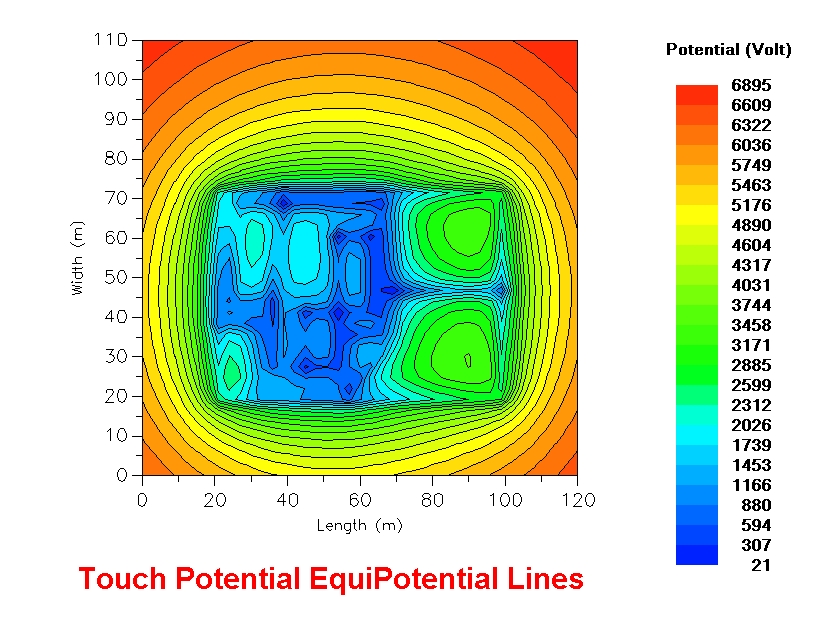
"Touch voltage" is the voltage between the energized object and the feet of a person in contact with the object. It is equal to the difference in voltage between the object and a point some distance away. The touch voltage could be nearly the full voltage across the grounded object if that object is grounded at a point remote from the place where the person is in contact with it. For example, a crane that was grounded to the system neutral and that contacted an energized line would expose any person in contact with the crane or its uninsulated load line to a touch voltage nearly equal to the full fault voltage.
"Mesh voltage" is a factor calculated or measured when a grid of grounding conductors is installed. Mesh voltage is the largest potential difference between metallic objects connected to the grid, and soil within the grid, under worst-case fault conditions. It is significant because a person may be standing inside the grid at a point with a large voltage relative to the grid itself.
An engineering analysis of the power system under fault conditions can be used to determine whether or not hazardous step and touch voltages will develop. The result of this analysis can show the need for protective measures and can guide the selection of appropriate precautions.
Hub AI
Earth potential rise AI simulator
(@Earth potential rise_simulator)
Earth potential rise
In electrical engineering, earth potential rise (EPR), also called ground potential rise (GPR), occurs when a large current flows to earth through an earth grid impedance. The potential relative to a distant point on the Earth is highest at the point where current enters the ground, and declines with distance from the source. Ground potential rise is a concern in the design of electrical substations because the high potential may be a hazard to people or equipment.
The change of voltage over distance (potential gradient) may be so high that a person could be injured due to the voltage developed between two feet, or between the ground on which the person is standing and a metal object. Any conducting object connected to the substation earth ground, such as telephone wires, rails, fences, or metallic piping, may also be energized at the ground potential in the substation. This transferred potential is a hazard to people and equipment outside the substation.
Earth potential rise (EPR) is caused by electrical faults that occur at electrical substations, power plants, or high-voltage transmission lines. Short-circuit current flows through the plant structure and equipment and into the grounding electrode. The resistance of the Earth is non-zero, so current injected into the earth at the grounding electrode produces a potential rise with respect to a distant reference point. The resulting potential rise can cause hazardous voltage, many hundreds of metres away from the actual fault location. Many factors determine the level of hazard, including: available fault current, soil type, soil moisture, temperature, underlying rock layers, and clearing time to interrupt a fault.
Earth potential rise is a safety issue in the coordination of power and telecommunications services. An EPR event at a site such as an electrical distribution substation may expose personnel, users or structures to hazardous voltages.
"Step voltage" is the voltage between the feet of a person standing near an energized grounded object. It is equal to the difference in voltage, given by the voltage distribution curve, between two points at different distances from the "electrode". A person could be at risk of injury during a fault simply by standing near the grounding point.
"Touch voltage" is the voltage between the energized object and the feet of a person in contact with the object. It is equal to the difference in voltage between the object and a point some distance away. The touch voltage could be nearly the full voltage across the grounded object if that object is grounded at a point remote from the place where the person is in contact with it. For example, a crane that was grounded to the system neutral and that contacted an energized line would expose any person in contact with the crane or its uninsulated load line to a touch voltage nearly equal to the full fault voltage.
"Mesh voltage" is a factor calculated or measured when a grid of grounding conductors is installed. Mesh voltage is the largest potential difference between metallic objects connected to the grid, and soil within the grid, under worst-case fault conditions. It is significant because a person may be standing inside the grid at a point with a large voltage relative to the grid itself.
An engineering analysis of the power system under fault conditions can be used to determine whether or not hazardous step and touch voltages will develop. The result of this analysis can show the need for protective measures and can guide the selection of appropriate precautions.