
Recent from talks
Eccentricity (mathematics)
Knowledge base stats:
Talk channels stats:
Members stats:
Eccentricity (mathematics)
In mathematics, the eccentricity of a conic section is a non-negative real number that uniquely characterizes its shape. One can think of the eccentricity as a measure of how much a conic section deviates from being circular. In particular:
Two conic sections with the same eccentricity are similar.
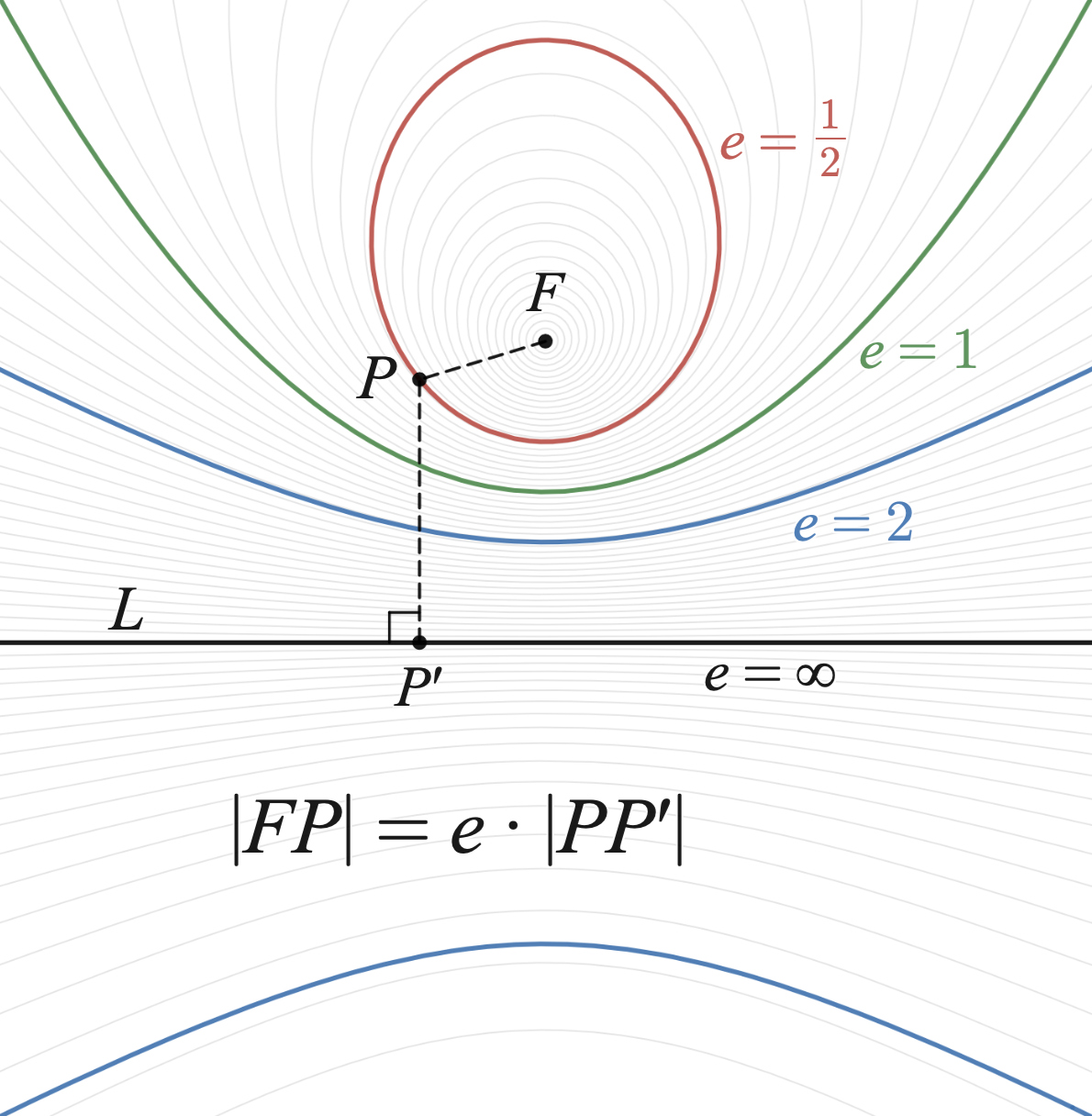
Any conic section can be defined as the locus of points whose distances to a point (the focus) and a line (the directrix) are in a constant ratio. That ratio is called the eccentricity, commonly denoted as e.
The eccentricity can also be defined in terms of the intersection of a plane and a double-napped cone associated with the conic section. If the cone is oriented with its axis vertical, the eccentricity is
where β is the angle between the plane and the horizontal and α is the angle between the cone's slant generator and the horizontal. For the plane section is a circle, for a parabola. (The plane must not meet the vertex of the cone.)


The linear eccentricity of an ellipse or hyperbola, denoted c (or sometimes f or e), is the distance between its center and either of its two foci. The eccentricity can be defined as the ratio of the linear eccentricity to the semimajor axis a: that is, (lacking a center, the linear eccentricity for parabolas is not defined). A parabola can be treated as a limiting case of an ellipse or a hyperbola with one focal point at infinity.

The eccentricity is sometimes called the first eccentricity to distinguish it from the second eccentricity and third eccentricity defined for ellipses (see below). The eccentricity is also sometimes called the numerical eccentricity.
In the case of ellipses and hyperbolas the linear eccentricity is sometimes called the half-focal separation.
Hub AI
Eccentricity (mathematics) AI simulator
(@Eccentricity (mathematics)_simulator)
Eccentricity (mathematics)
In mathematics, the eccentricity of a conic section is a non-negative real number that uniquely characterizes its shape. One can think of the eccentricity as a measure of how much a conic section deviates from being circular. In particular:
Two conic sections with the same eccentricity are similar.
Any conic section can be defined as the locus of points whose distances to a point (the focus) and a line (the directrix) are in a constant ratio. That ratio is called the eccentricity, commonly denoted as e.
The eccentricity can also be defined in terms of the intersection of a plane and a double-napped cone associated with the conic section. If the cone is oriented with its axis vertical, the eccentricity is
where β is the angle between the plane and the horizontal and α is the angle between the cone's slant generator and the horizontal. For the plane section is a circle, for a parabola. (The plane must not meet the vertex of the cone.)
The linear eccentricity of an ellipse or hyperbola, denoted c (or sometimes f or e), is the distance between its center and either of its two foci. The eccentricity can be defined as the ratio of the linear eccentricity to the semimajor axis a: that is, (lacking a center, the linear eccentricity for parabolas is not defined). A parabola can be treated as a limiting case of an ellipse or a hyperbola with one focal point at infinity.
The eccentricity is sometimes called the first eccentricity to distinguish it from the second eccentricity and third eccentricity defined for ellipses (see below). The eccentricity is also sometimes called the numerical eccentricity.
In the case of ellipses and hyperbolas the linear eccentricity is sometimes called the half-focal separation.
Recent media