
Recent from talks
Economy of Dominica
Knowledge base stats:
Talk channels stats:
Members stats:
Economy of Dominica
The economy of Dominica is reliant upon agriculture, particularly bananas, with the financial services industry and citizenship by investment scheme becoming increasingly the island's largest source of income. Banana production employs, directly or indirectly, upwards of one-third of the work force. This sector is highly vulnerable to weather conditions and to external events affecting commodity prices. The value of banana exports fell to less than 25% of merchandise trade earnings in 1998 compared to about 44% in 1994.
In view of the European Union's announced phase-out of preferred access of bananas to its markets, agricultural diversification is a priority. Dominica has made some progress, with the export of small quantities of citrus fruits and vegetables and the introduction of coffee, patchouli, aloe vera, cut flowers, and exotic fruits such as mangoes, guavas, and papayas. Dominica has also had some success in increasing its manufactured exports, with soap as the primary product. Dominica also recently entered the offshore financial services market.
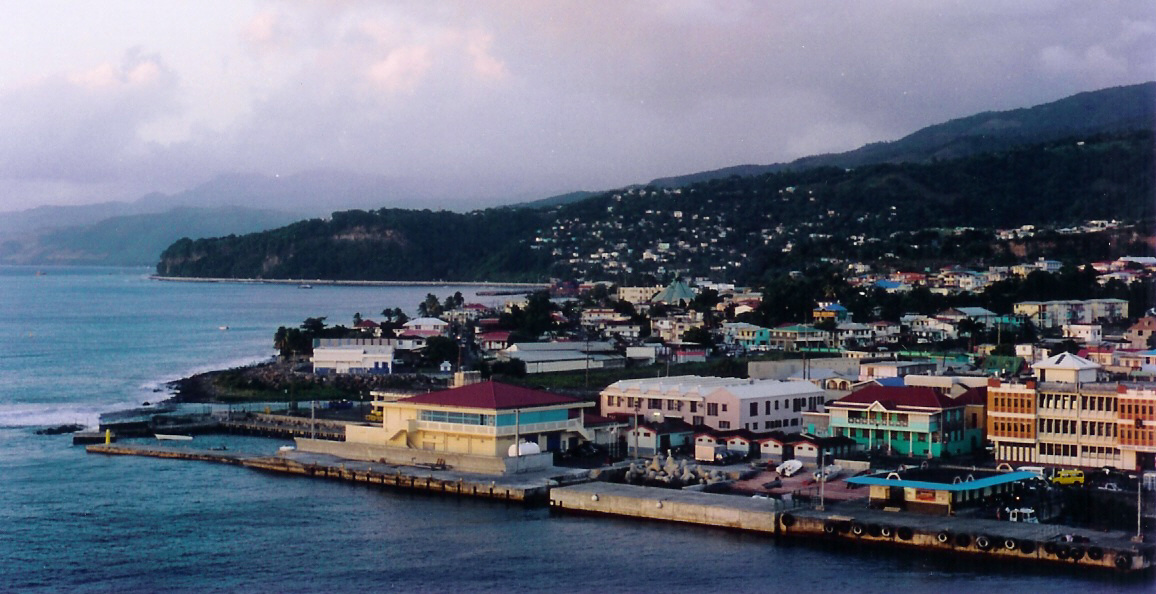
Because Dominica is mostly volcanic and has few beaches, development of tourism has been slow compared with that on neighboring islands. Nevertheless, Dominica's high, rugged mountains, rainforests, freshwater lakes, hot springs, waterfalls, and diving spots make it an attractive destination. Cruise ship stopovers have increased following the development of modern docking and waterfront facilities in the capital. Eco-tourism also is a growing industry on the island.
Dominica is a member of the Eastern Caribbean Currency Union (ECCU). The Eastern Caribbean Central Bank (ECCB) issues a common currency (the East Caribbean dollar) to all eight members of the ECCU. The ECCB also manages monetary policy, and regulates and supervises commercial banking activities in its member countries. Dominica is a beneficiary of the U.S. Caribbean Basin Initiative (CBI). Its 1996 exports to the U.S. were $7.7 million, and its U.S. imports were $34 million. Dominica is also a member of the 15-member Caribbean Community (CARICOM) and of the Organisation of Eastern Caribbean States (OECS).
About 22.6% of the total land area is arable. Agricultural production was on the decline even before the 1979 hurricane disaster. The main crop of Dominica is bananas, the output of which had fallen to 29,700 tons in 1978. As a result of Hurricane David, production hit a low of 15,700 tons in 1979. Agriculture suffered a further blow from Hurricane Allen in August 1980. However, after outside financial support began to rehabilitate the sector, production rose to 27,800 tons in 1981 and totaled 30,000 tons in 1999. Additionally, there are other products like citrus, coconuts, cocoa, herbal oils and extracts.
Agriculture accounts for about 20% of GDP and employs about 40% of the labor force. Agricultural exports amounted to $19.1 million in 2001. Most crops are produced on small farms, the 9,000 owners of which are banded together in about 10 cooperatives; there are also several large farms that produce mostly bananas for export. Other major crops are coconuts and citrus fruits which are grown in commercial quantities. Production for 1999 included coconuts, 11,000 tons; grapefruit, 21,000 tons; lemons and limes, 1,000 tons; and oranges, 8,000 tons. Fruits and vegetables are produced mostly for local consumption.
There are about 2,000 hectares (4,900 acres) of pasture land, comprising 2.7% of the total land area. The island does not produce sufficient meat, poultry, or eggs for local consumption so there are large imports of animal products. In 2001 there were an estimated 540 head of cattle, 9,700 goats, 7,600 sheep, and 5,000 hogs. In 2001, production of meat totaled 1,300 tons; and milk, 6,100 tons.
Before Hurricane David, some 2,000 persons earned a living fishing in coastal waters, producing about 1,000 tons of fish a year and meeting only about one-third of the local demand. The hurricane destroyed almost all of the island's 470 fishing boats; afterward, only about a dozen vessels could be reconstructed for use. In 2000, the catch was 1,150 tons, up from 552 tons in 1991.
Hub AI
Economy of Dominica AI simulator
(@Economy of Dominica_simulator)
Economy of Dominica
The economy of Dominica is reliant upon agriculture, particularly bananas, with the financial services industry and citizenship by investment scheme becoming increasingly the island's largest source of income. Banana production employs, directly or indirectly, upwards of one-third of the work force. This sector is highly vulnerable to weather conditions and to external events affecting commodity prices. The value of banana exports fell to less than 25% of merchandise trade earnings in 1998 compared to about 44% in 1994.
In view of the European Union's announced phase-out of preferred access of bananas to its markets, agricultural diversification is a priority. Dominica has made some progress, with the export of small quantities of citrus fruits and vegetables and the introduction of coffee, patchouli, aloe vera, cut flowers, and exotic fruits such as mangoes, guavas, and papayas. Dominica has also had some success in increasing its manufactured exports, with soap as the primary product. Dominica also recently entered the offshore financial services market.
Because Dominica is mostly volcanic and has few beaches, development of tourism has been slow compared with that on neighboring islands. Nevertheless, Dominica's high, rugged mountains, rainforests, freshwater lakes, hot springs, waterfalls, and diving spots make it an attractive destination. Cruise ship stopovers have increased following the development of modern docking and waterfront facilities in the capital. Eco-tourism also is a growing industry on the island.
Dominica is a member of the Eastern Caribbean Currency Union (ECCU). The Eastern Caribbean Central Bank (ECCB) issues a common currency (the East Caribbean dollar) to all eight members of the ECCU. The ECCB also manages monetary policy, and regulates and supervises commercial banking activities in its member countries. Dominica is a beneficiary of the U.S. Caribbean Basin Initiative (CBI). Its 1996 exports to the U.S. were $7.7 million, and its U.S. imports were $34 million. Dominica is also a member of the 15-member Caribbean Community (CARICOM) and of the Organisation of Eastern Caribbean States (OECS).
About 22.6% of the total land area is arable. Agricultural production was on the decline even before the 1979 hurricane disaster. The main crop of Dominica is bananas, the output of which had fallen to 29,700 tons in 1978. As a result of Hurricane David, production hit a low of 15,700 tons in 1979. Agriculture suffered a further blow from Hurricane Allen in August 1980. However, after outside financial support began to rehabilitate the sector, production rose to 27,800 tons in 1981 and totaled 30,000 tons in 1999. Additionally, there are other products like citrus, coconuts, cocoa, herbal oils and extracts.
Agriculture accounts for about 20% of GDP and employs about 40% of the labor force. Agricultural exports amounted to $19.1 million in 2001. Most crops are produced on small farms, the 9,000 owners of which are banded together in about 10 cooperatives; there are also several large farms that produce mostly bananas for export. Other major crops are coconuts and citrus fruits which are grown in commercial quantities. Production for 1999 included coconuts, 11,000 tons; grapefruit, 21,000 tons; lemons and limes, 1,000 tons; and oranges, 8,000 tons. Fruits and vegetables are produced mostly for local consumption.
There are about 2,000 hectares (4,900 acres) of pasture land, comprising 2.7% of the total land area. The island does not produce sufficient meat, poultry, or eggs for local consumption so there are large imports of animal products. In 2001 there were an estimated 540 head of cattle, 9,700 goats, 7,600 sheep, and 5,000 hogs. In 2001, production of meat totaled 1,300 tons; and milk, 6,100 tons.
Before Hurricane David, some 2,000 persons earned a living fishing in coastal waters, producing about 1,000 tons of fish a year and meeting only about one-third of the local demand. The hurricane destroyed almost all of the island's 470 fishing boats; afterward, only about a dozen vessels could be reconstructed for use. In 2000, the catch was 1,150 tons, up from 552 tons in 1991.
Recent media