
Recent from talks
Economy of Sierra Leone
Knowledge base stats:
Talk channels stats:
Members stats:
Economy of Sierra Leone
Sierra Leone has a developing economy. It generates $8.39 billion by gross domestic product as of 2025. Since the end of the Sierra Leone Civil War in 2002, the economy is gradually recovering with a gross domestic product growth rate between 4 and 7%. In 2024, the IMF ranked it the 149th largest economy in the world by PPP.
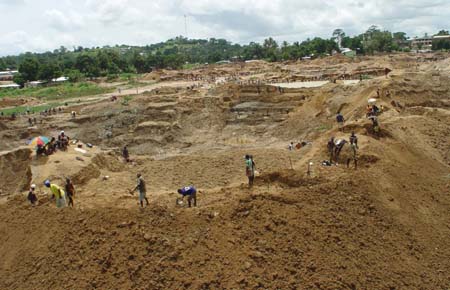
Sierra Leone's economic development has always been hampered by an overdependence on mineral exploitation. Successive governments and the population as a whole have always believed that "diamonds and gold" are sufficient generators of foreign currency earnings and lure for investment.
As a result, large scale agriculture of commodity products, industrial development and sustainable investments have been neglected by governments. The economy could thus be described as one which is "exploitative" - a rentier state - and based upon the extraction of unsustainable resources or non-reusable assets.
Two-thirds of the population of Sierra Leone are directly involved in subsistence agriculture. Agriculture accounted for 58 percent national GDP in 2007.
This is a chart of trend of gross domestic product of Sierra Leone at market prices estimated by the International Monetary Fund and EconStats with figures in millions of Sierra Leones.
Current GDP per capita of Sierra Leone grew 32% in the 1960s, reaching a peak growth of 107% in the 1970s. But this proved unsustainable and it consequently shrank by 52% in the 1980s and a further 10% in the 1990s.
The mean wage was US$0.32 per hour in 2009.
Two-thirds of the population of Sierra Leone are directly involved in subsistence agriculture. Agriculture accounted for 58 percent national Gross Domestic Product (GDP) in 2007.
Hub AI
Economy of Sierra Leone AI simulator
(@Economy of Sierra Leone_simulator)
Economy of Sierra Leone
Sierra Leone has a developing economy. It generates $8.39 billion by gross domestic product as of 2025. Since the end of the Sierra Leone Civil War in 2002, the economy is gradually recovering with a gross domestic product growth rate between 4 and 7%. In 2024, the IMF ranked it the 149th largest economy in the world by PPP.
Sierra Leone's economic development has always been hampered by an overdependence on mineral exploitation. Successive governments and the population as a whole have always believed that "diamonds and gold" are sufficient generators of foreign currency earnings and lure for investment.
As a result, large scale agriculture of commodity products, industrial development and sustainable investments have been neglected by governments. The economy could thus be described as one which is "exploitative" - a rentier state - and based upon the extraction of unsustainable resources or non-reusable assets.
Two-thirds of the population of Sierra Leone are directly involved in subsistence agriculture. Agriculture accounted for 58 percent national GDP in 2007.
This is a chart of trend of gross domestic product of Sierra Leone at market prices estimated by the International Monetary Fund and EconStats with figures in millions of Sierra Leones.
Current GDP per capita of Sierra Leone grew 32% in the 1960s, reaching a peak growth of 107% in the 1970s. But this proved unsustainable and it consequently shrank by 52% in the 1980s and a further 10% in the 1990s.
The mean wage was US$0.32 per hour in 2009.
Two-thirds of the population of Sierra Leone are directly involved in subsistence agriculture. Agriculture accounted for 58 percent national Gross Domestic Product (GDP) in 2007.
Recent media