Hubbry Logo
Ed Chynoweth CupEd Chynoweth CupMain
Open search
Ed Chynoweth Cup
Community hub
Ed Chynoweth Cup
logo
8 pages, 0 posts
0 subscribers
Be the first to start a discussion here.
Ed Chynoweth Cup
Ed Chynoweth Cup
from Wikipedia

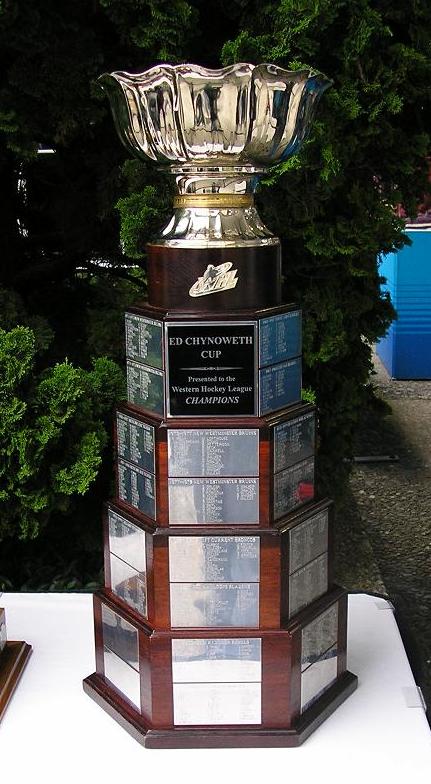
The Ed Chynoweth Cup is an ice hockey club championship trophy awarded to the playoff champion of the Western Hockey League (WHL). Originally called the President's Cup when the league was founded in 1966, the trophy was renamed in 2007 to honour Ed Chynoweth's long service to junior ice hockey in Canada. The WHL champion earns a berth into the Memorial Cup tournament, Canada's major junior hockey championship. The Kamloops Blazers and Medicine Hat Tigers have won the most WHL championships, with six each. The Spokane Chiefs were the first team to win the renamed trophy in the 2007–08 WHL season. The current (2024–25) holders of the Ed Chynoweth Cup are the Medicine Hat Tigers.

Key Information

History

[edit]

The Western Hockey League was founded in 1966 by seven teams from Saskatchewan and Alberta who were hoping to improve the quality of junior hockey in western Canada.[1] Despite gaining approval from the governing bodies of both provinces, the Canadian Amateur Hockey Association (CAHA) objected to the formation of the interprovincial league, refusing to sanction the circuit and suspending all players and officials who participated in the league from participation in any CAHA league or event.[2] Declared an "outlaw league" by the CAHA, the WHL's founders chose to play on, though the league was ruled ineligible to participate in the Memorial Cup, Canada's national junior championship.[1]

The first President's Cup champion was the Moose Jaw Canucks in 1967.[3] In 1971, CAHA reorganized the top level of junior hockey into two tiers, sanctioning the WHL as the top league in western Canada and one of three leagues that formed the Major Junior tier, along with the Ontario Hockey Association—now the Ontario Hockey League (OHL)—and the Quebec Major Junior Hockey League—now the Quebec Maritimes Junior Hockey League (QMJHL). Together, these three leagues form the Canadian Hockey League (CHL). The 1971 WHL champion Edmonton Oil Kings faced the Quebec Remparts in the 1972 Memorial Cup final, which nearly failed to materialize as the OHA and QMJHL initially refused to face the western champion. The Oil Kings were ultimately defeated by Quebec in an abbreviated best-of-three series, as opposed to the normal best-of-seven.[4] Three years later, in 1974, the Regina Pats became the first WHL champion to win the national title.[5]

The New Westminster Bruins emerged as the first dynasty in WHL history, winning four consecutive championships between 1975 and 1978, along with two Memorial Cups in 1977 and 1978.[3][6] In 1976, the Portland Winter Hawks became the first American-based team in the WHL, and six years later, the 1981–82 Winter Hawks recorded more firsts, becoming the first American team to win the President's Cup and the first American team to compete for the Memorial Cup.[7][8] One year later, the Winter Hawks won the 1983 Memorial Cup to become the first American champions, and the first to win the Memorial Cup without winning its own league title; Portland participated by virtue of hosting the tournament despite losing the WHL final to the Lethbridge Broncos.[9]

On December 30, 1986, four members of the Swift Current Broncos—Scott Kruger, Trent Kresse, Brent Ruff, and Chris Mantyka—were killed when the team bus crashed outside Swift Current.[10] The community rallied around the team, and less than three years later, the Broncos emerged as the top team in the CHL. Featuring Scott Kruger's younger brothers Darren and Trevor, the 1988–89 Broncos became the first team in WHL history to sweep their way through the playoffs, winning the President's Cup without losing a single game in the post-season.[11] The Broncos faced the host Saskatoon Blades in the 1989 Memorial Cup final, defeating their provincial rivals in the first all-WHL national championship.[12] The Kamloops Blazers dominated the WHL in the early 1990s, capturing four league championships between 1990 and 1995 and three Memorial Cups to cap a period where WHL teams won seven Memorial Cup championships in a nine-year period between 1987 and 1995.[3][5]

In 2007, the league renamed the championship trophy the Ed Chynoweth Cup in honour of Ed Chynoweth's long tenure with the league.[3] Chynoweth had served as president of both the WHL and CHL, from 1972 and 1975 respectively, until leaving both posts in 1995 to form the Edmonton Ice. He remained with the franchise through its transfer to Kootenay and until his death in 2008.[3] Chynoweth was described by OHL commissioner David Branch as being "the architect of the Canadian Hockey League as we know it today".[13] Chynoweth was posthumously elected to the Hockey Hall of Fame in 2008.[14]

List of winners

[edit]
  • Number in parentheses denotes total championships won to that point
The Calgary Hitmen celebrate after winning the 2010 championship

By season

[edit]
Season Winning team[3] Finalist[15] Games[15][a] Memorial Cup result
1966–67 Moose Jaw Canucks (1) Regina Pats 4–1 Ineligible[b]
1967–68 Estevan Bruins (1) Flin Flon Bombers 4–0–1 Estevan lost final[16][b]
1968–69 Flin Flon Bombers (1) Edmonton Oil Kings 4–2 Ineligible[b]
1969–70 Flin Flon Bombers (2) Edmonton Oil Kings 4–0 Ineligible[b]
1970–71 Edmonton Oil Kings (1) Flin Flon Bombers 4–1–1 Edmonton lost final[17]
1971–72 Edmonton Oil Kings (2) Regina Pats 4–1 Edmonton finished third[18]
1972–73 Medicine Hat Tigers (1) Saskatoon Blades 3–0–2 Medicine Hat finished third[19]
1973–74 Regina Pats (1) Calgary Centennials 4–0 Regina won Memorial Cup[6]
1974–75 New Westminster Bruins (1) Saskatoon Blades 4–3 New Westminster lost final[20]
1975–76 New Westminster Bruins (2) Saskatoon Blades 4–2–1 New Westminster lost final[21]
1976–77 New Westminster Bruins (3) Brandon Wheat Kings 4–1 New Westminster won Memorial Cup[6]
1977–78 New Westminster Bruins (4) Billings Bighorns 4–0 New Westminster won Memorial Cup[6]
1978–79 Brandon Wheat Kings (1) Portland Winter Hawks 4–2 Brandon lost final[22]
1979–80 Regina Pats (2) Victoria Cougars 4–1 Regina finished third[23]
1980–81 Victoria Cougars (1) Calgary Wranglers 4–3 Victoria finished third[24]
1981–82 Portland Winter Hawks (1) Regina Pats 4–1 Portland finished third[25]
1982–83 Lethbridge Broncos (1) Portland Winter Hawks 4–1 Portland won Memorial Cup[c]
Lethbridge finished fourth[26]
1983–84 Kamloops Junior Oilers (1) Regina Pats 4–3 Kamloops finished third[27]
1984–85 Prince Albert Raiders (1) Kamloops Blazers 4–0 Prince Albert won Memorial Cup[6]
1985–86 Kamloops Blazers (2) Medicine Hat Tigers 4–1 Kamloops finished third[28]
Portland finished fourth[d]
1986–87 Medicine Hat Tigers (2) Portland Winter Hawks 4–3 Medicine Hat won Memorial Cup[6]
1987–88 Medicine Hat Tigers (3) Kamloops Blazers 4–2 Medicine Hat won Memorial Cup[6]
1988–89 Swift Current Broncos (1) Portland Winterhawks 4–0 Swift Current won Memorial Cup[12]
Saskatoon lost final[e]
1989–90 Kamloops Blazers (3) Lethbridge Hurricanes 4–1 Kamloops finished fourth[29]
1990–91 Spokane Chiefs (1) Lethbridge Hurricanes 4–0 Spokane Won Memorial Cup[6]
1991–92 Kamloops Blazers (4) Saskatoon Blades 4–3 Kamloops won Memorial Cup[6]
Seattle finished third[f]
1992–93 Swift Current Broncos (2) Portland Winter Hawks 4–3 Swift Current finished fourth[30]
1993–94 Kamloops Blazers (5) Saskatoon Blades 4–3 Kamloops Won Memorial Cup[6]
1994–95 Kamloops Blazers (6) Brandon Wheat Kings 4–2 Kamloops won Memorial Cup[6]
Brandon finished third[g]
1995–96 Brandon Wheat Kings (2) Spokane Chiefs 4–1 Brandon finished third[31]
1996–97 Lethbridge Hurricanes (1) Seattle Thunderbirds 4–0 Lethbridge lost final[32]
1997–98 Portland Winter Hawks (2) Brandon Wheat Kings 4–0 Portland won Memorial Cup[6]
Spokane finished third[h]
1998–99 Calgary Hitmen (1) Kamloops Blazers 4–1 Calgary lost final[33]
1999–2000 Kootenay Ice (1) Spokane Chiefs 4–2 Kootenay finished fourth[34]
2000–01 Red Deer Rebels (1) Portland Winter Hawks 4–1 Red Deer won Memorial Cup[6]
Regina finished third[i]
2001–02 Kootenay Ice (2) Red Deer Rebels 4–2 Kootenay won Memorial Cup[6]
2002–03 Kelowna Rockets (1) Red Deer Rebels 4–2 Kelowna finished third[35]
2003–04 Medicine Hat Tigers (4) Everett Silvertips 4–0 Kelowna won Memorial Cup[j]
Medicine Hat finished third[36]
2004–05 Kelowna Rockets (2) Brandon Wheat Kings 4–1 Kelowna finished fourth[37]
2005–06 Vancouver Giants (1) Moose Jaw Warriors 4–0 Vancouver finished third[38]
2006–07 Medicine Hat Tigers (5) Vancouver Giants 4–3 Vancouver won Memorial Cup[k]
Medicine Hat lost final[39]
2007–08 Spokane Chiefs (2) Lethbridge Hurricanes 4–0 Spokane won Memorial Cup[6]
2008–09 Kelowna Rockets (3) Calgary Hitmen 4–2 Kelowna lost final
2009–10 Calgary Hitmen (2) Tri-City Americans 4–1 Brandon lost final[l]
Calgary finished third
2010–11 Kootenay Ice (3) Portland Winterhawks 4–1 Kootenay finished third
2011–12 Edmonton Oil Kings (1) Portland Winterhawks 4–3 Edmonton finished fourth
2012–13 Portland Winterhawks (3) Edmonton Oil Kings 4–2 Portland lost final[m]
Saskatoon finished fourth
2013–14 Edmonton Oil Kings (2) Portland Winterhawks 4–3 Edmonton won Memorial Cup
2014–15 Kelowna Rockets (4) Brandon Wheat Kings 4–0 Kelowna lost final
2015–16 Brandon Wheat Kings (3) Seattle Thunderbirds 4–1 Brandon finished fourth
Red Deer lost semifinal
2016–17 Seattle Thunderbirds (1) Regina Pats 4–2 Seattle finished fourth
2017–18 Swift Current Broncos (3) Everett Silvertips 4–2 Swift Current finished fourth
Regina lost final
2018–19 Prince Albert Raiders (2) Vancouver Giants 4–3 Prince Albert finished fourth
2019–20 WHL playoffs cancelled due to the COVID-19 pandemic — Ed Chynoweth Cup not awarded[40]
2020–21 WHL playoffs cancelled due to the COVID-19 pandemic — Ed Chynoweth Cup not awarded[41]
2021–22 Edmonton Oil Kings (3) Seattle Thunderbirds 4–2 Edmonton finished fourth
2022–23 Seattle Thunderbirds (2) Winnipeg Ice 4–1 Seattle lost final
2023–24 Moose Jaw Warriors (1) Portland Winterhawks 4–0 Moose Jaw lost semifinal[42]
2024–25 Medicine Hat Tigers (6) Spokane Chiefs 4–1 Medicine Hat lost final[43]

By team

[edit]
Team Won Lost Years Won Years Lost Finals Appearances
Kamloops Blazers[n] 6 3 1983–84, 1985–86, 1989–90, 1991–92, 1993–94, 1994–95 1984–85, 1987–88, 1998–99 9
Medicine Hat Tigers 6 1 1972–73, 1986–87, 1987–88, 2003–04, 2006–07, 2024–25 1985–86 7
Edmonton Oil Kings[o] 5 3 1970–71, 1971–72, 2011–12, 2013–14, 2021–22 1968–69, 1969–70, 2012–13 8
New Westminster Bruins 4 0 1974–75, 1975–76, 1976–77, 1977–78 4
Kelowna Rockets 4 0 2002–03, 2004–05, 2008–09, 2014–15 4
Portland Winterhawks 3 10 1981–82, 1997–98, 2012–13 1978–79, 1982–83, 1986–87, 1988–89, 1992–93, 2000–01, 2010–11, 2011–12, 2013–14, 2023–24 13
Brandon Wheat Kings 3 5 1978–79, 1995–96, 2015–16 1976–77, 1994–95, 1997–98, 2004–05, 2014–15 8
Swift Current Broncos 3 0 1988–89, 1992–93, 2017–18 3
Kootenay Ice 3 0 1999–2000, 2001–02, 2010–11 3
Regina Pats 2 5 1973–74, 1979–80 1966–67, 1971–72, 1981–82, 1983–84, 2016–17 7
Seattle Thunderbirds 2 3 2016–17, 2022–23 1996–97, 2015–16, 2021–22 5
Flin Flon Bombers 2 2 1968–69, 1969–70 1967–68, 1970–71 4
Spokane Chiefs 2 3 1990–91, 2007–08 1995–96, 1999–2000, 2024–25 5
Calgary Hitmen 2 1 1998–99, 2009–10 2008–09 3
Prince Albert Raiders 2 0 1984–85, 2018–19 2
Lethbridge Hurricanes 1 3 1996–97 1989–90, 1990–91, 2007–08 4
Red Deer Rebels 1 2 2000–01 2001–02, 2002–03 3
Vancouver Giants 1 2 2005–06 2006–07, 2018–19 3
Victoria Cougars 1 1 1980–81 1979–80 2
Moose Jaw Warriors 1 1 2023–24 2005–06 2
Moose Jaw Canucks 1 0 1966–67 1
Estevan Bruins 1 0 1967–68 1
Lethbridge Broncos 1 0 1982–83 1
Saskatoon Blades 0 5 1972–73, 1974–75, 1975–76, 1991–92, 1993–94 5
Everett Silvertips 0 2 2003–04, 2017–18 2
Calgary Centennials 0 1 1973–74 1
Billings Bighorns 0 1 1977–78 1
Calgary Wranglers 0 1 1980–81 1
Tri-City Americans 0 1 2009–10 1
Winnipeg Ice 0 1 2022–23 1

See also

[edit]

Notes

[edit]

References

[edit]
Revisions and contributorsEdit on WikipediaRead on Wikipedia
from Grokipedia
The Ed Chynoweth Cup is the championship trophy awarded annually to the winner of the (WHL) playoffs, recognizing the top team in this major league spanning and the . The trophy is contested in a best-of-seven series between the champions of the WHL's Eastern and Western Conferences, with the victor advancing to represent the league at the , the Canadian Hockey League's national junior championship. Named in honor of Edward "Ed" Chynoweth, a pivotal figure in junior hockey administration, the cup was renamed from its previous designation, the , in May 2007 to commemorate his lifelong contributions to the sport. Born in Dodsland, , Chynoweth served as WHL president from 1972 to 1996 (with a brief exception in 1979–80) and later as board chairman from 1996 to 1998 and 2004 to 2007; he also held the presidency of the Canadian Major Junior Hockey League (now the CHL) from 1975 to 1995. Under his leadership, Chynoweth established the WHL Scholarship Program, which has awarded over 8,000 scholarships to players, revived the Junior Hockey Championships in , and chaired multiple tournaments between 1974 and 1995. He passed away in 2008 from cancer and was posthumously inducted into the in the builder category that same year. The trophy's history traces back to the WHL's founding in 1966–67, when it was originally known as the President's Cup and symbolized the league's pursuit of excellence in developing young talent for professional hockey. Since the renaming, notable winners have included the 2024 , who claimed their first WHL title with a 4-2 series victory over the , and the 2025 , who defeated the 4-1 to secure the cup. The Ed Chynoweth Cup remains a cornerstone of the WHL, embodying the league's commitment to competitive play, player development, and the legacy of its namesake.

Background

Trophy Description

The Ed Chynoweth Cup is the club championship trophy awarded annually to the playoff champion of the (WHL). It represents the pinnacle of achievement within the WHL, earned by the team that triumphs through a series of postseason rounds to claim the league title. Originally known as the President's Cup, the trophy has been presented since the WHL's inaugural playoff season in 1967, when the Moose Jaw Canucks defeated the in the finals. In 2007, it was renamed the Ed Chynoweth Cup to honor the long-serving WHL executive. The cup trophy itself symbolizes the WHL's competitive excellence and is hoisted by the winning team in a ceremonial presentation immediately following the clinching game of the WHL Championship Series, typically held in the victor's home arena. The significance of the Ed Chynoweth Cup extends beyond the WHL, as it grants the recipient an automatic berth to the , Canada's major junior hockey championship tournament. This event features the playoff champions from the three CHL member leagues—the (OHL), (), and WHL—along with a host team, in a round-robin format culminating in a final game for the national title. As such, the Ed Chynoweth Cup serves as a critical milestone in the pathway from WHL regular-season success through league playoffs to contention for the broader () crown.

Ed Chynoweth Biography

Edward Chynoweth was born on December 14, 1941, in Dodsland, , a small rural community, and was raised in the nearby town of Coleville. Growing up in these towns, he developed an early passion for hockey, which shaped his future career in the sport. Chynoweth later moved to , where he entered the executive ranks of hockey administration, beginning with roles in local organizations such as becoming president of the Saskatoon Minor Hockey Association. He married Linda, and the couple relocated to in 1976, where they raised their two sons, and Dean. Chynoweth's career in hockey administration spanned over three decades. He served as the first full-time president of the (WHL) from 1972 to 1996, with a brief hiatus in 1979–80 when he owned the , and later as board chairman from 1996 to 1998 and 2004 to 2007. He also held the presidency of the Canadian Major Junior Hockey League (now the Canadian Hockey League or CHL) from 1975 to 1995. Under his leadership, Chynoweth established the WHL Scholarship Program, which has awarded over 3,000 scholarships to players; revived the World Junior Hockey Championships in Canada; and chaired multiple tournaments between 1974 and 1995. Chynoweth passed away on April 22, 2008, in , , at the age of 66, after a battle with . In recognition of his lifelong contributions to hockey, he was posthumously inducted into the in the Builder category in 2008 and is also honored as an inductee in the Saskatchewan Sports Hall of Fame.

WHL Playoffs

Team Qualification

The (WHL) consists of 22 teams divided into two conferences: the Eastern Conference with 11 teams split between the Central and East Divisions, and the Western Conference with 11 teams split between the B.C. and U.S. Divisions. This structure facilitates regional rivalries while allowing for conference-based competition throughout the regular season and playoffs. Teams qualify for the WHL , which determine the Ed Chynoweth Cup , based on in the regular season. The top eight teams in each conference advance, with the top three finishers from each division automatically qualifying, followed by the two highest-point teams from the remaining clubs in the conference serving as . Seeding within the conference prioritizes the two division winners as the No. 1 and No. 2 seeds based on regular-season points, providing them with favorable first-round matchups against the wild cards or lower seeds. The features a 68-game for each , with standings determined by a points system awarding two points for a regulation win, one point for an or loss, and zero for a regulation loss. Playoff seeding is thus based on total points accumulated, emphasizing consistent performance across the season. In the event of ties for seeding or qualification spots, tiebreakers are applied in order: head-to-head record between the tied teams, differential in those head-to-head games, and overall wins percentage. The current qualification format was adopted in to better align with divisional play and promote rivalries, replacing a prior system of simply advancing the top eight teams per regardless of divisional standing, which had been in place since the early . Earlier formats in the league's history involved fewer playoff teams, such as top four per division in the . The 2020-21 season deviated due to the , featuring a shortened 24-game regular season played in hub cities but no , resulting in no Ed Chynoweth Cup being awarded that year.

Playoff Rounds and Format

The (WHL) playoffs feature a 16-team divided between the Eastern and Western Conferences, consisting of four rounds leading to the WHL Championship: quarterfinals, semifinals, conference finals, and the WHL finals. The top eight teams from each conference qualify based on regular-season performance, setting the stage for intra-conference competition through the conference finals. In the quarterfinals, also known as the first round, matchups are determined within each using a seeded format: the first-place team faces the eighth seed, second against seventh, third against sixth, and fourth against fifth. These series are contested in a best-of-seven format, with the higher-seeded team receiving home-ice advantage. The semifinals, or second round, involve the four advancing teams from each , which are re-seeded based on their regular-season points totals, pairing the highest remaining against the lowest and the second-highest against the third-lowest. This re-seeding promotes competitive balance by avoiding fixed brackets and often results in cross-divisional matchups within the . Like the quarterfinals, these are best-of-seven series with home-ice advantage awarded to the higher . The conference finals pit the two semifinal winners in each conference against one another in another best-of-seven series, determining the Eastern and Western Conference champions who advance to the WHL finals. The higher-seeded team again holds home-ice advantage in this round. All playoff series follow a 2-2-1-1-1 game schedule, where the team with home-ice advantage hosts the first two games, the opponent hosts the next two, and the higher seed hosts games five and seven if necessary. Tied games proceed to , consisting of 20-minute periods played at full strength (five-on-five) in sudden-death fashion, continuing until a goal is scored, with no shootouts used in playoffs. The current format, emphasizing conference-based play with re-seeding after the first round, was reintroduced in the 2021-22 season following a period of divisional seeding from 2015 to 2020. All rounds have utilized the best-of-seven structure since the 1980s, evolving from earlier variations that included best-of-five series and round-robin formats in the 1970s.

Championship Series

Series Structure

The Ed Chynoweth Cup is contested in a best-of-seven series between the champions of the Eastern and Western Conferences, with the first team to win four games claiming the . This format ensures a competitive culmination to the WHL playoffs, emphasizing endurance and home-ice advantage. The series typically begins in mid-May and follows a 2-3-2 format, where Games 1 and 2 are played at the higher-seeded team's home arena, Games 3 through 5 at the lower seed's venue, and Games 6 and 7 (if necessary) returning to the higher seed. For the 2025 series, this structure was applied with Game 1 on May 9 in , , as the Tigers held the higher seed over the . Games alternate between the competing teams' home arenas, fostering fan engagement across regions, and all contests are broadcast live on TSN as the WHL's national partner, alongside regional networks for local audiences. Following the series, the WHL announces its Playoffs Most Valuable Player award, selected by playoff media members to honor the standout performer across the postseason. In 2025, goaltender Harrison Meneghin received the honor for his 14-1-0 record, 2.35 goals-against average, .906 save percentage, and three shutouts. Tiebreakers and overtime procedures mirror those in earlier playoff rounds, with tied games proceeding to 20-minute sudden-victory periods at full strength (5-on-5) until a goal is scored, and no shootouts permitted. In the championship, the defeated the 4-1, securing the Ed Chynoweth Cup with a 4-2 victory in Game 5 on May 17. This outcome highlighted the series' intensity, as the Tigers rallied after splitting the first two games to win three straight on the road.

Notable Finals

The WHL Championship Series has produced several memorable long series that tested the endurance of teams and fans alike. One notable example is the 2010 final between the and , which, while concluding in five games with a 4-1 Hitmen victory, highlighted intense competition in a packed schedule across multiple venues. Other series have extended to the full seven games, such as the 2003 matchup where the defeated the 4-3 in a thrilling decider, showcasing the parity and resilience in WHL playoff hockey. These extended contests often feature dramatic momentum shifts, contributing to the league's reputation for unpredictable outcomes. Upsets in the finals have added to the excitement, with lower-seeded teams occasionally toppling conference champions. In 2024, the Eastern Conference's third-seeded stunned the Western Conference's top-seeded , sweeping them 4–0 to claim their first-ever WHL title in franchise history. Similarly, the 2023 final saw the , as Western champions, overcome the heavily favored Eastern top seed in five games, demonstrating how seeding does not always predict success in the high-stakes series. These victories underscore the competitive balance within the league, where underdogs can capitalize on momentum and home-ice advantages. Record performances have defined standout moments in finals history. The 2025 championship featured a high-scoring Game 2, where the defeated the 6-2, marking one of the more offensive outbursts in recent series play. Goaltending heroics have also shone, as seen in the 2025 clincher where Medicine Hat's Harrison Meneghin anchored a 4-2 victory in Game 5, securing the 4-1 series win with strong defensive support that limited Spokane's high-powered attack. Such individual and team efforts often elevate the series beyond mere wins, setting benchmarks for future playoffs. Key milestones highlight the evolution of U.S. participation in the WHL. The became the first U.S.-based team to win the championship in 1982, defeating the and paving the way for greater American involvement in the league. Back-to-back triumphs have been rare but impactful, with the achieving this feat in 2012 and 2013 by edging out the in both series, solidifying their status as a powerhouse. These achievements not only boosted cross-border rivalries but also expanded the league's footprint. Finals have drawn record crowds, amplifying their cultural significance, particularly in Alberta rivalries like those between the and . The 2024 Moose Jaw clincher against Portland attracted a sold-out home crowd of over 5,000, reflecting surging fan enthusiasm for championship hockey. These events foster intense regional pride, with packed arenas creating electric atmospheres that rival NHL playoff games and strengthen community ties to junior hockey. Since the trophy's renaming in 2007, the WHL has seen increased parity, leading to more first-time winners and diverse champions. Teams like the 2018 Swift Current Broncos and 2024 claimed their inaugural titles, while the 2025 ended an 18-year drought with a 4-1 series over Spokane. This trend of emerging contenders has refreshed the competition, distributing success beyond traditional powerhouses and enhancing the league's overall appeal.

Historical Development

Establishment and Early Years

The traces its origins to 1966, when it was established as the Canadian Major Junior Hockey League (CMJHL) amid efforts to create a professional-oriented junior circuit independent from the Canadian Amateur Hockey Association (CAHA). The inaugural 1966–67 season featured seven teams primarily from and : the Calgary Buffaloes, , Estevan Bruins, Moose Jaw Canucks, , , and Swift Current Broncos. This formation addressed growing concerns over player compensation and development in junior hockey, positioning the league as a rival to existing structures. In , following its first season, the league renamed itself the Western Canada Junior Hockey League (WCJHL) and introduced the President's Cup as its championship trophy, awarded to the playoff winner. The Moose Jaw Canucks claimed the inaugural title, defeating the 4–1 in a best-of-seven final series. Early playoff formats varied, with series lengths ranging from best-of-five to best-of-seven depending on the round and year, reflecting the league's evolving structure during its formative period. U.S. teams were absent until the mid-1970s, limiting the league's geographic scope to . A pivotal development occurred in 1970 when the CAHA sanctioned the league—then known as the (WCHL) after another renaming in 1968—allowing WHL champions to compete for the , Canada's national junior title. This integration elevated the league's status, culminating in the ' first victory in 1972 after they won the President's Cup that season. Expansion further intensified competition, notably with the addition of the Portland Winter Hawks in 1976 (relocating from Edmonton following the 1975–76 season), marking the WHL's initial foray into the . Throughout the 1960s and 1970s, Alberta and Saskatchewan teams dominated early President's Cup contention, leveraging strong local talent pipelines and regional rivalries. For instance, the Regina Pats captured the 1974 title en route to a Memorial Cup championship, underscoring the Prairie provinces' early stranglehold on WHL success before broader expansion diluted this concentration.

Renaming and Legacy

On May 21, 2007, the Western Hockey League (WHL) announced the renaming of its championship trophy from the President's Cup to the Ed Chynoweth Cup, in recognition of Ed Chynoweth's extensive leadership as the league's president from 1972 to 1996, with the exception of the 1979–80 season. This change honored his pivotal role in transforming the WHL into a premier junior hockey entity, replacing the original name established when the league was founded in 1966. Chynoweth's professional tenure extended beyond the WHL presidency; he served as president of the (CHL) from 1975 to 1995 and as chairman of the WHL Board of Governors from 1996 to 1998 and again from 2004 to 2007. During his WHL presidency, he oversaw significant expansion, including the addition of U.S.-based franchises, which helped integrate the league across the Canada-U.S. border. He also standardized junior player development practices, fostering a more professional structure for scouting, training, and transitions to higher levels of hockey, while guiding the league's growth from 12 teams in 1972 to 16 by 1995. Following his passing, Chynoweth received posthumous induction into the in 2008 as a builder, acknowledging his foundational impact on junior hockey governance. His influence extended to the , where the round-robin format among league champions was introduced in under his early leadership, a structure that persists today and promotes competitive balance. Chynoweth's efforts elevated the professionalism of junior hockey overall, establishing rigorous standards for league operations and player welfare that influenced the broader CHL ecosystem. A lasting element of his legacy is the Ed Chynoweth Trophy, awarded annually since 1996 to the leading scorer at the tournament, symbolizing his commitment to recognizing offensive excellence in junior play. Today, the Ed Chynoweth Cup continues to signify the WHL's role as a vital talent pipeline to the National Hockey League (NHL), with champions advancing to the and producing stars such as , who honed his skills in the WHL during the league's formative years under Chynoweth's guidance. This enduring connection underscores how his vision has sustained the WHL's reputation for developing elite professional talent.

Winners

By Season

The Ed Chynoweth Cup, awarded annually to the (WHL) playoff champion, has been contested since the league's inception as the Western Canada Junior Hockey League in 1966–67 (renamed WHL in 1979). The finals series is a best-of-seven matchup between the Eastern and Western Conference champions (conferences established in 1991). Below is a complete list of winners from 1966–67 to 2024–25, including runner-up, series result, and key notes such as playoff MVP (awarded since 1989), clincher location, sweeps, or historical context like ineligibility for the in early years due to league status.
SeasonChampionRunner-upSeries ResultNotes
1966–67Moose Jaw CanucksRegina Pats4–1Ineligible for Memorial Cup; clincher in Moose Jaw, Saskatchewan.
1967–68Estevan BruinsFlin Flon Bombers4–0–1Lost Memorial Cup final; clincher in Estevan, Saskatchewan.
1968–69Flin Flon BombersEdmonton Oil Kings4–2Ineligible for Memorial Cup; clincher in Flin Flon, Manitoba.
1969–70Flin Flon BombersEdmonton Oil Kings4–0Ineligible for Memorial Cup; sweep; clincher in Flin Flon.
1970–71Edmonton Oil KingsFlin Flon Bombers4–1–1Lost Memorial Cup final; clincher in Edmonton, Alberta.
1971–72Edmonton Oil KingsRegina Pats4–1Finished third at Memorial Cup; clincher in Edmonton.
1972–73Medicine Hat TigersSaskatoon Blades3–0–2Finished third at Memorial Cup; clincher in Medicine Hat, Alberta.
1973–74Regina PatsCalgary Centennials4–0Won Memorial Cup; sweep; clincher in Regina, Saskatchewan.
1974–75New Westminster BruinsSaskatoon Blades4–3Lost Memorial Cup final; clincher in New Westminster, British Columbia.
1975–76New Westminster BruinsSaskatoon Blades4–2–1Lost Memorial Cup final; clincher in New Westminster.
1976–77New Westminster BruinsBrandon Wheat Kings4–1Won Memorial Cup; clincher in New Westminster.
1977–78New Westminster BruinsBillings Bighorns4–0Won Memorial Cup; sweep; clincher in New Westminster.
1978–79Brandon Wheat KingsPortland Winter Hawks4–2Lost Memorial Cup final; clincher in Brandon, Manitoba.
1979–80Regina PatsVictoria Cougars4–1Finished third at Memorial Cup; clincher in Regina.
1980–81Victoria CougarsCalgary Wranglers4–3Finished third at Memorial Cup; clincher in Victoria, British Columbia.
1981–82Portland Winter HawksRegina Pats4–1Finished third at Memorial Cup; clincher in Portland, Oregon.
1982–83Lethbridge BroncosPortland Winter Hawks4–1Portland won Memorial Cup as host; clincher in Lethbridge, Alberta.
1983–84Kamloops Junior OilersRegina Pats4–3Finished third at Memorial Cup; clincher in Kamloops, British Columbia.
1984–85Prince Albert RaidersKamloops Blazers4–0Won Memorial Cup; sweep; clincher in Prince Albert, Saskatchewan.
1985–86Kamloops BlazersMedicine Hat Tigers4–1Finished third at Memorial Cup; clincher in Kamloops.
1986–87Medicine Hat TigersPortland Winter Hawks4–3Won Memorial Cup; MVP: Theoren Fleury; clincher in Medicine Hat.
1987–88Medicine Hat TigersKamloops Blazers4–2Won Memorial Cup; MVP: Trevor Schultze; clincher in Medicine Hat.
1988–89Swift Current BroncosPortland Winter Hawks4–0Won Memorial Cup; sweep; MVP: Scott Layden; clincher in Swift Current, Saskatchewan.
1989–90Kamloops BlazersLethbridge Hurricanes4–1Finished fourth at Memorial Cup; MVP: Dean Evason; clincher in Kamloops.
1990–91Spokane ChiefsLethbridge Hurricanes4–0Won Memorial Cup; sweep; MVP: Ray Whitney; clincher in Spokane, Washington.
1991–92Kamloops BlazersSaskatoon Blades4–3Won Memorial Cup; MVP: Darcy Martini; clincher in Kamloops.
1992–93Swift Current BroncosPortland Winter Hawks4–3Finished fourth at Memorial Cup; MVP: Brad McCrimmon; clincher in Swift Current.
1993–94Kamloops BlazersSaskatoon Blades4–3Won Memorial Cup; MVP: Nolan Yonkman; clincher in Kamloops.
1994–95Kamloops BlazersBrandon Wheat Kings4–2Won Memorial Cup; MVP: Ross Lupaschuk; clincher in Kamloops.
1995–96Brandon Wheat KingsSpokane Chiefs4–1Finished third at Memorial Cup; MVP: Brett Sonne; clincher in Brandon.
1996–97Lethbridge HurricanesSeattle Thunderbirds4–0Lost Memorial Cup final; sweep; MVP: Brad Leeb; clincher in Lethbridge.
1997–98Portland Winter HawksBrandon Wheat Kings4–0Won Memorial Cup; sweep; MVP: Kevin Karmazyn; clincher in Portland.
1998–99Calgary HitmenKamloops Blazers4–1Lost Memorial Cup final; MVP: Andrei Medvedev; clincher in Calgary, Alberta.
1999–00Kootenay IceSpokane Chiefs4–2Finished fourth at Memorial Cup; MVP: Dan Blackburn; clincher in Cranbrook, British Columbia.
2000–01Red Deer RebelsPortland Winter Hawks4–1Won Memorial Cup; MVP: Michael Garnet; clincher in Red Deer, Alberta.
2001–02Kootenay IceRed Deer Rebels4–2Won Memorial Cup; MVP: Duncan Milroy; clincher in Cranbrook.
2002–03Kelowna RocketsRed Deer Rebels4–2Finished third at Memorial Cup; MVP: Jesse Schultz; clincher in Kelowna, British Columbia.
2003–04Medicine Hat TigersEverett Silvertips4–0Finished third at Memorial Cup; sweep; MVP: Matt Keetley; clincher in Medicine Hat.
2004–05Kelowna RocketsBrandon Wheat Kings4–1Finished fourth at Memorial Cup; MVP: Blaise Bender; clincher in Kelowna.
2005–06Vancouver GiantsMoose Jaw Warriors4–0Finished third at Memorial Cup; sweep; MVP: Cody Hodgson; clincher in Vancouver, British Columbia.
2006–07Medicine Hat TigersVancouver Giants4–3Lost Memorial Cup final; MVP: Carson Crawford; clincher in Medicine Hat.
2007–08Spokane ChiefsLethbridge Hurricanes4–0Won Memorial Cup; sweep; clincher in Spokane.
2008–09Kelowna RocketsCalgary Hitmen4–2Lost Memorial Cup final; MVP: Zach Hamill; clincher in Kelowna.
2009–10Calgary HitmenTri-City Americans4–1Finished third at Memorial Cup; MVP: Martin Jones; clincher in Calgary.
2010–11Kootenay IcePortland Winterhawks4–1Finished third at Memorial Cup; MVP: Cody Eakin; clincher in Cranbrook.
2011–12Edmonton Oil KingsPortland Winterhawks4–3Finished fourth at Memorial Cup; MVP: Kristians Pelss; clincher in Edmonton, Alberta.
2012–13Portland WinterhawksEdmonton Oil Kings4–2Lost Memorial Cup final; MVP: Nic Petan; clincher in Portland.
2013–14Edmonton Oil KingsPortland Winterhawks4–3Won Memorial Cup; MVP: Henrik Samuelsson; clincher in Edmonton.
2014–15Kelowna RocketsBrandon Wheat Kings4–0Lost Memorial Cup final; sweep; MVP: Leon Draisaitl; clincher in Kelowna.
2015–16Brandon Wheat KingsSeattle Thunderbirds4–1Finished fourth at Memorial Cup; MVP: Nolan Patrick; clincher in Brandon.
2016–17Seattle ThunderbirdsRegina Pats4–2Finished fourth at Memorial Cup; MVP: Mathew Barzal; clincher in Seattle, Washington.
2017–18Swift Current BroncosEverett Silvertips4–2Finished fourth at Memorial Cup; MVP: Glenn Gawdin; clincher in Swift Current.
2018–19Prince Albert RaidersVancouver Giants4–3Finished fourth at Memorial Cup; MVP: Ian Scott; clincher in Prince Albert.
2019–20NoneNoneN/APlayoffs cancelled due to COVID-19 pandemic.
2020–21NoneNoneN/ANo playoffs due to COVID-19 pandemic.
2021–22Edmonton Oil KingsSeattle Thunderbirds4–2Finished fourth at Memorial Cup; MVP: Kaiden Guhle; clincher in Edmonton.
2022–23Seattle ThunderbirdsWinnipeg Ice4–1Lost Memorial Cup final; MVP: Thomas Milic; clincher in Seattle.
2023–24Moose Jaw WarriorsPortland Winterhawks4–2Lost Memorial Cup semifinal; MVP: Denton Mateychuk; clincher in Moose Jaw, Saskatchewan.
2024–25Medicine Hat TigersSpokane Chiefs4–1Lost Memorial Cup final; MVP: Harrison Meneghin; clincher in Medicine Hat.
Notable trends include the dominance of teams in the 1970s (New Westminster Bruins won four straight from 1974–75 to 1977–78) and Alberta squads in the 1980s ( and others secured multiple titles), reflecting regional strength during league expansion.

By Team

The Ed Chynoweth Cup has been won by 20 different franchises across the Western Hockey League's history, with the and tied for the most titles at six apiece. The Blazers franchise secured its championships in 1983 (as Junior Oilers), 1986, 1990, 1992, 1994, and 1995. The Tigers' six victories occurred in 1973, 1987, 1988, 2004, 2007, and 2025. Several franchises have recorded multiple championships, including the original with early successes before the team ceased operations in 1976 and was re-established in 2007 as a distinct entity that later added three more titles. The hold the record for most consecutive wins with four straight championships from 1975 to 1978, while several teams, including the (1994–1995) and (1987–1988), have achieved back-to-back titles. The following table summarizes all franchise wins, including totals, specific years, and notes on relocations, name changes, or status (active teams as of unless noted otherwise).
TeamTotal WinsYears WonNotes
61983, 1986, 1990, 1992, 1994, 1995Active; 1983 win as Kamloops Junior Oilers.
61973, 1987, 1988, 2004, 2007, 2025Active.
51971, 1972, 2012, 2014, 2022Active (modern iteration re-established 2007); original franchise defunct 1976.
41975, 1976, 1977, 1978Defunct (1988); played 1971–1981 and 1983–1988.
42003, 2005, 2009, 2015Active.
Portland Winter Hawks31982, 1998, 2013Active.
31979, 1996, 2016Active.
Swift Current Broncos31989, 1993, 2018Active.
32000, 2002, 2011Defunct as Kootenay Ice (2019); franchise relocated to (2019–2023), then to (2023–present).
21969, 1970Defunct in WHL (left league 1984); now in SJHL.
21974, 1980Active.
Lethbridge franchise (Broncos/Hurricanes)21983 (Broncos), 1997 (Hurricanes)Active as ; Broncos renamed 1987.
21985, 2019Active.
21991, 2008Active.
21999, 2010Active.
22017, 2023Active.
12006Active.
12001Active.
Moose Jaw Canucks11967Defunct (1967).
Estevan Bruins11968Defunct (1984); now in SJHL.
11981Defunct (1994); franchise relocated to (active).
12024Active.

References

Add your contribution
Related Hubs
User Avatar
No comments yet.