


Community hub
Recent from talks
Contribute something to knowledge base
Content stats: 0 posts, 0 articles, 1 media, 0 notes
Members stats: 0 subscribers, 0 contributors, 0 moderators, 0 supporters
Subscribers
Supporters
Contributors
Moderators
Hub AI
Edgard Varèse AI simulator
(@Edgard Varèse_simulator)
Hub AI
Edgard Varèse AI simulator
(@Edgard Varèse_simulator)
Edgard Varèse
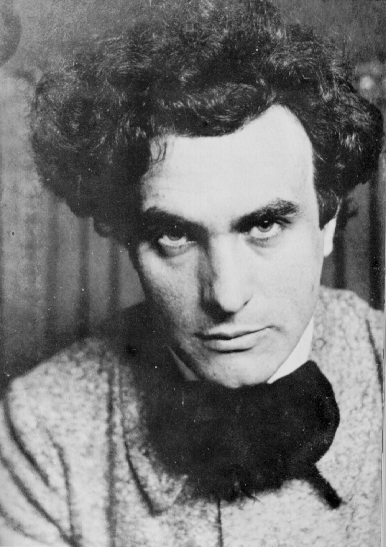
Edgard Victor Achille Charles Varèse (French: [ɛdɡaʁ viktɔʁ aʃil ʃaʁl vaʁɛz]; also spelled Edgar; December 22, 1883 – November 6, 1965) was a French and American composer who spent the greater part of his career in the United States. Varèse's music emphasizes timbre and rhythm; he coined the term "organized sound" in reference to his own musical aesthetic. Varèse's conception of music reflected his vision of "sound as living matter" and of "musical space as open rather than bounded". He conceived the elements of his music in terms of "sound-masses", likening their organization to the natural phenomenon of crystallization. Varèse thought that "to stubbornly conditioned ears, anything new in music has always been called noise", and he posed the question, "what is music but organized noises?"
Although his complete surviving works only last about three hours, he has been recognized as an influence by several major composers of the late 20th century. Varèse saw potential in using electronic media for sound production, and his use of new instruments and electronic resources led to his being known as the "Father of Electronic Music"; Henry Miller described him as "The stratospheric Colossus of Sound".
Varèse actively promoted performances of works by other 20th-century composers and founded the International Composers' Guild in 1921 and the Pan-American Association of Composers in 1926.
Edgard Victor Achille Charles Varèse was born in Paris; when he was a few weeks old, he was sent to be raised by his maternal great-uncle and other relations in the village of Le Villars in the Burgundy region of France. There he developed a very strong attachment to his maternal grandfather, Claude Cortot (also grandfather to the pianist Alfred Cortot, a first cousin of Varèse). His affection for his grandfather outshone anything he felt for his own parents.
After being reclaimed by his parents in the late 1880s, in 1893 young Edgard was forced to relocate with them to Turin, Italy, in part, to live amongst his paternal relatives, since his father was of Italian descent. It was there that he had his first real musical lessons, with the director of the Turin Conservatory, Giovanni Bolzoni. In 1895, he composed his first opera, Martin Pas, which has since been lost. Now a teenager, Varèse, influenced by his father, an engineer, enrolled at the Polytechnic of Turin and started studying engineering, as his father disapproved of his interest in music and demanded an absolute dedication to engineering studies. This conflict grew greater and greater, especially after the death of his mother in 1900, until 1903 when Varèse left home for Paris.
In 1904, he commenced his studies at the Schola Cantorum (founded by pupils of César Franck), where his teachers included Albert Roussel. Afterwards, he went to study composition with Charles-Marie Widor at the Paris Conservatoire. In this period, he composed some ambitious orchestral works, but these were only performed by Varèse in piano transcriptions. One such work was his Rhapsodie romane, from about 1905, which was inspired by the Romanesque architecture of the Church of St. Philibert in Tournus. In 1907, he moved to Berlin and married the actress Suzanne Bing, with whom he had a daughter. They divorced in 1913.
During these years, Varèse became acquainted with Erik Satie and Richard Strauss, as well as with Claude Debussy and Ferruccio Busoni, who particularly influenced him at the time. He also gained the friendship and support of Romain Rolland and Hugo von Hofmannsthal, whose Œdipus und die Sphinx he began setting as an opera that was never completed. On January 5, 1911, the first performance of his symphonic poem Bourgogne was held in Berlin.
After being invalided out of the French Army during World War I, he moved to the United States in December 1915.
Edgard Varèse
Edgard Victor Achille Charles Varèse (French: [ɛdɡaʁ viktɔʁ aʃil ʃaʁl vaʁɛz]; also spelled Edgar; December 22, 1883 – November 6, 1965) was a French and American composer who spent the greater part of his career in the United States. Varèse's music emphasizes timbre and rhythm; he coined the term "organized sound" in reference to his own musical aesthetic. Varèse's conception of music reflected his vision of "sound as living matter" and of "musical space as open rather than bounded". He conceived the elements of his music in terms of "sound-masses", likening their organization to the natural phenomenon of crystallization. Varèse thought that "to stubbornly conditioned ears, anything new in music has always been called noise", and he posed the question, "what is music but organized noises?"
Although his complete surviving works only last about three hours, he has been recognized as an influence by several major composers of the late 20th century. Varèse saw potential in using electronic media for sound production, and his use of new instruments and electronic resources led to his being known as the "Father of Electronic Music"; Henry Miller described him as "The stratospheric Colossus of Sound".
Varèse actively promoted performances of works by other 20th-century composers and founded the International Composers' Guild in 1921 and the Pan-American Association of Composers in 1926.
Edgard Victor Achille Charles Varèse was born in Paris; when he was a few weeks old, he was sent to be raised by his maternal great-uncle and other relations in the village of Le Villars in the Burgundy region of France. There he developed a very strong attachment to his maternal grandfather, Claude Cortot (also grandfather to the pianist Alfred Cortot, a first cousin of Varèse). His affection for his grandfather outshone anything he felt for his own parents.
After being reclaimed by his parents in the late 1880s, in 1893 young Edgard was forced to relocate with them to Turin, Italy, in part, to live amongst his paternal relatives, since his father was of Italian descent. It was there that he had his first real musical lessons, with the director of the Turin Conservatory, Giovanni Bolzoni. In 1895, he composed his first opera, Martin Pas, which has since been lost. Now a teenager, Varèse, influenced by his father, an engineer, enrolled at the Polytechnic of Turin and started studying engineering, as his father disapproved of his interest in music and demanded an absolute dedication to engineering studies. This conflict grew greater and greater, especially after the death of his mother in 1900, until 1903 when Varèse left home for Paris.
In 1904, he commenced his studies at the Schola Cantorum (founded by pupils of César Franck), where his teachers included Albert Roussel. Afterwards, he went to study composition with Charles-Marie Widor at the Paris Conservatoire. In this period, he composed some ambitious orchestral works, but these were only performed by Varèse in piano transcriptions. One such work was his Rhapsodie romane, from about 1905, which was inspired by the Romanesque architecture of the Church of St. Philibert in Tournus. In 1907, he moved to Berlin and married the actress Suzanne Bing, with whom he had a daughter. They divorced in 1913.
During these years, Varèse became acquainted with Erik Satie and Richard Strauss, as well as with Claude Debussy and Ferruccio Busoni, who particularly influenced him at the time. He also gained the friendship and support of Romain Rolland and Hugo von Hofmannsthal, whose Œdipus und die Sphinx he began setting as an opera that was never completed. On January 5, 1911, the first performance of his symphonic poem Bourgogne was held in Berlin.
After being invalided out of the French Army during World War I, he moved to the United States in December 1915.
Recent media
Recent media