



Community hub
Recent from talks
Knowledge base stats:
Talk channels stats:
Members stats:
Edict of Potsdam
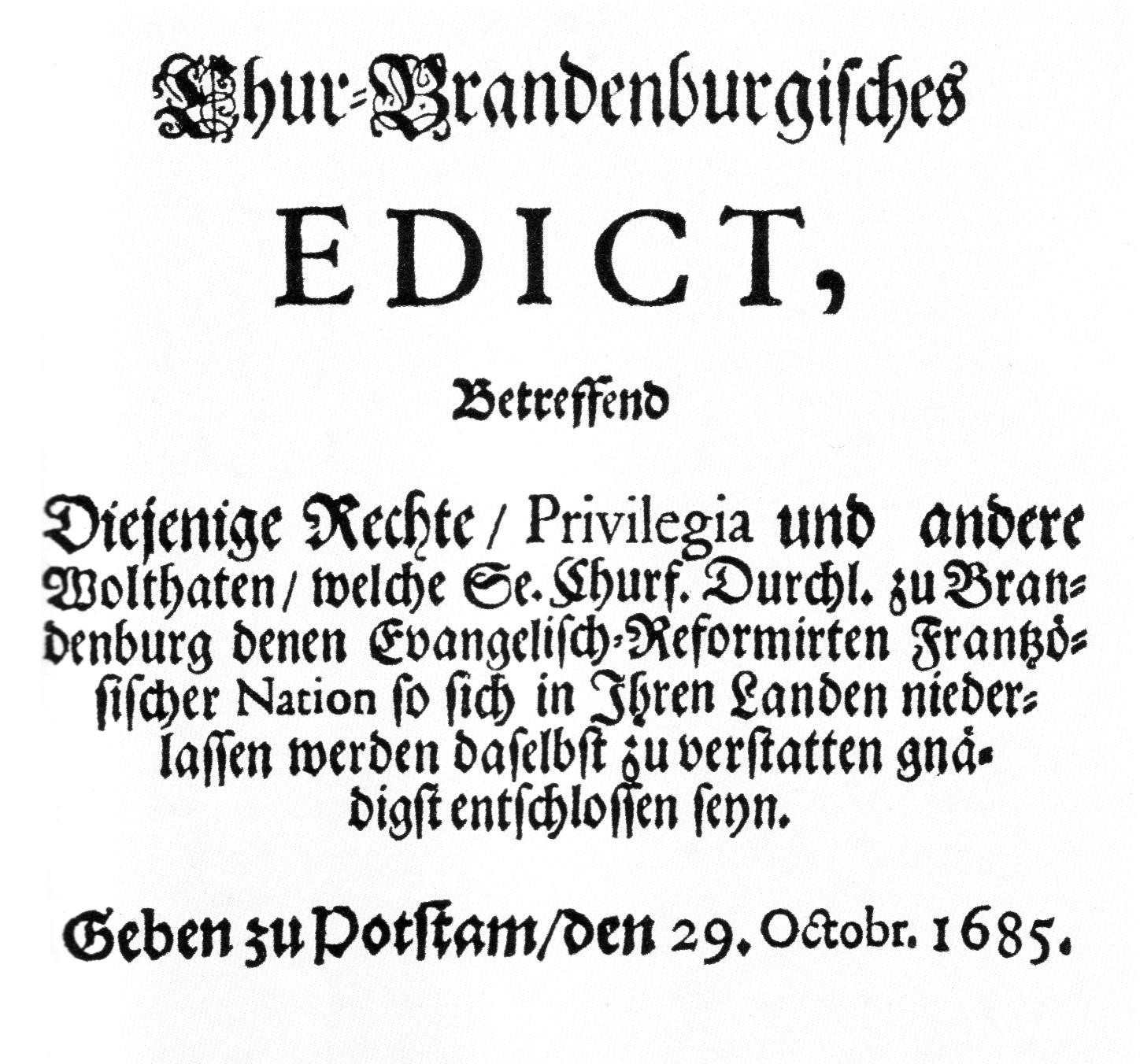
The Edict of Potsdam (German: Edikt von Potsdam) was a proclamation issued by Frederick William, Elector of Brandenburg and Duke of Prussia, in Potsdam on 29 October 1685, as a response to the revocation of the Edict of Nantes by the Edict of Fontainebleau. It encouraged Protestants to relocate to Brandenburg.
On 22 October 1685, King Louis XIV of France issued the Edict of Fontainebleau, which was part of a program of persecution that closed Huguenot churches and schools. This policy escalated the harassment of religious minorities since the dragonnades were created in 1681 in order to intimidate Huguenots into converting to Catholicism. As a result, a large number of Protestants — estimates range from 210,000 to 900,000 — left France over the next two decades.
Across the Rhine it has been estimated that the Holy Roman Empire had lost a third of its population through slaughter, famine and plague during the Thirty Years' War (1618-1648). The western part of Brandenburg-Prussia fell within the empire: badly depopulated, the territory faced a desperate labour shortage during the second half of the seventeenth century.
The novelist Theodor Fontane was descended from French religious refugees who had relocated to Brandenburg-Prussia in response to the Edicts of Fontainbleau and Potsdam. Two hundred years later, he wrote a lengthy and resounding
"Prologue to the two hundredth anniversary celebration of the French colony":
A shelter found, freedom of [religious] belief,
And refuge from oppression of the conscience.
A courageous prince, free and devout,
Received us here, as he prince of the country
Received us as his own people. No envy was awakened,
No jealousy, - People opened their doors
And welcomed us as Brothers in Christ......
Ein Obdach fanden, Freistatt für den Glauben,
Und Zuflucht vor Bedrängnis der Gewissen.
Ein hochmuther Fürst, so frei wie fromm,
Empfing uns hier, und wie der Fürst des Landes
Empfing uns auch sein Volk. Kein Neid ward wach,
Nicht Eifersucht, - man öffnete die Thür
Und hieß als Glaubensbrüder uns willkommen......
Encouraged by the French theologian-philosopher Jakob Abbadie, on 29 October 1685, Frederick William, Elector of Brandenburg issued the Edict of Potsdam.
A large number of religious refugees had arrived by ship at Cadzand and other coastal ports in the Netherlands. The edict, which reflected a hands-on practical approach by the Prussian leadership, provided for Prussian diplomats in Amsterdam to arrange ships to transport these by sea to the Free City of Hamburg where Prussian representatives would be on hand to arrange transport up the Elbe to their chosen destinations in the Brandenburg-Prussia heartland. For people fleeing from eastern and southern France provision was made for a land route via Sedan and the Duchy of Cleves, which had become a territory of Brandenburg-Prussia in 1666, and where the Great Elector (as the Prussian ruler is identified in English language history books) had arranged for them to be settled locally or transported on via the Rhine to new homes further east. In its third section the edict spelled out a succession of suggested places where the migrants might wish to live, and went on to promise "free choice [as to] their place of settlement... wherever they find it most convenient to practice their professions and trades".
The edict expressly ruled out any customs duties or other taxes on assets that the migrants were able to bring along with them. Migrants would be accommodated in abandoned and dilapidated properties which their owners had lacked the means to make habitable. They would receive their properties free of mortgages or other debts or obligations, and they would be provided at no cost to themselves with the necessary timber and other building materials. Any former proprietors would be compensated for the transfer value of properties allocated to the migrants, and the new settlers would enjoy a six-year tax holiday in respect of any property taxes (though they would remain subject to the same taxes on consumption as other citizens).
Hub AI
Edict of Potsdam AI simulator
(@Edict of Potsdam_simulator)
Edict of Potsdam
The Edict of Potsdam (German: Edikt von Potsdam) was a proclamation issued by Frederick William, Elector of Brandenburg and Duke of Prussia, in Potsdam on 29 October 1685, as a response to the revocation of the Edict of Nantes by the Edict of Fontainebleau. It encouraged Protestants to relocate to Brandenburg.
On 22 October 1685, King Louis XIV of France issued the Edict of Fontainebleau, which was part of a program of persecution that closed Huguenot churches and schools. This policy escalated the harassment of religious minorities since the dragonnades were created in 1681 in order to intimidate Huguenots into converting to Catholicism. As a result, a large number of Protestants — estimates range from 210,000 to 900,000 — left France over the next two decades.
Across the Rhine it has been estimated that the Holy Roman Empire had lost a third of its population through slaughter, famine and plague during the Thirty Years' War (1618-1648). The western part of Brandenburg-Prussia fell within the empire: badly depopulated, the territory faced a desperate labour shortage during the second half of the seventeenth century.
The novelist Theodor Fontane was descended from French religious refugees who had relocated to Brandenburg-Prussia in response to the Edicts of Fontainbleau and Potsdam. Two hundred years later, he wrote a lengthy and resounding
"Prologue to the two hundredth anniversary celebration of the French colony":
A shelter found, freedom of [religious] belief,
And refuge from oppression of the conscience.
A courageous prince, free and devout,
Received us here, as he prince of the country
Received us as his own people. No envy was awakened,
No jealousy, - People opened their doors
And welcomed us as Brothers in Christ......
Ein Obdach fanden, Freistatt für den Glauben,
Und Zuflucht vor Bedrängnis der Gewissen.
Ein hochmuther Fürst, so frei wie fromm,
Empfing uns hier, und wie der Fürst des Landes
Empfing uns auch sein Volk. Kein Neid ward wach,
Nicht Eifersucht, - man öffnete die Thür
Und hieß als Glaubensbrüder uns willkommen......
Encouraged by the French theologian-philosopher Jakob Abbadie, on 29 October 1685, Frederick William, Elector of Brandenburg issued the Edict of Potsdam.
A large number of religious refugees had arrived by ship at Cadzand and other coastal ports in the Netherlands. The edict, which reflected a hands-on practical approach by the Prussian leadership, provided for Prussian diplomats in Amsterdam to arrange ships to transport these by sea to the Free City of Hamburg where Prussian representatives would be on hand to arrange transport up the Elbe to their chosen destinations in the Brandenburg-Prussia heartland. For people fleeing from eastern and southern France provision was made for a land route via Sedan and the Duchy of Cleves, which had become a territory of Brandenburg-Prussia in 1666, and where the Great Elector (as the Prussian ruler is identified in English language history books) had arranged for them to be settled locally or transported on via the Rhine to new homes further east. In its third section the edict spelled out a succession of suggested places where the migrants might wish to live, and went on to promise "free choice [as to] their place of settlement... wherever they find it most convenient to practice their professions and trades".
The edict expressly ruled out any customs duties or other taxes on assets that the migrants were able to bring along with them. Migrants would be accommodated in abandoned and dilapidated properties which their owners had lacked the means to make habitable. They would receive their properties free of mortgages or other debts or obligations, and they would be provided at no cost to themselves with the necessary timber and other building materials. Any former proprietors would be compensated for the transfer value of properties allocated to the migrants, and the new settlers would enjoy a six-year tax holiday in respect of any property taxes (though they would remain subject to the same taxes on consumption as other citizens).