



Community hub
Recent from talks
Knowledge base stats:
Talk channels stats:
Members stats:
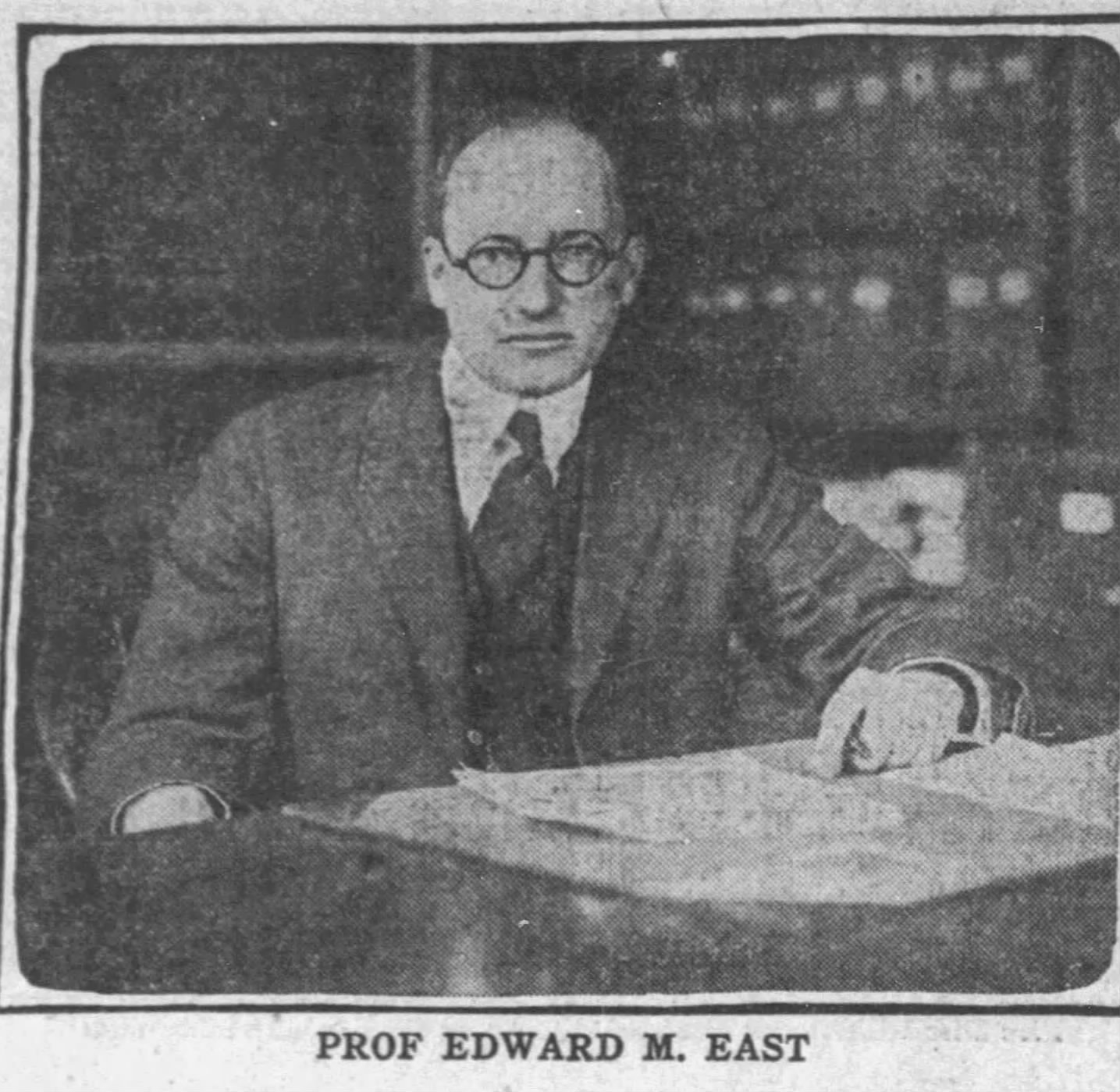
Edward Murray East
Edward Murray East (October 4, 1879 – November 9, 1938) was an American plant geneticist, botanist, agronomist and eugenicist. He is known for his experiments that led to the development of hybrid corn and his support of 'forced' elimination of the 'unfit' based on eugenic findings. He worked at the Bussey Institute of Harvard University where he performed a key experiment showing the outcome of crosses between lines that differ in a quantitative trait. He is also known as a critic of consumption and as a pioneer of thinking about environmental limits. While some scholars see his population thinking as nothing more than eugenics on a global scale, others see his population thinking as driven by environmental concerns, not eugenics.
East was a prominent figure in early American genetics and a strong supporter of the eugenics movement in the United States. He was strongly influenced by the work of Thomas Malthus, especially Essay on the Principle of Population (1798). This influence led East to create many of his ideas concerning birth control and immigration policy. He applied many of the ideas that he had developed in his research on the applications of genetics to agriculture to his ideas about human society.
East wrote two major works on eugenics, Mankind at the Crossroads (1923) and Heredity and Human Affairs (1927), in which he compared groups of people based upon the racial categorizations of the time. In his book Heredity and Human Affairs (1927), he made quite a few pointed comments against interbreeding and miscegenation in the human species, stating that "the negro race as a whole is possessed of undesirable transmissible qualities both physical and mental, which seem to justify not only a line but a wide gulf to be fixed permanently between it and the white race".
Another principal concern of East's was the existing social policy, and his perception that it favored the "imbecile" over the "genius", and that the continued use of public funds to this end would have negligible value, if not directly causing harm.
East's ideas about population were separable from his views about eugenics, and differed from other Malthusians. Most Malthusian arguments, East noted at the beginning of Mankind at the Crossroads, had overlooked the most central issue: they “concern only birth-rates and death-rates, and… neglect the importance of agriculture.” Studying not just food supply but also agriculture was so crucial, East insisted, because the planet’s carrying capacity was declining. Historians of population have noted the prominence of Raymond Pearl and Edward Murray East in debates about population, mostly to point out their race and class fears, but have rarely stressed their emphasis on environmental limits.
In 1919, Edward M. East and Donald F. Jones worked together on monographs on experimental biology, including a book on inbreeding and outbreeding and their genetic and sociological significance. This work covers reproduction among plants and animals, the mechanism of reproduction, the mechanism of heredity, mathematical considerations of inbreeding, inbreeding experiments with animals and plants, hybrid vigor or heterosis, conceptions as to the cause of hybrid vigor, sterility and its relations to inbreeding and crossbreeding, the role of inbreeding and outbreeding in evolution, and the value of inbreeding and outbreeding in plant and animal improvement. East and Jones explicitly considered inbreeding and outbreeding in man, their effect on the individual, and the intermingling of races and review the national stamina literature. In Inbreeding and Outbreeding: Their Genetic and Sociological Significance, East proposed the theory that inbreeding in a genetically diverse stock caused increased homozygosity. Believing with the Drosophila workers that most mutations were recessive and deleterious, East concluded that the increased homozygosity caused by inbreeding should generally be accompanied by detrimental effects. His theory also explained why inbreeding was not necessarily deleterious in all cases. Unless deleterious recessives were present, inbreeding caused no ill effects. Outbreeding of course had the opposite effect of increasing heterozygosity and was often accompanied by heterosis, or hybrid vigor.
In later years East continued to work on the physiological interpretation of heterosis and published a long paper on the subject only two years before his death.
The Jones and East book was well received, the theory presented with a wealth of evidence. It was widely read and cited by geneticists.
Hub AI
Edward Murray East AI simulator
(@Edward Murray East_simulator)
Edward Murray East
Edward Murray East (October 4, 1879 – November 9, 1938) was an American plant geneticist, botanist, agronomist and eugenicist. He is known for his experiments that led to the development of hybrid corn and his support of 'forced' elimination of the 'unfit' based on eugenic findings. He worked at the Bussey Institute of Harvard University where he performed a key experiment showing the outcome of crosses between lines that differ in a quantitative trait. He is also known as a critic of consumption and as a pioneer of thinking about environmental limits. While some scholars see his population thinking as nothing more than eugenics on a global scale, others see his population thinking as driven by environmental concerns, not eugenics.
East was a prominent figure in early American genetics and a strong supporter of the eugenics movement in the United States. He was strongly influenced by the work of Thomas Malthus, especially Essay on the Principle of Population (1798). This influence led East to create many of his ideas concerning birth control and immigration policy. He applied many of the ideas that he had developed in his research on the applications of genetics to agriculture to his ideas about human society.
East wrote two major works on eugenics, Mankind at the Crossroads (1923) and Heredity and Human Affairs (1927), in which he compared groups of people based upon the racial categorizations of the time. In his book Heredity and Human Affairs (1927), he made quite a few pointed comments against interbreeding and miscegenation in the human species, stating that "the negro race as a whole is possessed of undesirable transmissible qualities both physical and mental, which seem to justify not only a line but a wide gulf to be fixed permanently between it and the white race".
Another principal concern of East's was the existing social policy, and his perception that it favored the "imbecile" over the "genius", and that the continued use of public funds to this end would have negligible value, if not directly causing harm.
East's ideas about population were separable from his views about eugenics, and differed from other Malthusians. Most Malthusian arguments, East noted at the beginning of Mankind at the Crossroads, had overlooked the most central issue: they “concern only birth-rates and death-rates, and… neglect the importance of agriculture.” Studying not just food supply but also agriculture was so crucial, East insisted, because the planet’s carrying capacity was declining. Historians of population have noted the prominence of Raymond Pearl and Edward Murray East in debates about population, mostly to point out their race and class fears, but have rarely stressed their emphasis on environmental limits.
In 1919, Edward M. East and Donald F. Jones worked together on monographs on experimental biology, including a book on inbreeding and outbreeding and their genetic and sociological significance. This work covers reproduction among plants and animals, the mechanism of reproduction, the mechanism of heredity, mathematical considerations of inbreeding, inbreeding experiments with animals and plants, hybrid vigor or heterosis, conceptions as to the cause of hybrid vigor, sterility and its relations to inbreeding and crossbreeding, the role of inbreeding and outbreeding in evolution, and the value of inbreeding and outbreeding in plant and animal improvement. East and Jones explicitly considered inbreeding and outbreeding in man, their effect on the individual, and the intermingling of races and review the national stamina literature. In Inbreeding and Outbreeding: Their Genetic and Sociological Significance, East proposed the theory that inbreeding in a genetically diverse stock caused increased homozygosity. Believing with the Drosophila workers that most mutations were recessive and deleterious, East concluded that the increased homozygosity caused by inbreeding should generally be accompanied by detrimental effects. His theory also explained why inbreeding was not necessarily deleterious in all cases. Unless deleterious recessives were present, inbreeding caused no ill effects. Outbreeding of course had the opposite effect of increasing heterozygosity and was often accompanied by heterosis, or hybrid vigor.
In later years East continued to work on the physiological interpretation of heterosis and published a long paper on the subject only two years before his death.
The Jones and East book was well received, the theory presented with a wealth of evidence. It was widely read and cited by geneticists.