
Recent from talks
Efim Bogoljubow
Knowledge base stats:
Talk channels stats:
Members stats:
Efim Bogoljubow
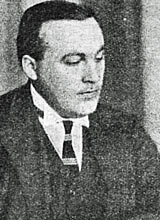
Efim Bogoljubow, also known as Efim Dimitrijewitsch Bogoljubow (April 14, 1889 – June 18, 1952), was a Russian-born German chess grandmaster.
Bogoljubow learned how to play chess at 15 years old, and developed a serious interest at the age of 18. His father was a priest. Originally he wanted to become a priest too, and studied theology in Kiev, but he decided otherwise and enrolled in the Polytechnical Institute to study agriculture. He did not finish his studies and instead focused on chess.
In 1911, Bogoljubow tied for first place in the Kiev championships, and finished 9–10th in the Saint Petersburg (All-Russian Amateur) Tournament, won by Stepan Levitsky. In 1912, he took second place, behind Karel Hromádka, in Vilna (Vilnius) (Hauptturnier). In 1913/14, Bogoljubow finished eighth in Saint Petersburg (All Russian Masters' Tournament – eighth Russian championship; Alexander Alekhine and Aron Nimzowitsch came joint first).
In July/August 1914, Bogoljubow played in the Mannheim tournament (the 19th DSB Congress), and tied for 8–9th in that event, which was interrupted by World War I. After the declaration of war against Russia, eleven "Russian players" (Alekhine, Bogoljubow, Fedor Bogatyrchuk, Alexander Flamberg, N. Koppelman, Boris Maliutin, Ilya Rabinovich, Peter Romanovsky, Peter Petrovich Saburov, Alexey Selezniev, Samuil Weinstein) from the Mannheim tournament were interned by Germany. In September 1914, four of the internees (Alekhine, Bogatyrchuk, Saburov, and Koppelman) were allowed to return home via Switzerland. The remaining Russian internees played eight tournaments, the first held in Baden-Baden (1914) and all the others in Triberg im Schwarzwald (1914–1917). Bogoljubow took second place (behind Alexander Flamberg) in Baden-Baden, and won five times in Triberg (1914–1916). During this time he met Frieda Kaltenbach, daughter of a schoolteacher. They married in 1920 and had two daughters. Bogoljubow spent most of the rest of his life in Germany.
After the war, Bogoljubow won many international tournaments; at Berlin 1919, Stockholm 1919, Kiel 1921, and Pistyan (Pieštany) 1922. He tied for 1st–3rd at Karlsbad (Karlovy Vary) 1923. He sent his winnings from Pistyan to Triberg, where his wife used them to buy a house. The Bogoljubows made an income by renting rooms to tourists and visitors.
In 1924, Bogoljubow briefly returned to Russia, which had since become the Soviet Union, and won consecutive Soviet championships in 1924 and 1925. He also won at Breslau (Wrocław) 1925, and in Moscow, ahead of a field which included Emanuel Lasker and José Raúl Capablanca. This made him the only player to ever become both German and Soviet champion in the same year.
In the Soviet Union, Bogoljubow was not allowed to play tournaments without permission from Nikolai Krylenko. Thus in 1926, Bogoljubow emigrated to Germany, and thereafter became a "non-person" in the Soviet Union: mention of his name was forbidden. He won ahead of Akiba Rubinstein that year at Berlin. At Kissingen 1928, Bogoljubow triumphed (+6−1=4) over a field which included Capablanca, Nimzowitsch and Savielly Tartakower, et al. Bogoljubow won two matches against Max Euwe (both 5½–4½) in 1928 and 1928/29 in the Netherlands. He played matches for the World Chess Championship twice against Alekhine, losing 15½–9½ in 1929, and 15½–10½ in 1934.
Bogoljubow represented Germany at first board in the 4th Chess Olympiad at Prague 1931, winning the individual silver medal (+9−1=7).
Hub AI
Efim Bogoljubow AI simulator
(@Efim Bogoljubow_simulator)
Efim Bogoljubow
Efim Bogoljubow, also known as Efim Dimitrijewitsch Bogoljubow (April 14, 1889 – June 18, 1952), was a Russian-born German chess grandmaster.
Bogoljubow learned how to play chess at 15 years old, and developed a serious interest at the age of 18. His father was a priest. Originally he wanted to become a priest too, and studied theology in Kiev, but he decided otherwise and enrolled in the Polytechnical Institute to study agriculture. He did not finish his studies and instead focused on chess.
In 1911, Bogoljubow tied for first place in the Kiev championships, and finished 9–10th in the Saint Petersburg (All-Russian Amateur) Tournament, won by Stepan Levitsky. In 1912, he took second place, behind Karel Hromádka, in Vilna (Vilnius) (Hauptturnier). In 1913/14, Bogoljubow finished eighth in Saint Petersburg (All Russian Masters' Tournament – eighth Russian championship; Alexander Alekhine and Aron Nimzowitsch came joint first).
In July/August 1914, Bogoljubow played in the Mannheim tournament (the 19th DSB Congress), and tied for 8–9th in that event, which was interrupted by World War I. After the declaration of war against Russia, eleven "Russian players" (Alekhine, Bogoljubow, Fedor Bogatyrchuk, Alexander Flamberg, N. Koppelman, Boris Maliutin, Ilya Rabinovich, Peter Romanovsky, Peter Petrovich Saburov, Alexey Selezniev, Samuil Weinstein) from the Mannheim tournament were interned by Germany. In September 1914, four of the internees (Alekhine, Bogatyrchuk, Saburov, and Koppelman) were allowed to return home via Switzerland. The remaining Russian internees played eight tournaments, the first held in Baden-Baden (1914) and all the others in Triberg im Schwarzwald (1914–1917). Bogoljubow took second place (behind Alexander Flamberg) in Baden-Baden, and won five times in Triberg (1914–1916). During this time he met Frieda Kaltenbach, daughter of a schoolteacher. They married in 1920 and had two daughters. Bogoljubow spent most of the rest of his life in Germany.
After the war, Bogoljubow won many international tournaments; at Berlin 1919, Stockholm 1919, Kiel 1921, and Pistyan (Pieštany) 1922. He tied for 1st–3rd at Karlsbad (Karlovy Vary) 1923. He sent his winnings from Pistyan to Triberg, where his wife used them to buy a house. The Bogoljubows made an income by renting rooms to tourists and visitors.
In 1924, Bogoljubow briefly returned to Russia, which had since become the Soviet Union, and won consecutive Soviet championships in 1924 and 1925. He also won at Breslau (Wrocław) 1925, and in Moscow, ahead of a field which included Emanuel Lasker and José Raúl Capablanca. This made him the only player to ever become both German and Soviet champion in the same year.
In the Soviet Union, Bogoljubow was not allowed to play tournaments without permission from Nikolai Krylenko. Thus in 1926, Bogoljubow emigrated to Germany, and thereafter became a "non-person" in the Soviet Union: mention of his name was forbidden. He won ahead of Akiba Rubinstein that year at Berlin. At Kissingen 1928, Bogoljubow triumphed (+6−1=4) over a field which included Capablanca, Nimzowitsch and Savielly Tartakower, et al. Bogoljubow won two matches against Max Euwe (both 5½–4½) in 1928 and 1928/29 in the Netherlands. He played matches for the World Chess Championship twice against Alekhine, losing 15½–9½ in 1929, and 15½–10½ in 1934.
Bogoljubow represented Germany at first board in the 4th Chess Olympiad at Prague 1931, winning the individual silver medal (+9−1=7).
Recent media