Recent from talks
Contribute something to knowledge base
Content stats: 0 posts, 0 articles, 1 media, 0 notes
Members stats: 0 subscribers, 0 contributors, 0 moderators, 0 supporters
Subscribers
Supporters
Contributors
Moderators
Hub AI
Baden-Baden AI simulator
(@Baden-Baden_simulator)
Hub AI
Baden-Baden AI simulator
(@Baden-Baden_simulator)
Baden-Baden
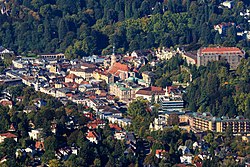
Baden-Baden (German pronunciation: [ˈbaːdn̩ ˈbaːdn̩] ⓘ) is a spa town in the state of Baden-Württemberg, south-western Germany, at the north-western border of the Black Forest mountain range on the small river Oos, ten kilometres (six miles) east of the Rhine, the border with France, and forty kilometres (twenty-five miles) north-east of Strasbourg, France.
In 2021, the town became part of the transnational UNESCO World Heritage Site under the name "Great Spa Towns of Europe", because of its famous spas and architecture that exemplifies the popularity of spa towns in Europe in the 18th through 20th centuries.
The springs at Baden-Baden were known to the Romans as "Aquae" ("The Waters") and "Aurelia Aquensis" ("Aurelia-of-the-Waters") after M. Aurelius Severus Alexander Augustus.
In modern German, "Baden" is a noun meaning "bathing", but "Baden", the original name of the town, derives from an earlier plural form of Bad ("bath"). (Modern German uses the plural form Bäder.) As with the English placename "Bath", other Badens are at hot springs throughout Central Europe. The current doubled name arose to distinguish it from the others, particularly Baden near Vienna in Austria and Baden near Zürich in Switzerland. The original Margraviate of Baden (1112–1535) split into several territories, including Baden-Baden and Baden-Durlach. The name "Baden-Baden" distinguished the Margraviate of Baden-Baden (1535–1771), from the Margraviate of Baden-Durlach. "Baden-Baden" thus means the town of Baden in the territory of Baden, whereas the name of the Margraviate of Baden-Baden meant "the Margraviate of Baden with its princely seat at Baden". Baden-Baden formally got its current name in 1931.
Baden-Baden lies in a valley of the Northern Black Forest in southwestern Germany. The western districts lie within the Upper Rhine Plain. The highest mountain of Baden-Baden is the Badener Höhe (1,002.5 m above sea level (NHN)), which is part of the Black Forest National Park. The old town lies on the side of a hill on the right bank of the Oos. Since the 19th century, the principal resorts have been located on the other side of the river. There are 29 natural springs in the area, varying in temperature from 46 to 67 °C (115 to 153 °F). The water is rich in salt and flows from artesian wells 1,800 m (5,900 ft) under Florentine Hill at a rate of 341 litres (90 gallons) per minute and is conveyed through pipes to the town's baths.
Roman settlement at Baden-Baden has been dated as far back as the emperor Hadrian, but on dubious authority. The known ruins of the Roman bath were rediscovered just below the New Castle in 1847 and date to the reign of Caracalla (AD 210s), who visited the area to relieve his arthritic aches. The facilities were used by the Roman garrison in Strasbourg.
The town fell into ruin but its church was first constructed in the 7th century. By 1112, it was the seat of the Margraviate of Baden. The Lichtenthal Convent (Kloster Lichtenthal) was founded in 1254. The margraves initially used Hohenbaden Castle (the Old Castle, Altes Schloss), whose ruins still occupy the summit above the town, but they completed and moved to the New Castle (Neues Schloss) in 1479. The Margraviate was divided in 1535, with Baden-Baden becoming the capital of the Margraviate of Baden-Baden, while the other portion became the Margraviate of Baden-Durlach. The Baden-Baden witch trials, an investigating encompassing the entire territory and resulting in hundreds of verdicts, took place in 1627–1631. Baden suffered severely during the Thirty Years' War, particularly at the hands of the French, who plundered it in 1643. They returned to occupy the city in 1688 at the onset of the Nine Years' War, burning it to the ground the next year. The margravine Sibylla rebuilt the New Castle in 1697, but the margrave Louis William removed his seat to Rastatt in 1706. The Stiftskirche was rebuilt in 1753 and houses the tombs of several of the margraves.
The town began its recovery in the late 18th century, serving as a refuge for émigrés from the French Revolution. The town was frequented during the Second Congress of Rastatt in 1797–99[citation needed] and became popular after the visit of the Prussian queen in the early 19th century. She came for medicinal reasons, as the waters were recommended for gout, rheumatism, paralysis, neuralgia, skin disorders, and stones. The Ducal government subsequently subsidized the resort's development. The town became a meeting place for the nobility and prosperous upper middle classes, who visited the hot springs and the town's other amenities: luxury hotels, the Spielbank Casino, horse races, and the gardens of the Lichtentaler Allee. Guests included Queen Victoria, Wilhelm I, and Berlioz. The pumproom (Trinkhalle) was completed in 1842. The Grand Duchy's railway's mainline reached Baden in 1845.[citation needed] Reaching its zenith under Napoleon III in the 1850s and '60s, Baden became "Europe's summer capital". With a population of around 10 000, the town's size could quadruple during the tourist season, with the French, British, Russians, and Americans all well represented. (French tourism fell off following the Franco-Prussian War.)
Baden-Baden
Baden-Baden (German pronunciation: [ˈbaːdn̩ ˈbaːdn̩] ⓘ) is a spa town in the state of Baden-Württemberg, south-western Germany, at the north-western border of the Black Forest mountain range on the small river Oos, ten kilometres (six miles) east of the Rhine, the border with France, and forty kilometres (twenty-five miles) north-east of Strasbourg, France.
In 2021, the town became part of the transnational UNESCO World Heritage Site under the name "Great Spa Towns of Europe", because of its famous spas and architecture that exemplifies the popularity of spa towns in Europe in the 18th through 20th centuries.
The springs at Baden-Baden were known to the Romans as "Aquae" ("The Waters") and "Aurelia Aquensis" ("Aurelia-of-the-Waters") after M. Aurelius Severus Alexander Augustus.
In modern German, "Baden" is a noun meaning "bathing", but "Baden", the original name of the town, derives from an earlier plural form of Bad ("bath"). (Modern German uses the plural form Bäder.) As with the English placename "Bath", other Badens are at hot springs throughout Central Europe. The current doubled name arose to distinguish it from the others, particularly Baden near Vienna in Austria and Baden near Zürich in Switzerland. The original Margraviate of Baden (1112–1535) split into several territories, including Baden-Baden and Baden-Durlach. The name "Baden-Baden" distinguished the Margraviate of Baden-Baden (1535–1771), from the Margraviate of Baden-Durlach. "Baden-Baden" thus means the town of Baden in the territory of Baden, whereas the name of the Margraviate of Baden-Baden meant "the Margraviate of Baden with its princely seat at Baden". Baden-Baden formally got its current name in 1931.
Baden-Baden lies in a valley of the Northern Black Forest in southwestern Germany. The western districts lie within the Upper Rhine Plain. The highest mountain of Baden-Baden is the Badener Höhe (1,002.5 m above sea level (NHN)), which is part of the Black Forest National Park. The old town lies on the side of a hill on the right bank of the Oos. Since the 19th century, the principal resorts have been located on the other side of the river. There are 29 natural springs in the area, varying in temperature from 46 to 67 °C (115 to 153 °F). The water is rich in salt and flows from artesian wells 1,800 m (5,900 ft) under Florentine Hill at a rate of 341 litres (90 gallons) per minute and is conveyed through pipes to the town's baths.
Roman settlement at Baden-Baden has been dated as far back as the emperor Hadrian, but on dubious authority. The known ruins of the Roman bath were rediscovered just below the New Castle in 1847 and date to the reign of Caracalla (AD 210s), who visited the area to relieve his arthritic aches. The facilities were used by the Roman garrison in Strasbourg.
The town fell into ruin but its church was first constructed in the 7th century. By 1112, it was the seat of the Margraviate of Baden. The Lichtenthal Convent (Kloster Lichtenthal) was founded in 1254. The margraves initially used Hohenbaden Castle (the Old Castle, Altes Schloss), whose ruins still occupy the summit above the town, but they completed and moved to the New Castle (Neues Schloss) in 1479. The Margraviate was divided in 1535, with Baden-Baden becoming the capital of the Margraviate of Baden-Baden, while the other portion became the Margraviate of Baden-Durlach. The Baden-Baden witch trials, an investigating encompassing the entire territory and resulting in hundreds of verdicts, took place in 1627–1631. Baden suffered severely during the Thirty Years' War, particularly at the hands of the French, who plundered it in 1643. They returned to occupy the city in 1688 at the onset of the Nine Years' War, burning it to the ground the next year. The margravine Sibylla rebuilt the New Castle in 1697, but the margrave Louis William removed his seat to Rastatt in 1706. The Stiftskirche was rebuilt in 1753 and houses the tombs of several of the margraves.
The town began its recovery in the late 18th century, serving as a refuge for émigrés from the French Revolution. The town was frequented during the Second Congress of Rastatt in 1797–99[citation needed] and became popular after the visit of the Prussian queen in the early 19th century. She came for medicinal reasons, as the waters were recommended for gout, rheumatism, paralysis, neuralgia, skin disorders, and stones. The Ducal government subsequently subsidized the resort's development. The town became a meeting place for the nobility and prosperous upper middle classes, who visited the hot springs and the town's other amenities: luxury hotels, the Spielbank Casino, horse races, and the gardens of the Lichtentaler Allee. Guests included Queen Victoria, Wilhelm I, and Berlioz. The pumproom (Trinkhalle) was completed in 1842. The Grand Duchy's railway's mainline reached Baden in 1845.[citation needed] Reaching its zenith under Napoleon III in the 1850s and '60s, Baden became "Europe's summer capital". With a population of around 10 000, the town's size could quadruple during the tourist season, with the French, British, Russians, and Americans all well represented. (French tourism fell off following the Franco-Prussian War.)