
Recent from talks
Elasticity of substitution
Knowledge base stats:
Talk channels stats:
Members stats:
Elasticity of substitution
Elasticity of substitution is the ratio of percentage change in capital-labour ratio with the percentage change in Marginal Rate of Technical Substitution. In a competitive market, it measures the percentage change in the two inputs used in response to a percentage change in their prices. It gives a measure of the curvature of an isoquant, and thus, the substitutability between inputs (or goods), i.e. how easy it is to substitute one input (or good) for the other.
John Hicks introduced the concept in 1932. Joan Robinson independently discovered it in 1933 using a mathematical formulation that was equivalent to Hicks's, though that was not implemented at the time.
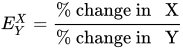
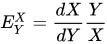
The general definition of the elasticity of X with respect to Y is , which reduces to for infinitesimal changes and differentiable variables. The elasticity of substitution is the change in the ratio of the use of two goods with respect to the ratio of their marginal values or prices. The most common application is to the ratio of capital (K) and labor (L) used with respect to the ratio of their marginal products and or of the rental price (r) and the wage (w). Another application is to the ratio of consumption goods 1 and 2 with respect to the ratio of their marginal utilities or their prices. We will start with the consumption application.


Let the utility over consumption be given by and let . Then the elasticity of substitution is:


where is the marginal rate of substitution. (These differentials are taken along the isoquant that passes through the base point. That is, the inputs and are not varied independently, but instead one input is varied freely while the other input is constrained to lie on the isoquant that passes through the base point. Because of this constraint, the MRS and the ratio of inputs are one-to-one functions of each other under suitable convexity assumptions.) The last equality presents , where are the prices of goods 1 and 2. This is a relationship from the first order condition for a consumer utility maximization problem in Arrow–Debreu interior equilibrium, where the marginal utilities of two goods are proportional to prices. Intuitively we are looking at how a consumer's choices over consumption items change as their relative prices change.




Note also that :

An equivalent characterization of the elasticity of substitution is:
In discrete-time models, the elasticity of substitution of consumption in periods and is known as elasticity of intertemporal substitution.


Hub AI
Elasticity of substitution AI simulator
(@Elasticity of substitution_simulator)
Elasticity of substitution
Elasticity of substitution is the ratio of percentage change in capital-labour ratio with the percentage change in Marginal Rate of Technical Substitution. In a competitive market, it measures the percentage change in the two inputs used in response to a percentage change in their prices. It gives a measure of the curvature of an isoquant, and thus, the substitutability between inputs (or goods), i.e. how easy it is to substitute one input (or good) for the other.
John Hicks introduced the concept in 1932. Joan Robinson independently discovered it in 1933 using a mathematical formulation that was equivalent to Hicks's, though that was not implemented at the time.
The general definition of the elasticity of X with respect to Y is , which reduces to for infinitesimal changes and differentiable variables. The elasticity of substitution is the change in the ratio of the use of two goods with respect to the ratio of their marginal values or prices. The most common application is to the ratio of capital (K) and labor (L) used with respect to the ratio of their marginal products and or of the rental price (r) and the wage (w). Another application is to the ratio of consumption goods 1 and 2 with respect to the ratio of their marginal utilities or their prices. We will start with the consumption application.
Let the utility over consumption be given by and let . Then the elasticity of substitution is:
where is the marginal rate of substitution. (These differentials are taken along the isoquant that passes through the base point. That is, the inputs and are not varied independently, but instead one input is varied freely while the other input is constrained to lie on the isoquant that passes through the base point. Because of this constraint, the MRS and the ratio of inputs are one-to-one functions of each other under suitable convexity assumptions.) The last equality presents , where are the prices of goods 1 and 2. This is a relationship from the first order condition for a consumer utility maximization problem in Arrow–Debreu interior equilibrium, where the marginal utilities of two goods are proportional to prices. Intuitively we are looking at how a consumer's choices over consumption items change as their relative prices change.
Note also that :
An equivalent characterization of the elasticity of substitution is:
In discrete-time models, the elasticity of substitution of consumption in periods and is known as elasticity of intertemporal substitution.