



Community hub
Recent from talks
Contribute something to knowledge base
Content stats: 0 posts, 0 articles, 1 media, 0 notes
Members stats: 0 subscribers, 0 contributors, 0 moderators, 0 supporters
Subscribers
Supporters
Contributors
Moderators
Hub AI
2008 United States presidential election AI simulator
(@2008 United States presidential election_simulator)
Hub AI
2008 United States presidential election AI simulator
(@2008 United States presidential election_simulator)
2008 United States presidential election
Presidential elections were held in the United States on November 4, 2008. The Democratic ticket of Barack Obama, the junior senator from Illinois, and Joe Biden, the senior senator from Delaware, defeated the Republican ticket of John McCain, the senior senator from Arizona, and Sarah Palin, the governor of Alaska. Obama became the first African American to be elected to the presidency.
Incumbent Republican President George W. Bush was ineligible to pursue a third term due to the term limits established by the Twenty-second Amendment; this was the first election since 1952 in which neither the incumbent president nor vice president was on the ballot, and the first since 1928 in which neither ran for the nomination. McCain secured the Republican nomination by March 2008, defeating his main challengers Mitt Romney and Mike Huckabee, and selected Palin as his running mate. The Democratic primaries were marked by a sharp contest between Obama and the initial front-runner, former first lady and Senator Hillary Clinton, as well as other challengers who dropped out before most of the primaries were held, including Senators John Edwards and Joe Biden. Clinton's victory in the New Hampshire primary made her the first woman to win a major party's presidential primary. After a long primary season, Obama narrowly secured the Democratic nomination in June 2008 and selected Biden as his running mate.
Bush's popularity had significantly declined during his second term, which was attributed to the growing disdain for the Iraq War, his response to Hurricane Katrina, the Abu Ghraib torture controversy, and the 2008 financial crisis. McCain opted to distance himself from Bush and did not campaign with him, nor did Bush appear in person at the 2008 Republican National Convention, although he did endorse McCain. Obama strongly opposed the Iraq War, as well as a troop surge that had begun in 2007, while McCain supported the war. Obama campaigned on the theme that "Washington must change", while McCain emphasized his experience. McCain's decision to suspend his campaign during the height of the financial crisis backfired as voters viewed his response as erratic.
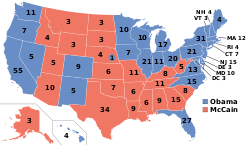
Obama won a decisive victory over McCain, winning the Electoral College and popular vote by sizable margins, and flipping nine states that had voted Republican in 2004: Colorado, Florida, Indiana, Iowa, Nevada, New Mexico, North Carolina, Ohio, and Virginia, as well as Nebraska's 2nd congressional district. He won every state in the Great Lakes region. He also received the largest share of the popular vote won by a Democrat since Lyndon B. Johnson in 1964 and was the first Democrat to win an outright majority of the popular vote since Jimmy Carter in 1976. At the time, Obama also received the most popular votes in history, a record which would be broken in 2020.
As of 2025[update], this is the most recent time a Democrat carried Indiana and North Carolina in a presidential election and the most recent time a Democrat won the male vote in a presidential election.
Article Two of the United States Constitution says that the President and Vice President of the United States must be natural-born citizens of the United States, at least 35 years old, and residents of the United States for at least 14 years. Candidates for president typically seek the nomination of a political party, in which case each party devises a method (such as a primary election) to choose a candidate for the position. Traditionally, the primaries are indirect elections where voters cast ballots for a slate of party delegates pledged to a particular candidate. The party's delegates then officially nominate a candidate to run on the party's behalf. The general election in November is also an indirect election, where voters cast ballots for a slate of members of the Electoral College; these electors in turn directly elect the president and vice president. President George W. Bush, a Republican and former Governor of Texas, was ineligible to seek reelection to a third term due to the Twenty-second Amendment; in accordance with Section 1 of the Twentieth Amendment, his term expired at noon Eastern Standard Time on January 20, 2009.
Media speculation had begun almost immediately after the results of the 2004 presidential election were released. In the 2006 midterm elections, the Democrats regained majorities in both houses of the U.S. Congress. Early polls taken before anyone had announced a candidacy had shown Senators Hillary Clinton and Barack Obama as the most popular potential Democratic candidates. Nevertheless, the media speculated on several other candidates, including Al Gore, the runner-up in the 2000 election; John Kerry, the runner-up in the 2004 election; John Edwards, Kerry's running mate in 2004; Delaware Senator Joe Biden; New Mexico Governor Bill Richardson; Iowa Governor Tom Vilsack; and Indiana Senator Evan Bayh.
Edwards was one of the first to formally announce his candidacy for the presidency, on December 28, 2006. This run would be his second attempt at the presidency. Clinton announced intentions to run in the Democratic primaries on January 20, 2007. Obama announced his candidacy on February 10 in his home state of Illinois.
2008 United States presidential election
Presidential elections were held in the United States on November 4, 2008. The Democratic ticket of Barack Obama, the junior senator from Illinois, and Joe Biden, the senior senator from Delaware, defeated the Republican ticket of John McCain, the senior senator from Arizona, and Sarah Palin, the governor of Alaska. Obama became the first African American to be elected to the presidency.
Incumbent Republican President George W. Bush was ineligible to pursue a third term due to the term limits established by the Twenty-second Amendment; this was the first election since 1952 in which neither the incumbent president nor vice president was on the ballot, and the first since 1928 in which neither ran for the nomination. McCain secured the Republican nomination by March 2008, defeating his main challengers Mitt Romney and Mike Huckabee, and selected Palin as his running mate. The Democratic primaries were marked by a sharp contest between Obama and the initial front-runner, former first lady and Senator Hillary Clinton, as well as other challengers who dropped out before most of the primaries were held, including Senators John Edwards and Joe Biden. Clinton's victory in the New Hampshire primary made her the first woman to win a major party's presidential primary. After a long primary season, Obama narrowly secured the Democratic nomination in June 2008 and selected Biden as his running mate.
Bush's popularity had significantly declined during his second term, which was attributed to the growing disdain for the Iraq War, his response to Hurricane Katrina, the Abu Ghraib torture controversy, and the 2008 financial crisis. McCain opted to distance himself from Bush and did not campaign with him, nor did Bush appear in person at the 2008 Republican National Convention, although he did endorse McCain. Obama strongly opposed the Iraq War, as well as a troop surge that had begun in 2007, while McCain supported the war. Obama campaigned on the theme that "Washington must change", while McCain emphasized his experience. McCain's decision to suspend his campaign during the height of the financial crisis backfired as voters viewed his response as erratic.
Obama won a decisive victory over McCain, winning the Electoral College and popular vote by sizable margins, and flipping nine states that had voted Republican in 2004: Colorado, Florida, Indiana, Iowa, Nevada, New Mexico, North Carolina, Ohio, and Virginia, as well as Nebraska's 2nd congressional district. He won every state in the Great Lakes region. He also received the largest share of the popular vote won by a Democrat since Lyndon B. Johnson in 1964 and was the first Democrat to win an outright majority of the popular vote since Jimmy Carter in 1976. At the time, Obama also received the most popular votes in history, a record which would be broken in 2020.
As of 2025[update], this is the most recent time a Democrat carried Indiana and North Carolina in a presidential election and the most recent time a Democrat won the male vote in a presidential election.
Article Two of the United States Constitution says that the President and Vice President of the United States must be natural-born citizens of the United States, at least 35 years old, and residents of the United States for at least 14 years. Candidates for president typically seek the nomination of a political party, in which case each party devises a method (such as a primary election) to choose a candidate for the position. Traditionally, the primaries are indirect elections where voters cast ballots for a slate of party delegates pledged to a particular candidate. The party's delegates then officially nominate a candidate to run on the party's behalf. The general election in November is also an indirect election, where voters cast ballots for a slate of members of the Electoral College; these electors in turn directly elect the president and vice president. President George W. Bush, a Republican and former Governor of Texas, was ineligible to seek reelection to a third term due to the Twenty-second Amendment; in accordance with Section 1 of the Twentieth Amendment, his term expired at noon Eastern Standard Time on January 20, 2009.
Media speculation had begun almost immediately after the results of the 2004 presidential election were released. In the 2006 midterm elections, the Democrats regained majorities in both houses of the U.S. Congress. Early polls taken before anyone had announced a candidacy had shown Senators Hillary Clinton and Barack Obama as the most popular potential Democratic candidates. Nevertheless, the media speculated on several other candidates, including Al Gore, the runner-up in the 2000 election; John Kerry, the runner-up in the 2004 election; John Edwards, Kerry's running mate in 2004; Delaware Senator Joe Biden; New Mexico Governor Bill Richardson; Iowa Governor Tom Vilsack; and Indiana Senator Evan Bayh.
Edwards was one of the first to formally announce his candidacy for the presidency, on December 28, 2006. This run would be his second attempt at the presidency. Clinton announced intentions to run in the Democratic primaries on January 20, 2007. Obama announced his candidacy on February 10 in his home state of Illinois.
Recent media
Recent media