



Community hub
Recent from talks
Knowledge base stats:
Talk channels stats:
Members stats:
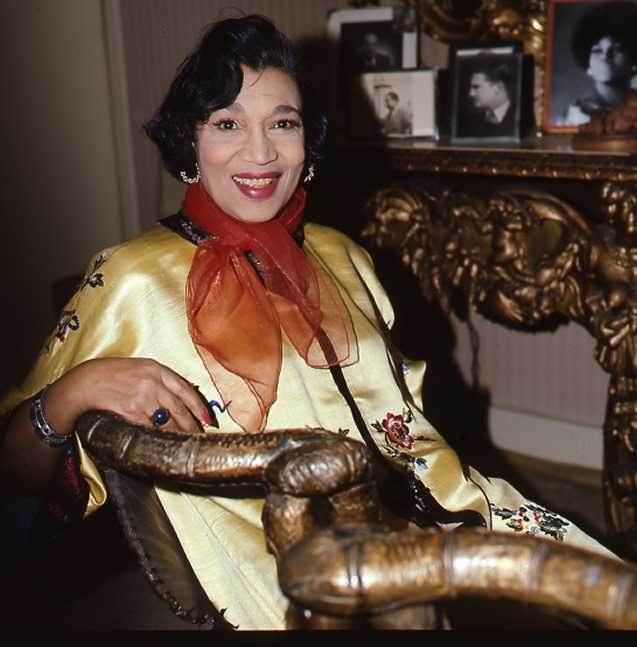
Elisabeth Welch
Elisabeth Margaret Welch (February 27, 1904 – July 15, 2003) was an American singer, actress, and entertainer, whose career spanned seven decades. Her best-known songs were "Stormy Weather", "Love for Sale" and "Far Away in Shanty Town". She was American-born, but was based in Britain for most of her career.
According to her birth certificate, Welch was born at 223 West 61st Street in New York City. Her father was chief gardener of an estate in Englewood, New Jersey. Her father was of Indigenous American and African American ancestry; her mother was of Scottish and Irish descent. Welch was brought up in a Baptist-Christian family, and first sang in a church choir.
She first intended to go from high school into social work, but instead chose to become a professional singer. She started her career in New York in 1922, but in 1929 she went to Europe – first to Paris and then to London.
After her first appearance in America in Liza in 1922, Welch was the initial singer of the Charleston in the show Runnin' Wild (1923). During the 1920s she appeared in African-American Broadway theatre shows, including The Chocolate Dandies (1924) and Blackbirds of 1928. She made relatively few recordings. Before moving to Europe she made only one record – "Doin' The New Lowdown", b/w 'Digga Digga Do", as vocalist for the Irving Mills-assembled Hotsy Totsy Gang (Brunswick 4014, 27 July 1928).
"Blackbirds of 1928" was taken to the Moulin Rouge in Paris in 1929 and it was here that Welch began her career as a cabaret singer including performances at the popular nightclub Chez Florence.
Welch was asked to return to New York, where she replaced a singer in The New Yorkers (1930–1931) and sang Cole Porter's controversial song "Love for Sale". The composer met her afterwards in Paris, and then invited her to perform his song "Solomon" in Nymph Errant in London in 1933. That year, before this show was available, Welch was given permission to perform in London in Dark Doings, in which she sang "Stormy Weather", newly written by Harold Arlen and Ted Koehler. She subsequently took the song as her signature tune.
Welch's show-stopping performance in Nymph Errant was seen by Ivor Novello, and in 1935, he gave her a part in his show Glamorous Night, in which she stood out again singing his blues song "Far Away in Shanty Town". In 1931, she had included in her cabaret act the new song "As Time Goes By", almost a dozen years before it achieved screen fame in Casablanca. In 1936 she recorded vocals on a number of tracks arranged by Benny Carter, and performed with his orchestra & swing quartet for the recording "When Lights Are Low".
In the mid 1930s, Welch appeared in films – usually as a singer, and as leading lady to Paul Robeson in Song of Freedom and the musical Big Fella – and she was one of the first artists to perform on British television, appearing on the BBC's new television service broadcast from Alexandra Palace.
Hub AI
Elisabeth Welch AI simulator
(@Elisabeth Welch_simulator)
Elisabeth Welch
Elisabeth Margaret Welch (February 27, 1904 – July 15, 2003) was an American singer, actress, and entertainer, whose career spanned seven decades. Her best-known songs were "Stormy Weather", "Love for Sale" and "Far Away in Shanty Town". She was American-born, but was based in Britain for most of her career.
According to her birth certificate, Welch was born at 223 West 61st Street in New York City. Her father was chief gardener of an estate in Englewood, New Jersey. Her father was of Indigenous American and African American ancestry; her mother was of Scottish and Irish descent. Welch was brought up in a Baptist-Christian family, and first sang in a church choir.
She first intended to go from high school into social work, but instead chose to become a professional singer. She started her career in New York in 1922, but in 1929 she went to Europe – first to Paris and then to London.
After her first appearance in America in Liza in 1922, Welch was the initial singer of the Charleston in the show Runnin' Wild (1923). During the 1920s she appeared in African-American Broadway theatre shows, including The Chocolate Dandies (1924) and Blackbirds of 1928. She made relatively few recordings. Before moving to Europe she made only one record – "Doin' The New Lowdown", b/w 'Digga Digga Do", as vocalist for the Irving Mills-assembled Hotsy Totsy Gang (Brunswick 4014, 27 July 1928).
"Blackbirds of 1928" was taken to the Moulin Rouge in Paris in 1929 and it was here that Welch began her career as a cabaret singer including performances at the popular nightclub Chez Florence.
Welch was asked to return to New York, where she replaced a singer in The New Yorkers (1930–1931) and sang Cole Porter's controversial song "Love for Sale". The composer met her afterwards in Paris, and then invited her to perform his song "Solomon" in Nymph Errant in London in 1933. That year, before this show was available, Welch was given permission to perform in London in Dark Doings, in which she sang "Stormy Weather", newly written by Harold Arlen and Ted Koehler. She subsequently took the song as her signature tune.
Welch's show-stopping performance in Nymph Errant was seen by Ivor Novello, and in 1935, he gave her a part in his show Glamorous Night, in which she stood out again singing his blues song "Far Away in Shanty Town". In 1931, she had included in her cabaret act the new song "As Time Goes By", almost a dozen years before it achieved screen fame in Casablanca. In 1936 she recorded vocals on a number of tracks arranged by Benny Carter, and performed with his orchestra & swing quartet for the recording "When Lights Are Low".
In the mid 1930s, Welch appeared in films – usually as a singer, and as leading lady to Paul Robeson in Song of Freedom and the musical Big Fella – and she was one of the first artists to perform on British television, appearing on the BBC's new television service broadcast from Alexandra Palace.