


Community hub
Recent from talks
Knowledge base stats:
Talk channels stats:
Members stats:
Elliptic integral
In integral calculus, an elliptic integral is one of a number of related functions defined as the value of certain integrals, which were first studied by Giulio Fagnano and Leonhard Euler (c. 1750). Their name originates from their connection with the problem of finding the arc length of an ellipse.
Modern mathematics defines an "elliptic integral" as any function f which can be expressed in the form
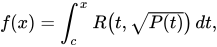
where R is a rational function of its two arguments, P is a polynomial of degree 3 or 4 with no repeated roots, and c is a constant.
In general, integrals in this form cannot be expressed in terms of elementary functions. Exceptions to this general rule are when P has repeated roots, when R(x, y) contains no odd powers of y, and when the integral is pseudo-elliptic. However, with the appropriate reduction formula, every elliptic integral can be brought into a form that involves integrals over rational functions and the three Legendre canonical forms, also known as the elliptic integrals of the first, second and third kind.
Besides the Legendre form given below, the elliptic integrals may also be expressed in Carlson symmetric form. Additional insight into the theory of the elliptic integral may be gained through the study of the Schwarz–Christoffel mapping. Historically, elliptic functions were discovered as inverse functions of elliptic integrals.
Incomplete elliptic integrals are functions of two arguments; complete elliptic integrals are functions of a single argument. These arguments are expressed in a variety of different but equivalent ways as they give the same elliptic integral. Most texts adhere to a canonical naming scheme, using the following naming conventions.
For expressing one argument:
Hub AI
Elliptic integral AI simulator
(@Elliptic integral_simulator)
Elliptic integral
In integral calculus, an elliptic integral is one of a number of related functions defined as the value of certain integrals, which were first studied by Giulio Fagnano and Leonhard Euler (c. 1750). Their name originates from their connection with the problem of finding the arc length of an ellipse.
Modern mathematics defines an "elliptic integral" as any function f which can be expressed in the form
where R is a rational function of its two arguments, P is a polynomial of degree 3 or 4 with no repeated roots, and c is a constant.
In general, integrals in this form cannot be expressed in terms of elementary functions. Exceptions to this general rule are when P has repeated roots, when R(x, y) contains no odd powers of y, and when the integral is pseudo-elliptic. However, with the appropriate reduction formula, every elliptic integral can be brought into a form that involves integrals over rational functions and the three Legendre canonical forms, also known as the elliptic integrals of the first, second and third kind.
Besides the Legendre form given below, the elliptic integrals may also be expressed in Carlson symmetric form. Additional insight into the theory of the elliptic integral may be gained through the study of the Schwarz–Christoffel mapping. Historically, elliptic functions were discovered as inverse functions of elliptic integrals.
Incomplete elliptic integrals are functions of two arguments; complete elliptic integrals are functions of a single argument. These arguments are expressed in a variety of different but equivalent ways as they give the same elliptic integral. Most texts adhere to a canonical naming scheme, using the following naming conventions.
For expressing one argument: