



Community hub
Recent from talks
Knowledge base stats:
Talk channels stats:
Members stats:
Embalming chemicals
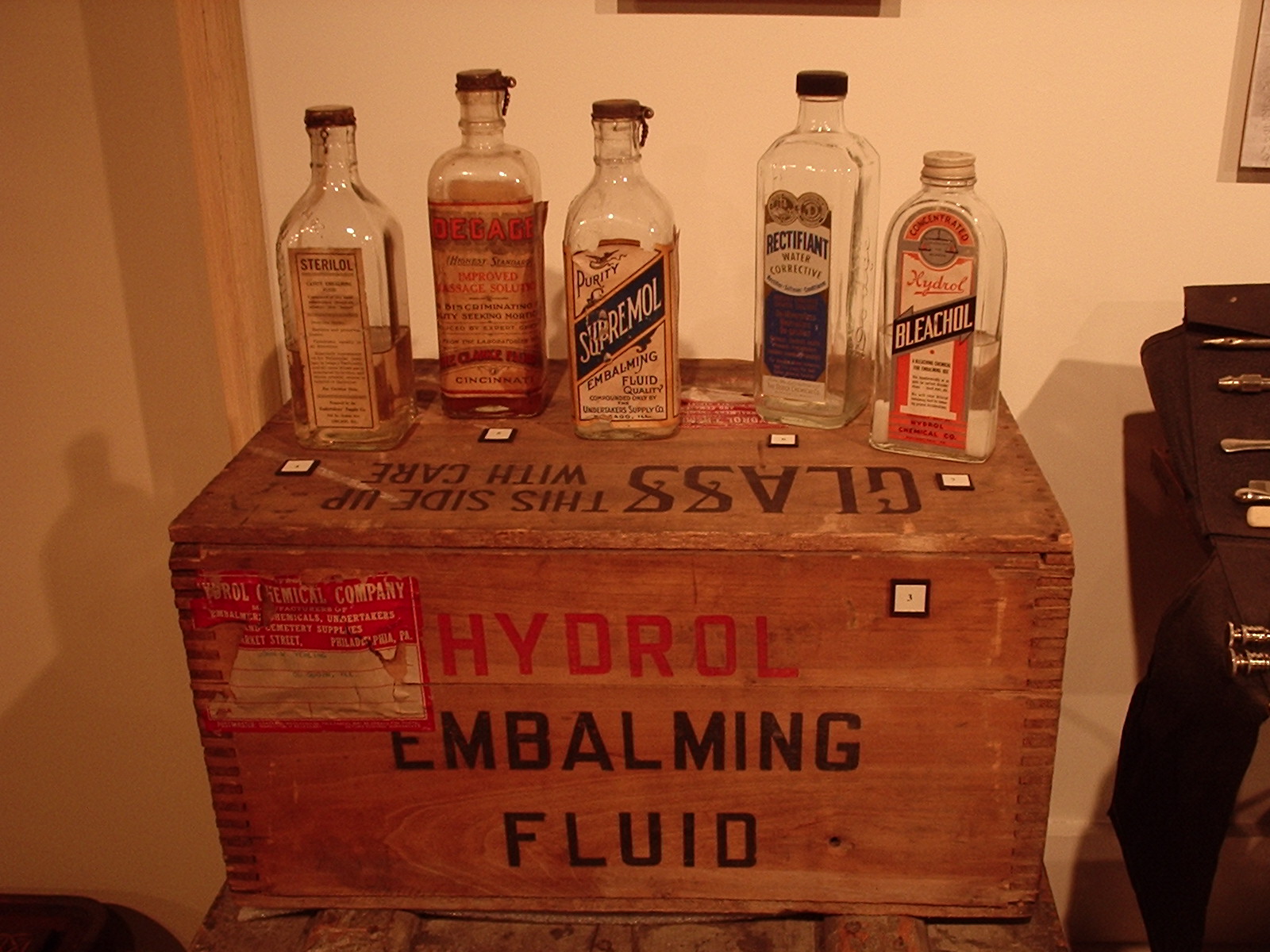
Embalming chemicals are a variety of preservatives, sanitising and disinfectant agents, and additives used in modern embalming to temporarily prevent decomposition and restore a natural appearance for viewing a body after death in funeral homes. A mixture of these chemicals is known as embalming fluid and is used to preserve bodies of deceased persons for both funeral purposes and in medical research in anatomical laboratories. The period for which a body is embalmed is dependent on time, expertise of the embalmer and factors regarding duration of stay and purpose.
Typically, embalming fluid contains a mixture of formaldehyde, glutaraldehyde, methanol, and other solvents. The formaldehyde content generally ranges from 5–37% and the methanol content may range from 9–56%.
In the United States alone, about 20 million liters (roughly 5.3 million gallons) of embalming fluid are used every year.
Embalming fluid acts to fix (denature) cellular proteins, meaning that they cannot act as a nutrient source for bacteria; embalming fluid also kills the bacteria themselves. Formaldehyde or glutaraldehyde fixes tissue or cells by irreversibly connecting a primary amine group in a protein molecule with a nearby nitrogen atom in a protein or DNA molecule through a -CH2- linkage called a Schiff base. The end result also creates the simulation, via color changes, of the appearance of blood flowing under the skin.
Modern embalming is not done with a single fixative. Instead, various chemicals are used to create a mixture, called an arterial solution, which is uniquely generated for the needs of each case. For example, a body needing to be repatriated overseas needs a higher index (percentage of diluted preservative chemical) than one simply for viewing (known in the United States and Canada as a funeral visitation) at a funeral home prior to burial for a cemetery, entombment for a mausoleum or cremation in a crematorium.
Embalming fluid is injected into the arterial system of the deceased's abdomen and a trocar is inserted into the body cavity. The organs in the chest cavity and the abdomen are then punctured and drained of gas and fluid contents. Many other bodily fluids may also be displaced and removed from the body using the arterial system and in the case of cavity treatment aspirated from the body and replaced with a specialty fluid known as cavity fluid.
It is important to distinguish between an arterial chemical (or fluid), which is generally taken to be the product in its original composition, and an arterial solution, which is a diluted mixture of chemicals and made to order for each body. Non-preservative chemicals in an arterial solution are generally called "accessory chemicals" or co/pre-injectants, depending on their time of utilization.
Potential ingredients in an arterial solution include:
Hub AI
Embalming chemicals AI simulator
(@Embalming chemicals_simulator)
Embalming chemicals
Embalming chemicals are a variety of preservatives, sanitising and disinfectant agents, and additives used in modern embalming to temporarily prevent decomposition and restore a natural appearance for viewing a body after death in funeral homes. A mixture of these chemicals is known as embalming fluid and is used to preserve bodies of deceased persons for both funeral purposes and in medical research in anatomical laboratories. The period for which a body is embalmed is dependent on time, expertise of the embalmer and factors regarding duration of stay and purpose.
Typically, embalming fluid contains a mixture of formaldehyde, glutaraldehyde, methanol, and other solvents. The formaldehyde content generally ranges from 5–37% and the methanol content may range from 9–56%.
In the United States alone, about 20 million liters (roughly 5.3 million gallons) of embalming fluid are used every year.
Embalming fluid acts to fix (denature) cellular proteins, meaning that they cannot act as a nutrient source for bacteria; embalming fluid also kills the bacteria themselves. Formaldehyde or glutaraldehyde fixes tissue or cells by irreversibly connecting a primary amine group in a protein molecule with a nearby nitrogen atom in a protein or DNA molecule through a -CH2- linkage called a Schiff base. The end result also creates the simulation, via color changes, of the appearance of blood flowing under the skin.
Modern embalming is not done with a single fixative. Instead, various chemicals are used to create a mixture, called an arterial solution, which is uniquely generated for the needs of each case. For example, a body needing to be repatriated overseas needs a higher index (percentage of diluted preservative chemical) than one simply for viewing (known in the United States and Canada as a funeral visitation) at a funeral home prior to burial for a cemetery, entombment for a mausoleum or cremation in a crematorium.
Embalming fluid is injected into the arterial system of the deceased's abdomen and a trocar is inserted into the body cavity. The organs in the chest cavity and the abdomen are then punctured and drained of gas and fluid contents. Many other bodily fluids may also be displaced and removed from the body using the arterial system and in the case of cavity treatment aspirated from the body and replaced with a specialty fluid known as cavity fluid.
It is important to distinguish between an arterial chemical (or fluid), which is generally taken to be the product in its original composition, and an arterial solution, which is a diluted mixture of chemicals and made to order for each body. Non-preservative chemicals in an arterial solution are generally called "accessory chemicals" or co/pre-injectants, depending on their time of utilization.
Potential ingredients in an arterial solution include: