



Community hub
Recent from talks
Knowledge base stats:
Talk channels stats:
Members stats:
Emergency brake (train)
On trains, the expression emergency brake has several meanings:
Industry vernacular for when the emergency brake is applied is go into emergency, as in phrases like "the train may fail to go into emergency" or "the ability of the train to go into emergency is paramount".
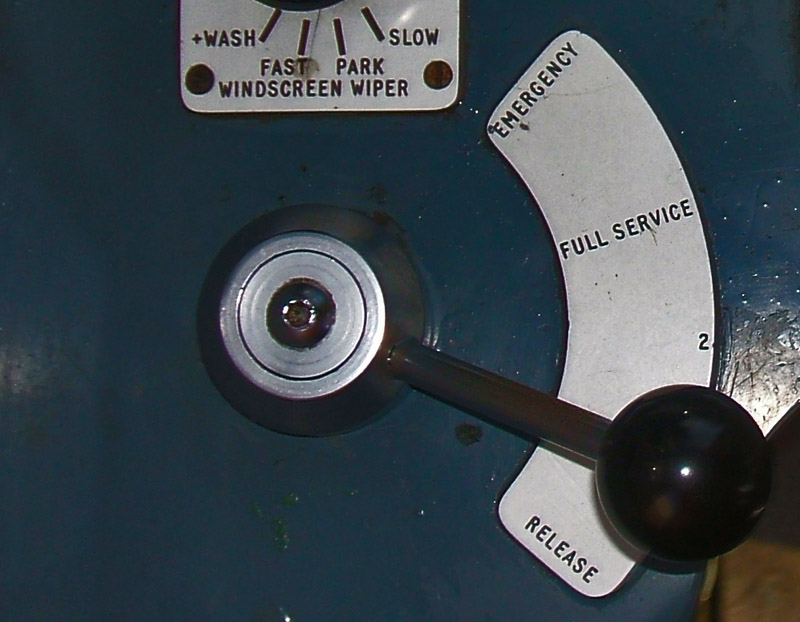
The emergency brake applies considerably more braking force than the standard full-service brake. The engine driver or motorman will only use the emergency brake as a last resort, since it may cause damage; even with modern wheel slide protection, a train may develop wheel-flats, and the rails themselves can suffer profile damage.
Putting the engine driver's brake handle into the emergency position may also:
Trains often have a facility in each car to enable passengers to apply the brakes in case of emergency. In many modern trains, the driver is able to prevent brake activation when a passenger operates the emergency alarm - an audible warning is sounded, and the driver is then able to talk to the person who activated the alarm on the intercom and see them on an internal CCTV. The driver can press an override button and hold the brakes off whilst they choose a safe place to stop the train. Because of possible serious problems, severe fines and/or imprisonment penalties are in place to deter people from activating the brake without good reason.
The alarm chain in a passenger coach is designed to create a break in the continuity of the brake pipes (whether vacuum or air brakes), immediately resulting in a loss of brake pressure (or vacuum) and thereby causing the train brakes to be applied. With vacuum brakes, a clappet valve is provided, which is released by the pulling of the alarm chain; with air brakes, there is a similar passenger emergency valve which can vent the brake pipe to the air.
In most locomotives (in addition to a warning lamp or buzzer being sounded) the master controller undergoes auto-regression, with the notches falling to zero rapidly as the locomotive's motive power is switched off. The guard may also notice the loss of brake pressure (although they may not know it is due to the pulling of the alarm chain) and is expected to apply their brakes immediately as well. It is possible for a driver to override the alarm-chain pull; this is sometimes done where it is known that miscreants resort to pulling the emergency chain solely to get the train to stop at a point convenient for themselves. However, such an act by the driver (or guard) of deliberately ignoring an indication of alarm-chain pulling is a serious matter.
In recent years locomotives have been fitted with emergency flashers on the roof of the cab, and these flashers are also activated when the brake pipe pressure is lost for any reason other than the driver's application of the brake valve. This alerts drivers of oncoming trains of the possibility of a derailed or parted rake which may foul other tracks (since brake pressure may have been lost for those reasons as well); at the locomotive, it is not possible to tell whether the loss of brake pressure is due to the pulling of the alarm chain.
Hub AI
Emergency brake (train) AI simulator
(@Emergency brake (train)_simulator)
Emergency brake (train)
On trains, the expression emergency brake has several meanings:
Industry vernacular for when the emergency brake is applied is go into emergency, as in phrases like "the train may fail to go into emergency" or "the ability of the train to go into emergency is paramount".
The emergency brake applies considerably more braking force than the standard full-service brake. The engine driver or motorman will only use the emergency brake as a last resort, since it may cause damage; even with modern wheel slide protection, a train may develop wheel-flats, and the rails themselves can suffer profile damage.
Putting the engine driver's brake handle into the emergency position may also:
Trains often have a facility in each car to enable passengers to apply the brakes in case of emergency. In many modern trains, the driver is able to prevent brake activation when a passenger operates the emergency alarm - an audible warning is sounded, and the driver is then able to talk to the person who activated the alarm on the intercom and see them on an internal CCTV. The driver can press an override button and hold the brakes off whilst they choose a safe place to stop the train. Because of possible serious problems, severe fines and/or imprisonment penalties are in place to deter people from activating the brake without good reason.
The alarm chain in a passenger coach is designed to create a break in the continuity of the brake pipes (whether vacuum or air brakes), immediately resulting in a loss of brake pressure (or vacuum) and thereby causing the train brakes to be applied. With vacuum brakes, a clappet valve is provided, which is released by the pulling of the alarm chain; with air brakes, there is a similar passenger emergency valve which can vent the brake pipe to the air.
In most locomotives (in addition to a warning lamp or buzzer being sounded) the master controller undergoes auto-regression, with the notches falling to zero rapidly as the locomotive's motive power is switched off. The guard may also notice the loss of brake pressure (although they may not know it is due to the pulling of the alarm chain) and is expected to apply their brakes immediately as well. It is possible for a driver to override the alarm-chain pull; this is sometimes done where it is known that miscreants resort to pulling the emergency chain solely to get the train to stop at a point convenient for themselves. However, such an act by the driver (or guard) of deliberately ignoring an indication of alarm-chain pulling is a serious matter.
In recent years locomotives have been fitted with emergency flashers on the roof of the cab, and these flashers are also activated when the brake pipe pressure is lost for any reason other than the driver's application of the brake valve. This alerts drivers of oncoming trains of the possibility of a derailed or parted rake which may foul other tracks (since brake pressure may have been lost for those reasons as well); at the locomotive, it is not possible to tell whether the loss of brake pressure is due to the pulling of the alarm chain.