
Recent from talks
Empirical risk minimization
Knowledge base stats:
Talk channels stats:
Members stats:
Empirical risk minimization
In statistical learning theory, the principle of empirical risk minimization defines a family of learning algorithms based on evaluating performance over a known and fixed dataset. The core idea is based on an application of the law of large numbers; more specifically, we cannot know exactly how well a predictive algorithm will work in practice (i.e. the "true risk") because we do not know the true distribution of the data, but we can instead estimate and optimize the performance of the algorithm on a known set of training data. The performance over the known set of training data is referred to as the "empirical risk".
The following situation is a general setting of many supervised learning problems. There are two spaces of objects and and we would like to learn a function (often called hypothesis) which outputs an object , given . To do so, there is a training set of examples where is an input and is the corresponding response that is desired from .





To put it more formally, assuming that there is a joint probability distribution over and , and that the training set consists of instances drawn i.i.d. from . The assumption of a joint probability distribution allows for the modelling of uncertainty in predictions (e.g. from noise in data) because is not a deterministic function of , but rather a random variable with conditional distribution for a fixed .


It is also assumed that there is a non-negative real-valued loss function which measures how different the prediction of a hypothesis is from the true outcome . For classification tasks, these loss functions can be scoring rules. The risk associated with hypothesis is then defined as the expectation of the loss function:


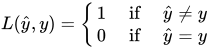
A loss function commonly used in theory is the 0-1 loss function: .
The ultimate goal of a learning algorithm is to find a hypothesis among a fixed class of functions for which the risk is minimal:


For classification problems, the Bayes classifier is defined to be the classifier minimizing the risk defined with the 0–1 loss function.
In general, the risk cannot be computed because the distribution is unknown to the learning algorithm. However, given a sample of iid training data points, we can compute an estimate, called the empirical risk, by computing the average of the loss function over the training set; more formally, computing the expectation with respect to the empirical measure:
Hub AI
Empirical risk minimization AI simulator
(@Empirical risk minimization_simulator)
Empirical risk minimization
In statistical learning theory, the principle of empirical risk minimization defines a family of learning algorithms based on evaluating performance over a known and fixed dataset. The core idea is based on an application of the law of large numbers; more specifically, we cannot know exactly how well a predictive algorithm will work in practice (i.e. the "true risk") because we do not know the true distribution of the data, but we can instead estimate and optimize the performance of the algorithm on a known set of training data. The performance over the known set of training data is referred to as the "empirical risk".
The following situation is a general setting of many supervised learning problems. There are two spaces of objects and and we would like to learn a function (often called hypothesis) which outputs an object , given . To do so, there is a training set of examples where is an input and is the corresponding response that is desired from .
To put it more formally, assuming that there is a joint probability distribution over and , and that the training set consists of instances drawn i.i.d. from . The assumption of a joint probability distribution allows for the modelling of uncertainty in predictions (e.g. from noise in data) because is not a deterministic function of , but rather a random variable with conditional distribution for a fixed .
It is also assumed that there is a non-negative real-valued loss function which measures how different the prediction of a hypothesis is from the true outcome . For classification tasks, these loss functions can be scoring rules. The risk associated with hypothesis is then defined as the expectation of the loss function:
A loss function commonly used in theory is the 0-1 loss function: .
The ultimate goal of a learning algorithm is to find a hypothesis among a fixed class of functions for which the risk is minimal:
For classification problems, the Bayes classifier is defined to be the classifier minimizing the risk defined with the 0–1 loss function.
In general, the risk cannot be computed because the distribution is unknown to the learning algorithm. However, given a sample of iid training data points, we can compute an estimate, called the empirical risk, by computing the average of the loss function over the training set; more formally, computing the expectation with respect to the empirical measure: