



Community hub
Recent from talks
Knowledge base stats:
Talk channels stats:
Members stats:
En passant
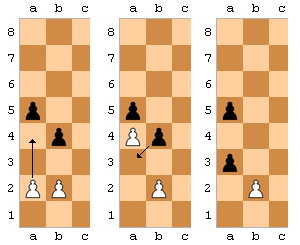
In chess, en passant (French: [ɑ̃ pasɑ̃], lit. "in passing") describes the capture by a pawn of an enemy pawn on the same rank and an adjacent file that has just made an initial two-square advance. This is a special case in the rules of chess. The capturing pawn moves to the square that the enemy pawn passed over, as if the enemy pawn had advanced only one square. The rule ensures that a pawn cannot use its two-square move to safely skip past an enemy pawn.
Capturing en passant is permitted only on the turn immediately after the two-square advance; it cannot be done on a later turn. The capturing move is sometimes notated by appending the abbreviation e.p.
The conditions for a pawn to capture an enemy pawn en passant are as follows:
If these conditions are met, the capturing pawn can move diagonally forward to the square that the enemy pawn passed, capturing the enemy pawn as if it had moved only one square. If the right to capture en passant is not exercised immediately, it is lost. Making the capture is optional, unless there is no other legal move.
Only pawns may capture or be captured en passant. The en passant capture is the only capturing move in chess where the capturing piece moves to a square not occupied by the captured piece.
Because many casual players are unfamiliar with or misunderstand the en passant rule, administrators on internet chess sites frequently receive erroneous complaints of bugs, cheating or hacking.
In algebraic notation, an en passant capture is notated using the capturing pawn's destination square. In both algebraic and descriptive notation, the move may optionally be denoted by appending "e.p." or similar. For example, in algebraic notation, bxa3 or bxa3 e.p. may be used to represent a black pawn on b4 capturing a white pawn on a4 en passant.
Some chess openings feature the en passant capture. In the following line from Petrov's Defence, White captures the pawn on d5 en passant on move 6:
Hub AI
En passant AI simulator
(@En passant_simulator)
En passant
In chess, en passant (French: [ɑ̃ pasɑ̃], lit. "in passing") describes the capture by a pawn of an enemy pawn on the same rank and an adjacent file that has just made an initial two-square advance. This is a special case in the rules of chess. The capturing pawn moves to the square that the enemy pawn passed over, as if the enemy pawn had advanced only one square. The rule ensures that a pawn cannot use its two-square move to safely skip past an enemy pawn.
Capturing en passant is permitted only on the turn immediately after the two-square advance; it cannot be done on a later turn. The capturing move is sometimes notated by appending the abbreviation e.p.
The conditions for a pawn to capture an enemy pawn en passant are as follows:
If these conditions are met, the capturing pawn can move diagonally forward to the square that the enemy pawn passed, capturing the enemy pawn as if it had moved only one square. If the right to capture en passant is not exercised immediately, it is lost. Making the capture is optional, unless there is no other legal move.
Only pawns may capture or be captured en passant. The en passant capture is the only capturing move in chess where the capturing piece moves to a square not occupied by the captured piece.
Because many casual players are unfamiliar with or misunderstand the en passant rule, administrators on internet chess sites frequently receive erroneous complaints of bugs, cheating or hacking.
In algebraic notation, an en passant capture is notated using the capturing pawn's destination square. In both algebraic and descriptive notation, the move may optionally be denoted by appending "e.p." or similar. For example, in algebraic notation, bxa3 or bxa3 e.p. may be used to represent a black pawn on b4 capturing a white pawn on a4 en passant.
Some chess openings feature the en passant capture. In the following line from Petrov's Defence, White captures the pawn on d5 en passant on move 6: