
Recent from talks
Enggano language
Knowledge base stats:
Talk channels stats:
Members stats:
Enggano language
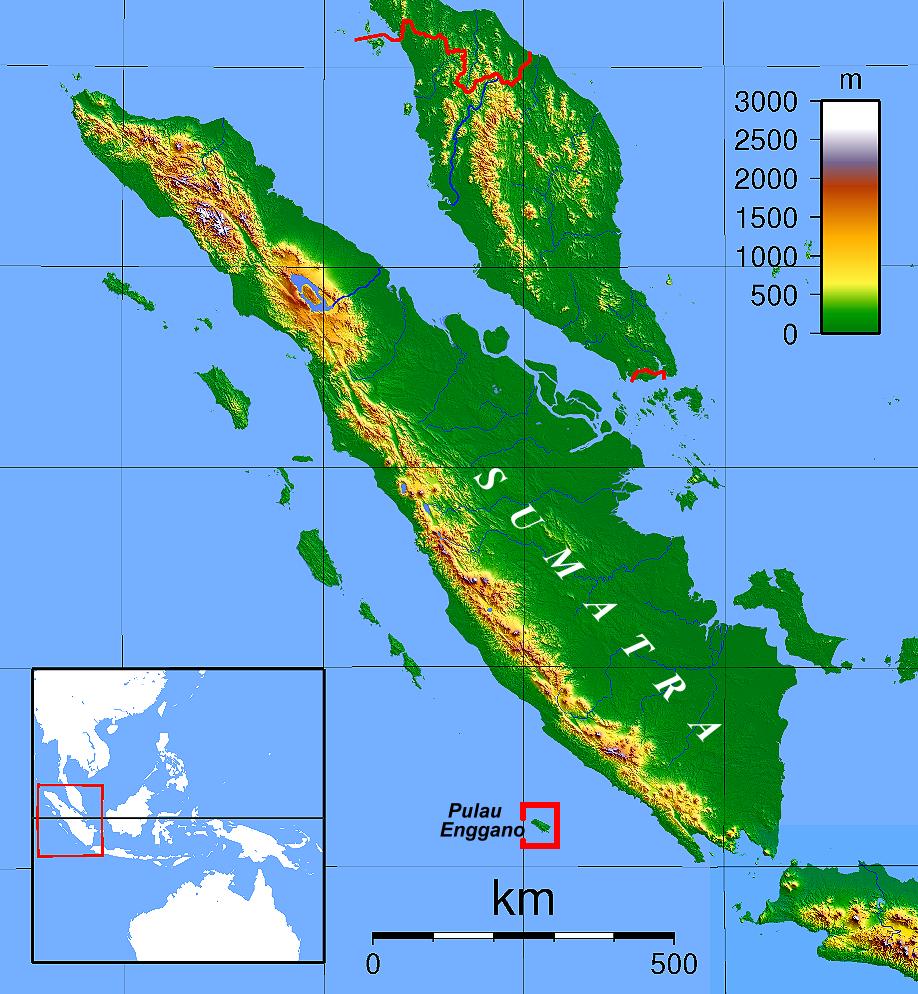
The Enggano language, or Engganese, is an Austronesian language spoken on Enggano Island off the southwestern coast of Sumatra, Indonesia.
Enggano is notable among the Austronesian languages of western Insular Southeast Asia because of many unusual sound changes, and a low number of words shared with other Austronesian languages. There is however general consensus among Austronesianists that Enggano belongs to the Austronesian language family. Failure to fully identify the inherited Austronesian elements in the basic lexicon and bound morphology of Enggano resulted in occasional proposals that Enggano might be a language isolate which had adopted Austronesian loanwords.
When first contacted by Europeans, the Enggano people had more cultural commonalities with indigenous peoples of the Nicobar Islands than with those of Austronesian Sumatra. For instance, beehive houses were typical of both Enggano Island and the Nicobar Islands. However, there are no apparent linguistic connections with Nicobarese or other Austroasiatic languages.
The classification of Enggano was controversial, ranging from proposals that negate its inclusion in the Austronesian family all the way to classifications that place Enggano in the Northwest Sumatra–Barrier Islands subgroup together with other Austronesian languages of the area (e.g. Nias).
Based on the low number of apparent Austronesian cognates, Capell (1982) proposed that Enggano is a language isolate rather than Austronesian as previously assumed. A similar view was echoed by Blench (2014) based on an inspection of Enggano's lexicon.
Edwards (2015) demonstrates that pronouns, numerals and many affixes in Enggano can be directly derived from Proto-Malayo-Polynesian. Based on this evidence, together with regular sound changes from Proto-Malayo-Polynesian to Enggano, Edwards shows that Enggano clearly belongs to the Malayo-Polynesian branch of the Austronesian languages, thus putting Capell's and Blench's proposals that Enggano is a non-Austronesian language to rest. Within Malayo-Polynesian, he considers Enggano to be a primary branch. While a large portion of its lexicon obviously cannot be derived from Proto-Malayo-Polynesian, it remains unclear whether this represents a non-Austronesian substratum from an unknown source language, or the result of internally-driven lexical replacement. He notes that Enggano possesses many aberrant phonological features (such as a small phonological inventory) and a low lexical retention rate, which is more typical of Austronesian languages spoken in eastern Indonesia and Melanesia than rather than those of western Indonesia. Enggano's lexical retention rate (i.e., percentage of lexical items that are cognate with reconstructed Proto-Austronesian forms) is only 21% (46 out of 217 words), while the lexical retention rate for Malay is 59% (132.5 out of 223 words). Some non-Austronesian languages in Southeast Asia, such as Nancowry, Semelai, and Abui also have low lexical retention rates.
Enggano has historically undergone several sound changes which are more far-reaching than changes observed in other Malayo-Polynesian languages of the area. These include for example (PMP = Proto-Malayo-Polynesian):
As for the last shift, Enggano is the only western Austronesian language in which it is found, while the same change occurred independently several times in Oceanic after *k shifted to glottal stop.
Hub AI
Enggano language AI simulator
(@Enggano language_simulator)
Enggano language
The Enggano language, or Engganese, is an Austronesian language spoken on Enggano Island off the southwestern coast of Sumatra, Indonesia.
Enggano is notable among the Austronesian languages of western Insular Southeast Asia because of many unusual sound changes, and a low number of words shared with other Austronesian languages. There is however general consensus among Austronesianists that Enggano belongs to the Austronesian language family. Failure to fully identify the inherited Austronesian elements in the basic lexicon and bound morphology of Enggano resulted in occasional proposals that Enggano might be a language isolate which had adopted Austronesian loanwords.
When first contacted by Europeans, the Enggano people had more cultural commonalities with indigenous peoples of the Nicobar Islands than with those of Austronesian Sumatra. For instance, beehive houses were typical of both Enggano Island and the Nicobar Islands. However, there are no apparent linguistic connections with Nicobarese or other Austroasiatic languages.
The classification of Enggano was controversial, ranging from proposals that negate its inclusion in the Austronesian family all the way to classifications that place Enggano in the Northwest Sumatra–Barrier Islands subgroup together with other Austronesian languages of the area (e.g. Nias).
Based on the low number of apparent Austronesian cognates, Capell (1982) proposed that Enggano is a language isolate rather than Austronesian as previously assumed. A similar view was echoed by Blench (2014) based on an inspection of Enggano's lexicon.
Edwards (2015) demonstrates that pronouns, numerals and many affixes in Enggano can be directly derived from Proto-Malayo-Polynesian. Based on this evidence, together with regular sound changes from Proto-Malayo-Polynesian to Enggano, Edwards shows that Enggano clearly belongs to the Malayo-Polynesian branch of the Austronesian languages, thus putting Capell's and Blench's proposals that Enggano is a non-Austronesian language to rest. Within Malayo-Polynesian, he considers Enggano to be a primary branch. While a large portion of its lexicon obviously cannot be derived from Proto-Malayo-Polynesian, it remains unclear whether this represents a non-Austronesian substratum from an unknown source language, or the result of internally-driven lexical replacement. He notes that Enggano possesses many aberrant phonological features (such as a small phonological inventory) and a low lexical retention rate, which is more typical of Austronesian languages spoken in eastern Indonesia and Melanesia than rather than those of western Indonesia. Enggano's lexical retention rate (i.e., percentage of lexical items that are cognate with reconstructed Proto-Austronesian forms) is only 21% (46 out of 217 words), while the lexical retention rate for Malay is 59% (132.5 out of 223 words). Some non-Austronesian languages in Southeast Asia, such as Nancowry, Semelai, and Abui also have low lexical retention rates.
Enggano has historically undergone several sound changes which are more far-reaching than changes observed in other Malayo-Polynesian languages of the area. These include for example (PMP = Proto-Malayo-Polynesian):
As for the last shift, Enggano is the only western Austronesian language in which it is found, while the same change occurred independently several times in Oceanic after *k shifted to glottal stop.
Recent media