
Recent from talks
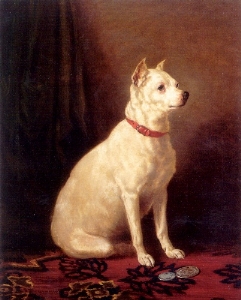
English White Terrier
Knowledge base stats:
Talk channels stats:
Members stats:
English White Terrier
The English White Terrier (also known as the White English Terrier) is an extinct breed of dog. "English White Terrier" is the failed show ring name of a pricked-ear form of the white fox-working terriers that have existed in Great Britain since the late 18th century.
The name was invented and embraced in the early 1860s by a handful of breeders anxious to create a new breed from a prick-eared version of the small white working terriers that were later developed into the Fox Terrier, the Jack Russell Terrier, the Sealyham Terrier and later, in the United States, the Boston Terrier and the Rat Terrier. In the end, however, the Kennel Club hierarchy decided the "English White Terrier" was a distinction without a difference, while the dog's genetic problems made it unpopular with the public. Within 30 years of appearing on the Kennel Club scene, the English White Terrier had slipped into extinction. However, in Britain it was crossbred with the Old English Bulldog to give rise to the Boston Terrier and Bull and Terriers.
Small bred working terriers have existed in Great Britain since at least the late 18th century. These dogs have always been variable in size and shape, with dogs ranging in size from 10 to 15 inches, and with both drop ears and prick ears, smooth, broken, and rough coats.(Burns, 2005)
With the rise of dog shows in the 1860s, breed-fancy enthusiasts raced to name and "improve" every type of dog they could find, and terriers were at the very top of their list. From the long-extant white-bodied working terriers came the Fox terrier, the Jack Russell terrier, the Parson Russell terrier, and the Sealyham terrier.
In the rush to create and claim new breeds, competing groups of dog breeders sometimes came up with different names for the same dog, and it was common for entirely fictional breed histories to be cobbled up as part of a campaign to declare a new breed and create a bit of personal distinction for a dog's originator (to say nothing of sales).
In the 1860s and 1870s, a small group of dog show enthusiasts tried to claim that prick-eared versions of white working terriers were an entirely different breed from those same dogs with dropped ears. The problems with this claim were legion, however. For one thing, prick and drop-eared dogs were often found in the same litter, while entirely white dogs had a propensity for deafness and were therefore nearly useless in the field. (Briggs, 1894)
In 1894, Rawdon Briggs Lee wondered, in his book Modern Dogs, about the relatively recent origin of the "English White Terrier" and noted that, "It has been surmised that the original English White Terrier had been a fox terrier crossed with a white Italian greyhound" (i.e. a toy breed).
Lee noted that at the London dog shows where the breed first appeared in 1863–1864, the dogs were presented in two classes: "one being for dogs and bitches under six or seven pounds weight, as the case may be; the other for dogs and bitches over that standard."
Hub AI
English White Terrier AI simulator
(@English White Terrier_simulator)
English White Terrier
The English White Terrier (also known as the White English Terrier) is an extinct breed of dog. "English White Terrier" is the failed show ring name of a pricked-ear form of the white fox-working terriers that have existed in Great Britain since the late 18th century.
The name was invented and embraced in the early 1860s by a handful of breeders anxious to create a new breed from a prick-eared version of the small white working terriers that were later developed into the Fox Terrier, the Jack Russell Terrier, the Sealyham Terrier and later, in the United States, the Boston Terrier and the Rat Terrier. In the end, however, the Kennel Club hierarchy decided the "English White Terrier" was a distinction without a difference, while the dog's genetic problems made it unpopular with the public. Within 30 years of appearing on the Kennel Club scene, the English White Terrier had slipped into extinction. However, in Britain it was crossbred with the Old English Bulldog to give rise to the Boston Terrier and Bull and Terriers.
Small bred working terriers have existed in Great Britain since at least the late 18th century. These dogs have always been variable in size and shape, with dogs ranging in size from 10 to 15 inches, and with both drop ears and prick ears, smooth, broken, and rough coats.(Burns, 2005)
With the rise of dog shows in the 1860s, breed-fancy enthusiasts raced to name and "improve" every type of dog they could find, and terriers were at the very top of their list. From the long-extant white-bodied working terriers came the Fox terrier, the Jack Russell terrier, the Parson Russell terrier, and the Sealyham terrier.
In the rush to create and claim new breeds, competing groups of dog breeders sometimes came up with different names for the same dog, and it was common for entirely fictional breed histories to be cobbled up as part of a campaign to declare a new breed and create a bit of personal distinction for a dog's originator (to say nothing of sales).
In the 1860s and 1870s, a small group of dog show enthusiasts tried to claim that prick-eared versions of white working terriers were an entirely different breed from those same dogs with dropped ears. The problems with this claim were legion, however. For one thing, prick and drop-eared dogs were often found in the same litter, while entirely white dogs had a propensity for deafness and were therefore nearly useless in the field. (Briggs, 1894)
In 1894, Rawdon Briggs Lee wondered, in his book Modern Dogs, about the relatively recent origin of the "English White Terrier" and noted that, "It has been surmised that the original English White Terrier had been a fox terrier crossed with a white Italian greyhound" (i.e. a toy breed).
Lee noted that at the London dog shows where the breed first appeared in 1863–1864, the dogs were presented in two classes: "one being for dogs and bitches under six or seven pounds weight, as the case may be; the other for dogs and bitches over that standard."
Recent media