
Recent from talks
Ensemble forecasting
Knowledge base stats:
Talk channels stats:
Members stats:
Ensemble forecasting
Ensemble forecasting is a method used in or within numerical weather prediction. Instead of making a single forecast of the most likely weather, a set (or ensemble) of forecasts is produced. This set of forecasts aims to give an indication of the range of possible future states of the atmosphere.
Ensemble forecasting is a form of Monte Carlo analysis. The multiple simulations are conducted to account for the two usual sources of uncertainty in forecast models: (1) the errors introduced by the use of imperfect initial conditions, amplified by the chaotic nature of the equations of the atmosphere, which is often referred to as sensitive dependence on initial conditions; and (2) errors introduced because of imperfections in the model formulation, such as the approximate mathematical methods to solve the equations. Ideally, the verified future atmospheric state should fall within the predicted ensemble spread, and the amount of spread should be related to the uncertainty (error) of the forecast.
In general, this approach can be used to make probabilistic forecasts of any dynamical system, and not just for weather prediction.
Today ensemble predictions are commonly made at most of the major operational weather prediction facilities worldwide, including:
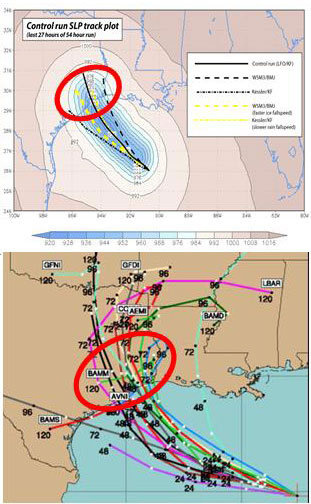
Experimental ensemble forecasts are made at a number of universities, such as the University of Washington, and ensemble forecasts in the US are also generated by the US Navy and Air Force. There are various ways of viewing the data such as spaghetti plots, ensemble means or Postage Stamps where a number of different results from the models run can be compared.
As proposed by Edward Lorenz in 1963, it is impossible for long-range forecasts—those made more than two weeks in advance—to predict the state of the atmosphere with any degree of skill owing to the chaotic nature of the fluid dynamics equations involved. Furthermore, existing observation networks have limited spatial and temporal resolution (for example, over large bodies of water such as the Pacific Ocean), which introduces uncertainty into the true initial state of the atmosphere. While a set of equations, known as the Liouville equations, exists to determine the initial uncertainty in the model initialization, the equations are too complex to run in real-time, even with the use of supercomputers. The practical importance of ensemble forecasts derives from the fact that in a chaotic and hence nonlinear system, the rate of growth of forecast error is dependent on starting conditions. An ensemble forecast therefore provides a prior estimate of state-dependent predictability, i.e. an estimate of the types of weather that might occur, given inevitable uncertainties in the forecast initial conditions and in the accuracy of the computational representation of the equations. These uncertainties limit forecast model accuracy to about six days into the future. The first operational ensemble forecasts were produced for sub-seasonal timescales in 1985. However, it was realised that the philosophy underpinning such forecasts was also relevant on shorter timescales – timescales where predictions had previously been made by purely deterministic means.
Edward Epstein recognized in 1969 that the atmosphere could not be completely described with a single forecast run due to inherent uncertainty, and proposed a stochastic dynamic model that produced means and variances for the state of the atmosphere. Although these Monte Carlo simulations showed skill, in 1974 Cecil Leith revealed that they produced adequate forecasts only when the ensemble probability distribution was a representative sample of the probability distribution in the atmosphere. It was not until 1992 that ensemble forecasts began being prepared by the European Centre for Medium-Range Weather Forecasts (ECMWF) and the National Centers for Environmental Prediction (NCEP).
There are two main sources of uncertainty that must be accounted for when making an ensemble weather forecast: initial condition uncertainty and model uncertainty.
Hub AI
Ensemble forecasting AI simulator
(@Ensemble forecasting_simulator)
Ensemble forecasting
Ensemble forecasting is a method used in or within numerical weather prediction. Instead of making a single forecast of the most likely weather, a set (or ensemble) of forecasts is produced. This set of forecasts aims to give an indication of the range of possible future states of the atmosphere.
Ensemble forecasting is a form of Monte Carlo analysis. The multiple simulations are conducted to account for the two usual sources of uncertainty in forecast models: (1) the errors introduced by the use of imperfect initial conditions, amplified by the chaotic nature of the equations of the atmosphere, which is often referred to as sensitive dependence on initial conditions; and (2) errors introduced because of imperfections in the model formulation, such as the approximate mathematical methods to solve the equations. Ideally, the verified future atmospheric state should fall within the predicted ensemble spread, and the amount of spread should be related to the uncertainty (error) of the forecast.
In general, this approach can be used to make probabilistic forecasts of any dynamical system, and not just for weather prediction.
Today ensemble predictions are commonly made at most of the major operational weather prediction facilities worldwide, including:
Experimental ensemble forecasts are made at a number of universities, such as the University of Washington, and ensemble forecasts in the US are also generated by the US Navy and Air Force. There are various ways of viewing the data such as spaghetti plots, ensemble means or Postage Stamps where a number of different results from the models run can be compared.
As proposed by Edward Lorenz in 1963, it is impossible for long-range forecasts—those made more than two weeks in advance—to predict the state of the atmosphere with any degree of skill owing to the chaotic nature of the fluid dynamics equations involved. Furthermore, existing observation networks have limited spatial and temporal resolution (for example, over large bodies of water such as the Pacific Ocean), which introduces uncertainty into the true initial state of the atmosphere. While a set of equations, known as the Liouville equations, exists to determine the initial uncertainty in the model initialization, the equations are too complex to run in real-time, even with the use of supercomputers. The practical importance of ensemble forecasts derives from the fact that in a chaotic and hence nonlinear system, the rate of growth of forecast error is dependent on starting conditions. An ensemble forecast therefore provides a prior estimate of state-dependent predictability, i.e. an estimate of the types of weather that might occur, given inevitable uncertainties in the forecast initial conditions and in the accuracy of the computational representation of the equations. These uncertainties limit forecast model accuracy to about six days into the future. The first operational ensemble forecasts were produced for sub-seasonal timescales in 1985. However, it was realised that the philosophy underpinning such forecasts was also relevant on shorter timescales – timescales where predictions had previously been made by purely deterministic means.
Edward Epstein recognized in 1969 that the atmosphere could not be completely described with a single forecast run due to inherent uncertainty, and proposed a stochastic dynamic model that produced means and variances for the state of the atmosphere. Although these Monte Carlo simulations showed skill, in 1974 Cecil Leith revealed that they produced adequate forecasts only when the ensemble probability distribution was a representative sample of the probability distribution in the atmosphere. It was not until 1992 that ensemble forecasts began being prepared by the European Centre for Medium-Range Weather Forecasts (ECMWF) and the National Centers for Environmental Prediction (NCEP).
There are two main sources of uncertainty that must be accounted for when making an ensemble weather forecast: initial condition uncertainty and model uncertainty.
Recent media