Hubbry Logo
Entropy of activationEntropy of activationMain
Open search
Entropy of activation
Community hub
Entropy of activation
logo
7 pages, 0 posts
0 subscribers
Be the first to start a discussion here.
Entropy of activation
from Wikipedia

In chemical kinetics, the entropy of activation of a reaction is one of the two parameters (along with the enthalpy of activation) that are typically obtained from the temperature dependence of a reaction rate constant, when these data are analyzed using the Eyring equation of the transition state theory. The standard entropy of activation is symbolized ΔS and equals the change in entropy when the reactants change from their initial state to the activated complex or transition state (Δ = change, S = entropy, = activation).

Importance

[edit]

Entropy of activation determines the preexponential factor A of the Arrhenius equation for temperature dependence of reaction rates. The relationship depends on the molecularity of the reaction:

  • for reactions in solution and unimolecular gas reactions
    A = (ekBT/h) exp(ΔS/R),
  • while for bimolecular gas reactions
    A = (e2kBT/h) (RT/p) exp(ΔS/R).

In these equations e is the base of natural logarithms, h is the Planck constant, kB is the Boltzmann constant and T the absolute temperature. R is the ideal gas constant. The factor is needed because of the pressure dependence of the reaction rate. R = 8.3145×10⁻² (bar·L)/(mol·K).[1]

The value of ΔS provides clues about the molecularity of the rate determining step in a reaction, i.e. the number of molecules that enter this step.[2] Positive values suggest that entropy increases upon achieving the transition state, which often indicates a dissociative mechanism in which the activated complex is loosely bound and about to dissociate. Negative values for ΔS indicate that entropy decreases on forming the transition state, which often indicates an associative mechanism in which two reaction partners form a single activated complex.[3]

Derivation

[edit]

It is possible to obtain entropy of activation using Eyring equation. This equation is of the form where:
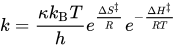
This equation can be turned into the form The plot of versus gives a straight line with slope from which the enthalpy of activation can be derived and with intercept from which the entropy of activation is derived.

References

[edit]
Revisions and contributorsEdit on WikipediaRead on Wikipedia
from Grokipedia
The entropy of activation, denoted as ΔS‡, is a thermodynamic quantity in transition state theory that describes the change in entropy when reactants form the activated complex, or transition state, during a chemical reaction. It reflects the difference in molecular disorder or configurational freedom between the reactants and the transition state, influencing the overall entropy contribution to the Gibbs free energy of activation (ΔG‡ = ΔH‡ - T ΔS‡), where ΔH‡ is the enthalpy of activation and T is the absolute temperature. In the Eyring equation, which relates the reaction rate constant k to these parameters as k = (kB T / h) e-ΔG‡ / RT (with kB as Boltzmann's constant, h as Planck's constant, and R as the gas constant), ΔS‡ helps predict how entropy changes affect reaction kinetics. This parameter is experimentally determined from the temperature dependence of the rate constant using the integrated form of the Eyring equation, often plotted as ln(k / T) versus 1/T, where the slope yields ΔH‡ / R and the intercept relates to ΔS‡ / R. Values of ΔS‡ typically range from negative (indicating a more ordered transition state, common in associative or bimolecular reactions due to loss of translational and rotational entropy) to positive (suggesting a looser transition state, as in dissociative or unimolecular processes). For instance, in SN2 reactions, ΔS‡ is often around -100 to -200 J K-1 mol-1, reflecting the constraints of the approaching nucleophile and leaving group, while in E1 eliminations, it can be near zero or positive due to increased vibrational freedom in the transition state. The magnitude and sign of ΔS‡ provide mechanistic insights, such as distinguishing between concerted and stepwise pathways, and are crucial in fields like organic synthesis, enzymology, and polymerization kinetics.

Fundamentals

Definition

The entropy of activation, denoted as ΔS\Delta S^\ddagger, is defined as the change in entropy associated with the formation of the transition state from the reactants in a chemical reaction. This parameter quantifies the difference in disorder or organizational freedom between the initial reactants and the high-energy transition state configuration. A positive ΔS\Delta S^\ddagger indicates an increase in disorder during activation, often due to greater vibrational or rotational freedom in the transition state, while a negative value suggests a loss of freedom, such as increased restriction in molecular motions. Expressed in units of J mol1^{-1} K1^{-1}, ΔS\Delta S^\ddagger plays a key role in determining the free energy of activation via the Gibbs equation: ΔG=ΔHTΔS\Delta G^\ddagger = \Delta H^\ddagger - T \Delta S^\ddagger where ΔH\Delta H^\ddagger is the enthalpy of activation and TT is the absolute temperature. This relationship highlights how entropic contributions influence the overall energy barrier for the reaction. The concept of entropy of activation was introduced by Henry Eyring in 1935 as part of the development of absolute reaction rate theory, providing a thermodynamic basis for understanding reaction rates beyond simple Arrhenius parameters.

Thermodynamic Context

The entropy of activation (ΔS\Delta S^\ddagger) provides a key thermodynamic perspective on the energy landscape of chemical reactions by contributing to the Gibbs free energy of activation (ΔG\Delta G^\ddagger), which determines the height of the activation barrier. A positive ΔS\Delta S^\ddagger decreases ΔG\Delta G^\ddagger, lowering the barrier and promoting faster rates, while a negative ΔS\Delta S^\ddagger increases it, imposing an entropic penalty that hinders the reaction. Unlike the standard entropy change (ΔS\Delta S^\circ) in equilibrium thermodynamics, which measures the entropy difference between stable reactants and products to assess overall reaction spontaneity via ΔG=ΔHTΔS\Delta G^\circ = \Delta H^\circ - T \Delta S^\circ, ΔS\Delta S^\ddagger captures the entropy shift to the transient transition state, emphasizing kinetic barriers over thermodynamic favorability. Whereas ΔS\Delta S^\circ often increases for reactions that generate more disorder (e.g., producing gases from solids), ΔS\Delta S^\ddagger typically involves partial ordering of reactants into a constrained activated complex, distinguishing activated states from equilibrium ones. Molecular structure profoundly affects ΔS\Delta S^\ddagger, particularly through changes in degrees of freedom during transition state formation. In bimolecular reactions, such as association processes, separate molecules must approach and lose independent translational and rotational motions, resulting in negative ΔS\Delta S^\ddagger values that reflect reduced configurational freedom and increased order. This structural constraint is less pronounced in unimolecular reactions, where ΔS\Delta S^\ddagger may be closer to zero or positive if the transition state allows greater vibrational or internal freedom. These values can vary significantly depending on the reaction phase and solvent; for example, gas-phase bimolecular reactions often exhibit more negative ΔS\Delta S^\ddagger due to complete loss of independent motions, while solvation in solution may moderate this effect. Observed ΔS\Delta S^\ddagger values typically range from -200 to +50 J mol1^{-1} K1^{-1} across various reactions, with negative values (often -50 to -150 J mol1^{-1} K1^{-1}) common in bimolecular associations due to freedom losses, while positive values up to around +35 J mol1^{-1} K1^{-1} appear in dissociative or loose transition state scenarios. These ranges highlight entropy's role in scaling activation barriers, with more negative ΔS\Delta S^\ddagger values amplifying the TΔS-T\Delta S^\ddagger term at higher temperatures.

Theoretical Derivation

Transition State Theory Overview

Transition state theory (TST), also known as activated complex theory, provides a foundational framework for understanding chemical reaction rates by focusing on the transient high-energy configuration, or transition state, that species must reach to convert reactants into products. Developed in the 1930s, TST evolved from the empirical Arrhenius equation, which describes the temperature dependence of reaction rates, by offering a mechanistic interpretation through statistical mechanics. Key contributions came from Henry Eyring, who formulated the theory of absolute reaction rates, and independently from Meredith Gwynne Evans and Michael Polanyi, who applied potential energy surface concepts to bimolecular reactions. At its core, TST assumes a quasi-equilibrium exists between the reactants and the activated complex at the transition state, allowing the concentration of the complex to be expressed in terms of an equilibrium constant. The transition state is conceptualized as a saddle point on the potential energy surface, where the system has one unstable degree of freedom along the reaction coordinate and stable vibrations in the other directions. A critical assumption is that the transmission coefficient is approximately 1 for simple cases, meaning nearly all activated complexes crossing the saddle point proceed to products without recrossing. This quasi-equilibrium approximation treats the formation of the transition state complex as a reversible process in equilibrium with reactants, enabling the use of thermodynamic parameters like the entropy of activation, ΔS‡, to quantify changes in disorder en route to the transition state. TST's assumptions hold best for gas-phase reactions under conditions where thermal equilibrium is maintained and classical mechanics apply. However, limitations arise in scenarios involving quantum effects, such as tunneling, which can enhance rates beyond classical predictions and require corrective factors. Additionally, for diffusion-controlled processes, particularly in solution, TST overestimates rates by neglecting frictional barriers, necessitating extensions like Kramers' theory to account for solvent dynamics. These constraints highlight TST's primary applicability to elementary gas-phase reactions while underscoring the need for refinements in more complex environments.

Mathematical Derivation

Within transition state theory, the entropy of activation, ΔS\Delta S^\ddagger, arises from the statistical mechanical treatment of the equilibrium between reactants and the transition state, expressed through molecular partition functions. For a general reaction involving reactants with partition function QrQ_r (product of individual reactant partition functions, adjusted for standard states) and the transition state with partition function QQ^\ddagger, the equilibrium constant KK^\ddagger for formation of the transition state is given by K=QQrexp(ΔE0RT),K^\ddagger = \frac{Q^\ddagger}{Q_r} \exp\left(-\frac{\Delta E_0^\ddagger}{RT}\right), where ΔE0\Delta E_0^\ddagger is the difference in zero-point energies between the transition state and reactants, RR is the gas constant, and TT is the temperature; this expression assumes gas-phase conditions and includes a factor for the change in number of molecules Δn\Delta n via standard-state corrections, such as (RT/P0)Δn(RT/P^0)^{\Delta n} for concentration units. The Gibbs free energy of activation is ΔG=RTlnK\Delta G^\ddagger = -RT \ln K^\ddagger, which decomposes into enthalpic and entropic contributions as ΔG=ΔHTΔS\Delta G^\ddagger = \Delta H^\ddagger - T \Delta S^\ddagger. Substituting the expression for KK^\ddagger yields ΔG=ΔE0+RTln(QrQ),\Delta G^\ddagger = \Delta E_0^\ddagger + RT \ln\left(\frac{Q_r}{Q^\ddagger}\right), where the logarithmic term captures the entropic effects from the density of states in phase space. The entropy of activation is then obtained from this relation, with the primary contribution ΔSRln(QQr),\Delta S^\ddagger \approx R \ln\left(\frac{Q^\ddagger}{Q_r}\right), plus corrections from the difference between ΔH\Delta H^\ddagger and ΔE0\Delta E_0^\ddagger, given by ΔS=Rln(QQr)+ΔHΔE0T,\Delta S^\ddagger = R \ln\left(\frac{Q^\ddagger}{Q_r}\right) + \frac{\Delta H^\ddagger - \Delta E_0^\ddagger}{T}, arising from temperature-dependent terms in the partition functions and standard-state conventions; ΔH\Delta H^\ddagger includes contributions like RTRT from translational and rotational degrees of freedom. The partition functions themselves factor into translational, rotational, vibrational, and electronic components: Q=QtransQrotQvibQelecQ = Q_\text{trans} Q_\text{rot} Q_\text{vib} Q_\text{elec}, each incorporating symmetry factors σ\sigma as Qrot=(1/σ)×Q_\text{rot} = (1/\sigma) \times (rotational integral). For the transition state, QQ^\ddagger excludes the reaction coordinate mode, treated separately as a loose vibration with frequency ν\nu^\ddagger, contributing to the prefactor in the rate expression. Symmetry factors adjust for indistinguishable configurations, such as σ/(σAσB)\sigma^\ddagger / (\sigma_A \sigma_B) for a bimolecular reaction, influencing ΔS\Delta S^\ddagger by altering the effective number of accessible states. Vibrational contributions to ΔS\Delta S^\ddagger stem from the product form Qvib=i11exp(hνi/kBT)Q_\text{vib} = \prod_i \frac{1}{1 - \exp(-h \nu_i / k_B T)}, where hh is Planck's constant and kBk_B is Boltzmann's constant; at the transition state, low-frequency modes (e.g., bending vibrations) often dominate the entropic change, leading to negative ΔS\Delta S^\ddagger for association reactions due to loss of rotational freedom, while high-frequency stretches contribute minimally. This vibrational partitioning, combined with the overall ln(Q/Qr)\ln(Q^\ddagger / Q_r) term, quantifies how structural loosening or tightening at the transition state affects disorder relative to reactants. The rate constant follows from the quasi-equilibrium assumption, with the transition state decomposing at frequency kBT/hk_B T / h, yielding the Eyring equation k=kBThK=kBThexp(ΔSR)exp(ΔHRT),k = \frac{k_B T}{h} K^\ddagger = \frac{k_B T}{h} \exp\left(\frac{\Delta S^\ddagger}{R}\right) \exp\left(-\frac{\Delta H^\ddagger}{RT}\right), directly linking the entropic term to the partition function ratio and confirming ΔS\Delta S^\ddagger as the logarithmic measure of state density changes. Standard-state corrections, such as dividing by NAN_A (Avogadro's number) for molar concentrations, ensure thermodynamic consistency.

Applications and Significance

Role in Reaction Kinetics

The entropy of activation, ΔS‡, plays a crucial role in determining the rate of chemical reactions by influencing the pre-exponential factor in the rate constant expression. A positive ΔS‡ indicates an increase in disorder from reactants to the transition state, which enhances the frequency of successful collisions and thereby accelerates the reaction rate; this is typical in dissociative mechanisms where bonds break early, releasing degrees of freedom./IV%3A__Reactivity_in_Organic_Biological_and_Inorganic_Chemistry_2/03%3A_Ligand_Substitution_in_Coordination_Complexes/3.05%3A_Activation_Parameters) Conversely, a negative ΔS‡ signifies a decrease in disorder, often due to the restriction of molecular motion in the transition state, which reduces the rate constant; this is common in associative mechanisms like SN2 reactions, where the nucleophile and substrate form a tight transition state, leading to typical ΔS‡ values of -30 to -50 cal mol⁻¹ K⁻¹. The temperature dependence of reaction rates further highlights entropy's kinetic role through its contribution to the Arrhenius pre-exponential factor, A. In the Arrhenius equation, k = A exp(-E_a / RT), the factor A is related to ΔS‡ approximately as
A=kBThexp(ΔSR),A = \frac{k_B T}{h} \exp\left(\frac{\Delta S^\ddagger}{R}\right),
where a more positive ΔS‡ increases A, amplifying the rate at all temperatures, while negative values diminish it. This connection arises from transition state theory, where the Eyring equation links ΔS‡ directly to the equilibrium between reactants and the activated complex./Kinetics/06%3A_Modeling_Reaction_Kinetics/6.02%3A_Temperature_Dependence_of_Reaction_Rates/6.2.03%3A_The_Arrhenius_Law/6.2.3.06%3A_The_Arrhenius_Law_-_Pre-exponential_Factors)
Enthalpy-entropy compensation effects often modulate these influences in series of related reactions, known as isokinetic series, where variations in ΔH‡ and ΔS‡ correlate such that changes in one partially offset the other in the Gibbs free energy of activation, ΔG‡ = ΔH‡ - TΔS‡. This linear relationship, characterized by an isokinetic temperature β, the temperature at which the rates of the reactions in the series are equal (intersection point of their Arrhenius plots), maintains relatively constant reaction rates across substituents or conditions despite opposing thermodynamic trends. Such compensation is widely observed in solvent or catalyst variations for a given reaction family. A representative example is the Diels-Alder cycloaddition, a [4+2] pericyclic reaction with a characteristically negative ΔS‡ of around -30 to -40 cal mol⁻¹ K⁻¹, arising from the loss of translational and rotational entropy as two molecules combine into one ordered transition state. This entropic penalty slows the bimolecular process, making it more sensitive to temperature increases that favor the -TΔS‡ term in ΔG‡, and underscores how entropy governs selectivity in concerted mechanisms.

Experimental Determination

The primary experimental method for determining the entropy of activation (ΔS‡) involves temperature-dependent measurements of reaction rate constants (k), followed by analysis using Eyring plots derived from transition state theory. In this approach, the natural logarithm of k/T is plotted against 1/T, where T is the absolute temperature; the slope of the linear plot yields -ΔH‡/R (with R as the gas constant), and the y-intercept provides ΔS‡/R plus a constant term involving fundamental constants. This method assumes a constant activation heat capacity (ΔC_p‡ ≈ 0) for linearity, allowing extraction of ΔS‡ values that reflect changes in molecular freedom or ordering at the transition state. For instance, in the hydrolysis of acetic anhydride in acetonitrile/water mixtures, iso-mole fraction Eyring plots confirm temperature-independent ΔS‡ around -100 J mol⁻¹ K⁻¹, indicating a structured transition state. Advanced techniques complement these rate studies by probing specific contributions to ΔS‡. Kinetic isotope effects (KIEs) reveal vibrational entropy changes by comparing rates for isotopically substituted reactants, as heavier isotopes alter zero-point energies and vibrational frequencies between ground and transition states. Primary KIEs, such as deuterium substitutions in C-H bond cleavages, primarily affect enthalpic terms but can indicate entropic contributions if the temperature dependence of the KIE deviates from expectations, signaling loose or restricted vibrational modes in the transition state. Similarly, pressure-dependent rate measurements determine the activation volume (ΔV‡) via the relation ∂ ln k / ∂P = -ΔV‡ / RT, which connects to entropy through the Maxwell relation ∂ΔS‡ / ∂P = -∂ΔV‡ / ∂T. In protein conformational fluctuations, for example, NMR relaxation dispersion under varying pressure (0.1–200 MPa) and temperature (10–40°C) yields ΔS‡ ≈ 17 J mol⁻¹ K⁻¹ alongside positive ΔV‡ ≈ 28 mL mol⁻¹, highlighting volume expansion that influences entropic barriers. For systems where direct experimentation is challenging, computational estimation using quantum chemistry methods like density functional theory (DFT) calculates ΔS‡ by evaluating partition functions for reactants and transition states. Optimized geometries and vibrational frequencies from DFT (e.g., B3LYP/6-31G(d,p)) enable computation of translational, rotational, and vibrational entropies via statistical mechanics, often combined with molecular dynamics for solvation. In the chorismate mutase enzyme reaction, empirical valence bond simulations at multiple temperatures extract ΔS‡ ≈ -20 cal mol⁻¹ K⁻¹, aligning with experimental free energies while accounting for complex environmental effects. Despite these approaches, challenges arise from deviations from ideal transition state theory assumptions and environmental influences. Non-linear Eyring plots, often due to non-zero ΔC_p‡ (e.g., 800 J K⁻¹ mol⁻¹), complicate parameter extraction and may require advanced fitting or multiple transition state models. In solution-phase reactions, solvent effects introduce significant errors, as polar or structured solvents alter solvation entropy contributions, necessitating explicit modeling like Langevin dipoles to correct gas-phase TST overestimations. Extensive sampling in computations is also essential for convergence in complex systems, where solvation models (e.g., CPCM vs. SMD) can vary ΔG‡ by up to 9.5 kcal mol⁻¹, indirectly impacting ΔS‡ reliability.

Importance in Catalysis and Mechanisms

In enzyme catalysis, the entropy of activation plays a crucial role in lowering the free energy barrier (ΔG‡) by minimizing the entropic penalty associated with transition state formation. Enzymes achieve this through pre-organization of their active sites, which aligns substrates and catalytic residues in optimal orientations prior to reaction, thereby reducing the loss of translational and rotational entropy that would otherwise occur in solution. For instance, in serine proteases such as chymotrypsin, the active site geometry positions the nucleophilic serine, histidine, and aspartate triad to facilitate acyl-enzyme intermediate formation with minimal additional disorder, effectively compensating for the typically negative ΔS‡ of the uncatalyzed hydrolysis reaction. This entropic facilitation can contribute up to 10 kcal/mol to the catalytic rate enhancement, as evidenced by computational and experimental analyses of substrate binding and transition state stabilization. The sign and magnitude of the entropy of activation provide key mechanistic insights into reaction pathways, particularly in distinguishing dissociative from associative processes. Positive ΔS‡ values, often ranging from +10 to +50 J/mol·K, indicate a dissociative mechanism like SN1, where bond cleavage releases degrees of freedom, increasing disorder in the transition state as a carbocation intermediate forms. In contrast, negative ΔS‡ values, typically -100 to -200 J/mol·K, suggest an associative SN2 pathway, where the tight transition state involving simultaneous bond breaking and forming restricts molecular motion. These entropic signatures, derived from temperature-dependent rate studies, have been instrumental in elucidating substitution mechanisms in organic and biochemical reactions, such as nucleophilic attacks on alkyl halides or enzyme-substrate complexes. In heterogeneous catalysis, entropy of activation influences reaction efficiency through surface adsorption effects, where adsorbate confinement alters the entropic barrier for elementary steps. Adsorption on catalyst surfaces, such as metal oxides or zeolites, typically incurs an entropy loss of 50-150 J/mol·K due to restricted translational and rotational freedoms, which can either raise or lower the overall ΔS‡ depending on the balance with desorption or reaction steps. For example, in alkane dehydrogenation on Pt catalysts, optimized pore sizes in nanoporous supports minimize this loss, enhancing turnover frequencies by up to 10^3-fold via reduced confinement penalties. Such considerations guide the design of industrial catalysts, like those in ammonia synthesis, where entropic adjustments via promoter addition tune adsorption strengths for balanced kinetics. Emerging research highlights the entropy of activation in photochemistry and electrochemistry, where external perturbations like light or charge transfer modulate entropic barriers. In photochemical reactions, such as photochromic back-reactions in diarylethenes, positive ΔS‡ values (up to +20 J/mol·K) arise from increased vibrational freedom in excited states, facilitating thermal reversion with minimal activation energy. In electrochemical contexts, particularly battery reactions post-2020, entropic effects govern lithium-ion intercalation and oxygen reduction, with activation entropies around 1-2 meV/K reflecting solvation shell reorganization during charge transfer. High-entropy electrolytes in Li-ion batteries exploit configurational entropy to stabilize interfaces, reducing overpotentials by 20-50 mV and improving cycle life under extreme conditions. These insights inform the development of sustainable energy systems by targeting entropic optimization in dynamic environments.

References

Add your contribution
Related Hubs
User Avatar
No comments yet.
