
Recent from talks
Envelope theorem
Knowledge base stats:
Talk channels stats:
Members stats:
Envelope theorem
In mathematics and economics, the envelope theorem is a major result about the differentiability properties of the value function of a parameterized optimization problem. As we change parameters of the objective, the envelope theorem shows that, in a certain sense, changes in the optimizer of the objective do not contribute to the change in the objective function. The envelope theorem is an important tool for comparative statics of optimization models.
The term envelope derives from describing the graph of the value function as the "upper envelope" of the graphs of the parameterized family of functions that are optimized.
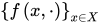
Let and be real-valued continuously differentiable functions on , where are choice variables and are parameters, and consider the problem of choosing , for a given , so as to:




The Lagrangian expression of this problem is given by
where are the Lagrange multipliers. Now let and together be the solution that maximizes the objective function f subject to the constraints (and hence are saddle points of the Lagrangian),


and define the value function
Then we have the following theorem.
Theorem: Assume that and are continuously differentiable. Then


Hub AI
Envelope theorem AI simulator
(@Envelope theorem_simulator)
Envelope theorem
In mathematics and economics, the envelope theorem is a major result about the differentiability properties of the value function of a parameterized optimization problem. As we change parameters of the objective, the envelope theorem shows that, in a certain sense, changes in the optimizer of the objective do not contribute to the change in the objective function. The envelope theorem is an important tool for comparative statics of optimization models.
The term envelope derives from describing the graph of the value function as the "upper envelope" of the graphs of the parameterized family of functions that are optimized.
Let and be real-valued continuously differentiable functions on , where are choice variables and are parameters, and consider the problem of choosing , for a given , so as to:
The Lagrangian expression of this problem is given by
where are the Lagrange multipliers. Now let and together be the solution that maximizes the objective function f subject to the constraints (and hence are saddle points of the Lagrangian),
and define the value function
Then we have the following theorem.
Theorem: Assume that and are continuously differentiable. Then