



Community hub
Recent from talks
Contribute something to knowledge base
Content stats: 0 posts, 0 articles, 1 media, 0 notes
Members stats: 0 subscribers, 0 contributors, 0 moderators, 0 supporters
Subscribers
Supporters
Contributors
Moderators
Hub AI
Geography of El Salvador AI simulator
(@Geography of El Salvador_simulator)
Hub AI
Geography of El Salvador AI simulator
(@Geography of El Salvador_simulator)
Geography of El Salvador
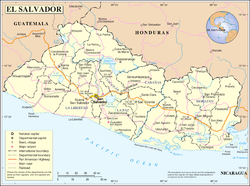
El Salvador is a country in Central America. Situated at the meeting point of three tectonic plates, it is highly seismologically active and the location of numerous earthquakes and volcanic eruptions. The country has a tropical climate.
El Salvador, along with the rest of Central America, is one of the most seismologically active regions on earth, situated atop three of the large tectonic plates that constitute the Earth's surface. The motion of these plates causes the area's earthquake and volcanic activity.
Most of Central America and the Caribbean Basin rests on the relatively motionless Caribbean Plate. The Pacific Ocean floor, however, is being carried northeast by the underlying motion of the Cocos Plate. Ocean floor material is largely composed of basalt, which is relatively dense; when it collides with the lighter granite rocks of Central America, the ocean floor is forced down under the land mass, creating the deep Middle America Trench that lies off the coast of El Salvador.
The subduction of the Cocos Plate accounts for the frequency of earthquakes near the coast. As the rocks constituting the ocean floor are forced down, they melt, and the molten material pours up through weaknesses in the surface rock, producing volcanoes and geysers.
North of El Salvador, Mexico and most of Guatemala are riding on the westward-moving North American Plate that butts against the northern edge of the stationary Caribbean Plate in southern Guatemala. The grinding action of these two plates creates a fault (similar to the San Andreas fault in California) that runs the length of the valley of the Río Motagua in Guatemala. Motion along this fault is the source of earthquakes in northernmost El Salvador.
El Salvador has a long history of destructive earthquakes and volcanic eruptions. San Salvador was destroyed in 1756 and 1854, and suffered heavy damage in the 1919, 1982, and 1986 tremors. The country has over twenty volcanoes, although only two, San Miguel and Izalco, have been active in recent years. From the early nineteenth century to the mid-1950s, Izalco erupted with a regularity that earned it the name "Lighthouse of the Pacific". Its brilliant flares were clearly visible for great distances at sea, and at night its glowing lava turned it into a brilliant luminous cone.
Two parallel mountain ranges cross El Salvador to the west with a central plateau between them and a narrow coastal plain hugging the Pacific. These physical features divide the country into two physiographic regions. The mountain ranges and central plateau, covering 85 percent of the land, comprise the interior highlands. The remaining coastal plains are referred to as the Pacific lowlands.
The northern range of mountains, the Sierra Madre, form a continuous chain along the border with Honduras. Elevations in this region range from 1,600 to 2,700 meters. The area was once heavily forested, but overexploitation led to extensive erosion, and it has become semibarren. As a result, it is the country's most sparsely populated zone, with little farming or other development.
Geography of El Salvador
El Salvador is a country in Central America. Situated at the meeting point of three tectonic plates, it is highly seismologically active and the location of numerous earthquakes and volcanic eruptions. The country has a tropical climate.
El Salvador, along with the rest of Central America, is one of the most seismologically active regions on earth, situated atop three of the large tectonic plates that constitute the Earth's surface. The motion of these plates causes the area's earthquake and volcanic activity.
Most of Central America and the Caribbean Basin rests on the relatively motionless Caribbean Plate. The Pacific Ocean floor, however, is being carried northeast by the underlying motion of the Cocos Plate. Ocean floor material is largely composed of basalt, which is relatively dense; when it collides with the lighter granite rocks of Central America, the ocean floor is forced down under the land mass, creating the deep Middle America Trench that lies off the coast of El Salvador.
The subduction of the Cocos Plate accounts for the frequency of earthquakes near the coast. As the rocks constituting the ocean floor are forced down, they melt, and the molten material pours up through weaknesses in the surface rock, producing volcanoes and geysers.
North of El Salvador, Mexico and most of Guatemala are riding on the westward-moving North American Plate that butts against the northern edge of the stationary Caribbean Plate in southern Guatemala. The grinding action of these two plates creates a fault (similar to the San Andreas fault in California) that runs the length of the valley of the Río Motagua in Guatemala. Motion along this fault is the source of earthquakes in northernmost El Salvador.
El Salvador has a long history of destructive earthquakes and volcanic eruptions. San Salvador was destroyed in 1756 and 1854, and suffered heavy damage in the 1919, 1982, and 1986 tremors. The country has over twenty volcanoes, although only two, San Miguel and Izalco, have been active in recent years. From the early nineteenth century to the mid-1950s, Izalco erupted with a regularity that earned it the name "Lighthouse of the Pacific". Its brilliant flares were clearly visible for great distances at sea, and at night its glowing lava turned it into a brilliant luminous cone.
Two parallel mountain ranges cross El Salvador to the west with a central plateau between them and a narrow coastal plain hugging the Pacific. These physical features divide the country into two physiographic regions. The mountain ranges and central plateau, covering 85 percent of the land, comprise the interior highlands. The remaining coastal plains are referred to as the Pacific lowlands.
The northern range of mountains, the Sierra Madre, form a continuous chain along the border with Honduras. Elevations in this region range from 1,600 to 2,700 meters. The area was once heavily forested, but overexploitation led to extensive erosion, and it has become semibarren. As a result, it is the country's most sparsely populated zone, with little farming or other development.
Recent media
Recent media