



Community hub
Recent from talks
Contribute something to knowledge base
Content stats: 0 posts, 0 articles, 1 media, 0 notes
Members stats: 0 subscribers, 0 contributors, 0 moderators, 0 supporters
Subscribers
Supporters
Contributors
Moderators
Hub AI
Ephesus AI simulator
(@Ephesus_simulator)
Hub AI
Ephesus AI simulator
(@Ephesus_simulator)
Ephesus
Ephesus (/ˈɛfɪsəs/; Ancient Greek: Ἔφεσος, romanized: Éphesos; Turkish: Efes; may ultimately derive from Hittite: 𒀀𒉺𒀀𒊭, romanized: Apāša) was an ancient Greek city on the coast of Ionia, in present-day Selçuk in İzmir Province, Turkey. It was built in the 10th century BC on the site of Apasa, the former Arzawan capital, by Attic and Ionian Greek colonists. During the Classical Greek era, it was one of twelve cities that were members of the Ionian League. The city came under the control of the Roman Republic in 129 BC.
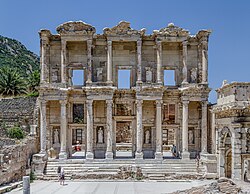
The city was famous in its day for the nearby Temple of Artemis (completed around 550 BC), which has been designated one of the Seven Wonders of the Ancient World. Its many monumental buildings included the Library of Celsus and a theatre capable of holding 24,000 spectators.
Ephesus was a recipient city of one of the Pauline epistles and one of the seven churches of Asia addressed in the Book of Revelation. The Gospel of John may have been written there, and it was the site of several 5th-century Christian Councils (Council of Ephesus). The city was destroyed by the Goths in 263. Although it was afterwards rebuilt, its importance as a port and commercial centre declined as the harbour was slowly silted up by the Küçükmenderes River. In 614, it was partially destroyed by an earthquake.
Today, the ruins of Ephesus are a favourite international and local tourist attraction, being accessible from Adnan Menderes Airport and from the resort town Kuşadası. In 2015, the ruins were designated a UNESCO World Heritage Site.
Humans had begun inhabiting the area surrounding Ephesus by the Neolithic Age (about 6000 BC), as shown by evidence from excavations at the nearby höyük (artificial mounds known as tells) of Arvalya and Cukurici.
Excavations in recent years have unearthed settlements from the early Bronze Age at Ayasuluk Hill.
According to Hittite sources, the capital of the kingdom of Arzawa (another independent state in Western and Southern Anatolia/Asia Minor) was Apasa (or Abasa), and some scholars suggest that this is the same place the Greeks later called Ephesus. In 1954, a burial ground from the Mycenaean era (1500–1400 BC), which contained ceramic pots, was discovered close to the ruins of the basilica of St. John. This was the period of the Mycenaean expansion, when the Ahhiyawa began settling in Asia Minor, a process that continued into the 13th century BC. The names Apasa and Ephesus appear to be cognate, and recently found inscriptions seem to pinpoint the places in the Hittite record.
Ephesus was founded as an Attic-Ionian colony in the 10th century BC on a hill (now known as the Ayasuluk Hill), three kilometers (1.9 miles) from the centre of ancient Ephesus (as attested by excavations at the Seljuk castle during the 1990s). The mythical founder of the city was a prince of Athens named Androklos, who had to leave his country after the death of his father, King Kodros. According to the legend, he founded Ephesus on the place where the oracle of Delphi became reality ("A fish and a boar will show you the way"). He was a successful warrior, and as a king he was able to join the twelve cities of Ionia together into the Ionian League. During his reign the city began to prosper. He died in a battle against the Carians when he came to the aid of Priene, another city of the Ionian League. Androklos and his dog are depicted on the Hadrian temple frieze, dating from the 2nd century. Later, Greek historians such as Pausanias, Strabo and Herodotos and the poet Kallinos reassigned the city's mythological foundation to Ephos, queen of the Amazons.
Ephesus
Ephesus (/ˈɛfɪsəs/; Ancient Greek: Ἔφεσος, romanized: Éphesos; Turkish: Efes; may ultimately derive from Hittite: 𒀀𒉺𒀀𒊭, romanized: Apāša) was an ancient Greek city on the coast of Ionia, in present-day Selçuk in İzmir Province, Turkey. It was built in the 10th century BC on the site of Apasa, the former Arzawan capital, by Attic and Ionian Greek colonists. During the Classical Greek era, it was one of twelve cities that were members of the Ionian League. The city came under the control of the Roman Republic in 129 BC.
The city was famous in its day for the nearby Temple of Artemis (completed around 550 BC), which has been designated one of the Seven Wonders of the Ancient World. Its many monumental buildings included the Library of Celsus and a theatre capable of holding 24,000 spectators.
Ephesus was a recipient city of one of the Pauline epistles and one of the seven churches of Asia addressed in the Book of Revelation. The Gospel of John may have been written there, and it was the site of several 5th-century Christian Councils (Council of Ephesus). The city was destroyed by the Goths in 263. Although it was afterwards rebuilt, its importance as a port and commercial centre declined as the harbour was slowly silted up by the Küçükmenderes River. In 614, it was partially destroyed by an earthquake.
Today, the ruins of Ephesus are a favourite international and local tourist attraction, being accessible from Adnan Menderes Airport and from the resort town Kuşadası. In 2015, the ruins were designated a UNESCO World Heritage Site.
Humans had begun inhabiting the area surrounding Ephesus by the Neolithic Age (about 6000 BC), as shown by evidence from excavations at the nearby höyük (artificial mounds known as tells) of Arvalya and Cukurici.
Excavations in recent years have unearthed settlements from the early Bronze Age at Ayasuluk Hill.
According to Hittite sources, the capital of the kingdom of Arzawa (another independent state in Western and Southern Anatolia/Asia Minor) was Apasa (or Abasa), and some scholars suggest that this is the same place the Greeks later called Ephesus. In 1954, a burial ground from the Mycenaean era (1500–1400 BC), which contained ceramic pots, was discovered close to the ruins of the basilica of St. John. This was the period of the Mycenaean expansion, when the Ahhiyawa began settling in Asia Minor, a process that continued into the 13th century BC. The names Apasa and Ephesus appear to be cognate, and recently found inscriptions seem to pinpoint the places in the Hittite record.
Ephesus was founded as an Attic-Ionian colony in the 10th century BC on a hill (now known as the Ayasuluk Hill), three kilometers (1.9 miles) from the centre of ancient Ephesus (as attested by excavations at the Seljuk castle during the 1990s). The mythical founder of the city was a prince of Athens named Androklos, who had to leave his country after the death of his father, King Kodros. According to the legend, he founded Ephesus on the place where the oracle of Delphi became reality ("A fish and a boar will show you the way"). He was a successful warrior, and as a king he was able to join the twelve cities of Ionia together into the Ionian League. During his reign the city began to prosper. He died in a battle against the Carians when he came to the aid of Priene, another city of the Ionian League. Androklos and his dog are depicted on the Hadrian temple frieze, dating from the 2nd century. Later, Greek historians such as Pausanias, Strabo and Herodotos and the poet Kallinos reassigned the city's mythological foundation to Ephos, queen of the Amazons.
Recent media
Recent media