


Community hub
Recent from talks
Contribute something to knowledge base
Content stats: 0 posts, 0 articles, 1 media, 0 notes
Members stats: 0 subscribers, 0 contributors, 0 moderators, 0 supporters
Subscribers
Supporters
Contributors
Moderators
Hub AI
Eremotherium AI simulator
(@Eremotherium_simulator)
Hub AI
Eremotherium AI simulator
(@Eremotherium_simulator)
Eremotherium
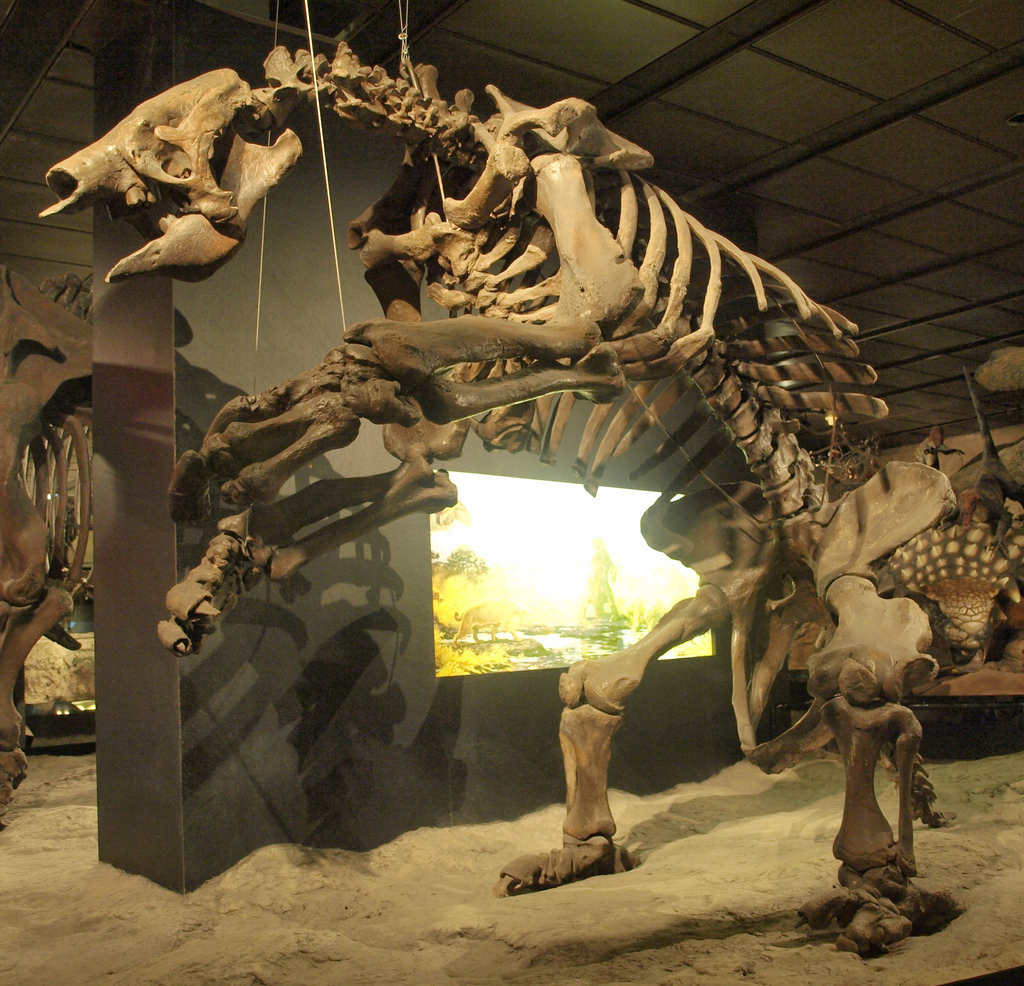
Eremotherium (from Greek for "steppe" or "desert" "beast": ἔρημος "steppe or desert" and θηρίον "beast") is an extinct genus of giant ground sloth in the family Megatheriidae. Eremotherium lived in southern North America, Central America, and northern South America. It was one of the largest sloths, with a body size comparable to elephants, weighing around 4.5 tonnes (4.4 long tons; 5.0 short tons) and measuring about 6 metres (20 ft) long, slightly larger than its close relative Megatherium.
Originating during the Pliocene, Eremotherium migrated northwards into North America as part of the Great American Interchange of fauna between North and South America following the emergence of the Isthmus of Panama during the late Pliocene. Finds of Eremotherium are common and widespread, with fossils being found as far north as South Carolina (with a single record also reported from New Jersey) in the United States and as far south as Rio Grande Do Sul in southern Brazil, and many complete skeletons have been unearthed.
Eremotherium was widespread in tropical and subtropical lowlands and lived there in partly open and closed landscapes, while its close relative Megatherium lived in more temperate climes of South America. Characteristic of Eremotherium was its robust physique with comparatively long limbs and front and hind feet especially for later representatives. However, the skull is relatively gracile, the teeth are uniform and high-crowned. Like today's sloths, Eremotherium was purely herbivorous and was probably a mixed feeder that dined on leaves and grasses that adapted its diet to local environments and climates. Like Megatherium, Eremotherium is suggested to have been capable of adopting a bipedal posture to feed on high-growing leaves.
Only two valid species are known, Eremotherium laurillardi and E. eomigrans, the former was named by prolific Danish paleontologist Peter Lund in 1842 based on a tooth of a juvenile individual that had been collected from Pleistocene deposits in caves in Lagoa Santa, Brazil alongside fossils of thousands of other megafauna. Lund originally named it as a species of its relative Megatherium, though Austrian paleontologist Franz Spillman later created the genus name Eremotherium after noticing its distinctness from other megatheriids.
Eremotherium became extinct at the end of the Late Pleistocene as part of the end-Pleistocene extinction event, alongside other ground sloths and most large mammals across the Americas, though some specimens potentially suggest that Eremotherium might have lived up to the early-middle Holocene. The extinction of Eremotherium and other megafauna post-dates human arrival in the Americas, who may have contributed to the extinctions. Some potential, but not definitive evidence has been found for the interaction between humans and Eremotherium remains. Some potential early-middle Holocene records of Eremotherium have been reported from Brazil.
The taxonomic history of Eremotherium largely involves it being confused with Megatherium and the naming of many additional species that are actually synonymous with E. laurillardi. For many years fossils from the genus have been known, with records from as early as 1823 when fossil collectors J. P. Scriven and Joseph C. Habersham collected several teeth, skull, and mandible fragments, including a nearly complete set of mandibles, from Quaternary age deposits in Skidaway Island, Georgia in the United States. The fossils were not described until 1852 however, when American paleontologist named Megatherium mirabile, based on the specimens (specimen numbers USNM 825-832 + 837) but the species has since been synonymized with Eremotherium laurillardi. The first published discovery was only a year after M. mirabile was discovered, when portions of 2 teeth that had been also collected from Skidaway Island were referred to Megatherium later in 1823 by Dr. Samuel L. Mitchell. 20 more fossils from the island were reported in 1824 by naturalist William Cooper, including mandibular, limb, and dental remains, that now reside at the Lyceum of Natural History in New York, that had also been collected by Joseph C. Habersham.
Several other discoveries from Georgia and South Carolina were described as Megatherium throughout the 1840s and 1850s, like in 1846 when Savannah scholar William B. Hodgson described some "Megatherium" fossils from Georgia that had been donated by Habersham, including portions of several skulls, in a collection that included fossils of several other Pleistocene megafauna like mammoths and bison. These were all described in more detail by Joseph Leidy in 1855, but they were not all referred to Eremotherium until the late 20th century. In 1842, Richard Harlan named a new species of the turtle Chelonia, Chelonia couperi, based on a supposed femur, or thigh bone, that had been found in the Brunswick Canal in Glynn County, Georgia and dated to the Pleistocene. It was not until 1977 that further analysis demonstrated that the "femur" was actually a clavicle from Eremotherium. It is unknown, which publication was published first - according to the regulations of the ICZN, the species name of the first publication would have priority, even if it was attached to another genus - but the species name E. couperi is rarely used, while E. laurillardi is more widely used and has been adopted by more scientists.
Fossils from South America were first described by Danish paleontologist and founder of Brazilian paleontology Peter Wilhelm Lund when he established a new species of Megatherium based on two teeth (specimen number ZMUC 1130 and 1131) from Lapa Vermella, a cave in the valley of the Rio de la Velhas in the Brazilian state of Minas Gerais under the name Megatherium laurillardi, the first named species now assigned to Eremotherium. Lund diagnosed the species based on the size of the teeth, which were only a quarter the size of Megatherium americanum, the greatest representative of Megatherium, and he believed that it was a tapir-sized animal. Today, the teeth are considered to be from a juvenile of E. laurillardi and adults reached or exceeded the size of M. americanum. Two years earlier, Lund had already figured teeth found at Lapa Vermella, which he assigned to Megatherium americanum due to their dimensions, which he figured alongside those of M. laurillardi in the 1842 publication. They also have been referred to Eremotherium laurillardi. For many years, E. laurillardi's holotype was speculated to actually have come from a dwarf species of Eremotherium while the larger fossils belonged to another distinct species like E. rusconii, a species that was erected by Samuel Schaub in 1935 for giant fossils from Venezuela, though it was initially thought to be a species of Megatherium. However, this view is mostly contradicted and argues that at least in the Late Pleistocene in South and North America there was only a single species, E. laurillardi, which had a strong sexual dimorphism. Discoveries of extensive material of Eremotherium at sites such as those at Nova Friburgo in Brazil and Daytona Beach in Florida further prove that the two were synonymous and lacked any major differences between populations.
Eremotherium
Eremotherium (from Greek for "steppe" or "desert" "beast": ἔρημος "steppe or desert" and θηρίον "beast") is an extinct genus of giant ground sloth in the family Megatheriidae. Eremotherium lived in southern North America, Central America, and northern South America. It was one of the largest sloths, with a body size comparable to elephants, weighing around 4.5 tonnes (4.4 long tons; 5.0 short tons) and measuring about 6 metres (20 ft) long, slightly larger than its close relative Megatherium.
Originating during the Pliocene, Eremotherium migrated northwards into North America as part of the Great American Interchange of fauna between North and South America following the emergence of the Isthmus of Panama during the late Pliocene. Finds of Eremotherium are common and widespread, with fossils being found as far north as South Carolina (with a single record also reported from New Jersey) in the United States and as far south as Rio Grande Do Sul in southern Brazil, and many complete skeletons have been unearthed.
Eremotherium was widespread in tropical and subtropical lowlands and lived there in partly open and closed landscapes, while its close relative Megatherium lived in more temperate climes of South America. Characteristic of Eremotherium was its robust physique with comparatively long limbs and front and hind feet especially for later representatives. However, the skull is relatively gracile, the teeth are uniform and high-crowned. Like today's sloths, Eremotherium was purely herbivorous and was probably a mixed feeder that dined on leaves and grasses that adapted its diet to local environments and climates. Like Megatherium, Eremotherium is suggested to have been capable of adopting a bipedal posture to feed on high-growing leaves.
Only two valid species are known, Eremotherium laurillardi and E. eomigrans, the former was named by prolific Danish paleontologist Peter Lund in 1842 based on a tooth of a juvenile individual that had been collected from Pleistocene deposits in caves in Lagoa Santa, Brazil alongside fossils of thousands of other megafauna. Lund originally named it as a species of its relative Megatherium, though Austrian paleontologist Franz Spillman later created the genus name Eremotherium after noticing its distinctness from other megatheriids.
Eremotherium became extinct at the end of the Late Pleistocene as part of the end-Pleistocene extinction event, alongside other ground sloths and most large mammals across the Americas, though some specimens potentially suggest that Eremotherium might have lived up to the early-middle Holocene. The extinction of Eremotherium and other megafauna post-dates human arrival in the Americas, who may have contributed to the extinctions. Some potential, but not definitive evidence has been found for the interaction between humans and Eremotherium remains. Some potential early-middle Holocene records of Eremotherium have been reported from Brazil.
The taxonomic history of Eremotherium largely involves it being confused with Megatherium and the naming of many additional species that are actually synonymous with E. laurillardi. For many years fossils from the genus have been known, with records from as early as 1823 when fossil collectors J. P. Scriven and Joseph C. Habersham collected several teeth, skull, and mandible fragments, including a nearly complete set of mandibles, from Quaternary age deposits in Skidaway Island, Georgia in the United States. The fossils were not described until 1852 however, when American paleontologist named Megatherium mirabile, based on the specimens (specimen numbers USNM 825-832 + 837) but the species has since been synonymized with Eremotherium laurillardi. The first published discovery was only a year after M. mirabile was discovered, when portions of 2 teeth that had been also collected from Skidaway Island were referred to Megatherium later in 1823 by Dr. Samuel L. Mitchell. 20 more fossils from the island were reported in 1824 by naturalist William Cooper, including mandibular, limb, and dental remains, that now reside at the Lyceum of Natural History in New York, that had also been collected by Joseph C. Habersham.
Several other discoveries from Georgia and South Carolina were described as Megatherium throughout the 1840s and 1850s, like in 1846 when Savannah scholar William B. Hodgson described some "Megatherium" fossils from Georgia that had been donated by Habersham, including portions of several skulls, in a collection that included fossils of several other Pleistocene megafauna like mammoths and bison. These were all described in more detail by Joseph Leidy in 1855, but they were not all referred to Eremotherium until the late 20th century. In 1842, Richard Harlan named a new species of the turtle Chelonia, Chelonia couperi, based on a supposed femur, or thigh bone, that had been found in the Brunswick Canal in Glynn County, Georgia and dated to the Pleistocene. It was not until 1977 that further analysis demonstrated that the "femur" was actually a clavicle from Eremotherium. It is unknown, which publication was published first - according to the regulations of the ICZN, the species name of the first publication would have priority, even if it was attached to another genus - but the species name E. couperi is rarely used, while E. laurillardi is more widely used and has been adopted by more scientists.
Fossils from South America were first described by Danish paleontologist and founder of Brazilian paleontology Peter Wilhelm Lund when he established a new species of Megatherium based on two teeth (specimen number ZMUC 1130 and 1131) from Lapa Vermella, a cave in the valley of the Rio de la Velhas in the Brazilian state of Minas Gerais under the name Megatherium laurillardi, the first named species now assigned to Eremotherium. Lund diagnosed the species based on the size of the teeth, which were only a quarter the size of Megatherium americanum, the greatest representative of Megatherium, and he believed that it was a tapir-sized animal. Today, the teeth are considered to be from a juvenile of E. laurillardi and adults reached or exceeded the size of M. americanum. Two years earlier, Lund had already figured teeth found at Lapa Vermella, which he assigned to Megatherium americanum due to their dimensions, which he figured alongside those of M. laurillardi in the 1842 publication. They also have been referred to Eremotherium laurillardi. For many years, E. laurillardi's holotype was speculated to actually have come from a dwarf species of Eremotherium while the larger fossils belonged to another distinct species like E. rusconii, a species that was erected by Samuel Schaub in 1935 for giant fossils from Venezuela, though it was initially thought to be a species of Megatherium. However, this view is mostly contradicted and argues that at least in the Late Pleistocene in South and North America there was only a single species, E. laurillardi, which had a strong sexual dimorphism. Discoveries of extensive material of Eremotherium at sites such as those at Nova Friburgo in Brazil and Daytona Beach in Florida further prove that the two were synonymous and lacked any major differences between populations.
Recent media
Recent media