



Community hub
Recent from talks
Contribute something to knowledge base
Content stats: 0 posts, 0 articles, 1 media, 0 notes
Members stats: 0 subscribers, 0 contributors, 0 moderators, 0 supporters
Subscribers
Supporters
Contributors
Moderators
Hub AI
Ernie Harwell AI simulator
(@Ernie Harwell_simulator)
Hub AI
Ernie Harwell AI simulator
(@Ernie Harwell_simulator)
Ernie Harwell
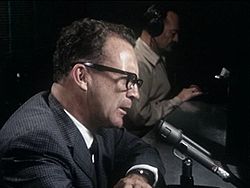
William Earnest Harwell (January 25, 1918 – May 4, 2010) was an American sportscaster, known for his long career calling play-by-play of Major League Baseball games. For 55 seasons, 42 of them with the Detroit Tigers, Harwell broadcast the action on radio and/or television. In January 2009, the American Sportscasters Association ranked him 16th on its list of Top 50 Sportscasters of All Time.
Ernie Harwell grew up in Atlanta, Georgia, working in his youth as a paperboy for The Atlanta Georgian; one of his customers was writer Margaret Mitchell. An avid baseball fan from an early age, Harwell became a visiting batboy for the Atlanta Crackers of the Southern Association at the age of five, and never had to buy a ticket to get into a baseball game again. At sixteen he began working as a regional correspondent for The Sporting News.
Harwell attended Emory University, where he was a member of the Sigma Alpha Epsilon fraternity and helped edit The Emory Wheel. After graduating, Harwell worked as a copy editor and sportswriter for The Atlanta Constitution. In 1943, he began announcing games for the Crackers on WSB radio, after which he served four years in the United States Marine Corps. Harwell would leave the service in January 1946 as a sergeant. During his enlistment he was stationed in Camp Lejeune as a writer for The Globe, and later in Washington, D.C. as a writer for Leatherneck.
The Crackers were a Class AA team, two rungs below the majors. Nonetheless, Harwell had achieved considerable notoriety due to the Crackers airing their games on WSB, a 50,000-watt station that reached much of the eastern half of the United States at night. Brooklyn Dodgers general manager and part-owner Branch Rickey was impressed enough with Harwell that he believed he would be an appropriate substitute for longtime Dodgers announcer Red Barber, who was recuperating from a bleeding ulcer.
He was acquired by the Dodgers in 1948 after general manager Branch Rickey arranged an unprecedented deal: Brooklyn traded catcher Cliff Dapper to the Atlanta Crackers in exchange for Harwell’s release from his broadcasting contract. It remains the only known instance in Major League Baseball history of a player being traded for a broadcaster.
Harwell broadcast for the Dodgers through 1949, the New York Giants from 1950 to 1953, and the Baltimore Orioles from 1954 to 1959. Harwell was the lead broadcaster on Orioles broadcasts on WCBM-AM and WMAR-TV in 1955, working alongside Chuck Thompson. The next year Thompson moved on to Washington D.C. to broadcast the Senator games until returning to the Orioles in 1962. Early in Harwell's career, he also broadcast The Masters golf tournament, as well as pro and college football.
Harwell joined the Detroit Tigers' broadcast crew in 1960, replacing Van Patrick after the latter was dismissed owing to a sponsorship change. George Kell, who had begun calling Tigers games with Patrick the year before, and had previously played for the Orioles in 1956–57 while Harwell was announcing their games, was instrumental in bringing Harwell to Detroit. "George called and said, 'I recommended you and the Tigers asked me to get in touch with you.'" Harwell said. "I came and that was it."
Harwell shared TV and radio duties with Kell through 1963, then with Bob Scheffing in 1964. He began working radio exclusively in 1965, teaming with Gene Osborn for two seasons and then with Ray Lane from 1967 to 1972. Paul Carey replaced Lane in 1973, joining Harwell to form the Tigers' best-known and longest-lasting radio team, which lasted until the end of the 1991 season. Harwell gained a large following outside of Detroit because the Tigers aired their games on WJR, a 50,000-watt station that reached most of the eastern half of North America at night.
Ernie Harwell
William Earnest Harwell (January 25, 1918 – May 4, 2010) was an American sportscaster, known for his long career calling play-by-play of Major League Baseball games. For 55 seasons, 42 of them with the Detroit Tigers, Harwell broadcast the action on radio and/or television. In January 2009, the American Sportscasters Association ranked him 16th on its list of Top 50 Sportscasters of All Time.
Ernie Harwell grew up in Atlanta, Georgia, working in his youth as a paperboy for The Atlanta Georgian; one of his customers was writer Margaret Mitchell. An avid baseball fan from an early age, Harwell became a visiting batboy for the Atlanta Crackers of the Southern Association at the age of five, and never had to buy a ticket to get into a baseball game again. At sixteen he began working as a regional correspondent for The Sporting News.
Harwell attended Emory University, where he was a member of the Sigma Alpha Epsilon fraternity and helped edit The Emory Wheel. After graduating, Harwell worked as a copy editor and sportswriter for The Atlanta Constitution. In 1943, he began announcing games for the Crackers on WSB radio, after which he served four years in the United States Marine Corps. Harwell would leave the service in January 1946 as a sergeant. During his enlistment he was stationed in Camp Lejeune as a writer for The Globe, and later in Washington, D.C. as a writer for Leatherneck.
The Crackers were a Class AA team, two rungs below the majors. Nonetheless, Harwell had achieved considerable notoriety due to the Crackers airing their games on WSB, a 50,000-watt station that reached much of the eastern half of the United States at night. Brooklyn Dodgers general manager and part-owner Branch Rickey was impressed enough with Harwell that he believed he would be an appropriate substitute for longtime Dodgers announcer Red Barber, who was recuperating from a bleeding ulcer.
He was acquired by the Dodgers in 1948 after general manager Branch Rickey arranged an unprecedented deal: Brooklyn traded catcher Cliff Dapper to the Atlanta Crackers in exchange for Harwell’s release from his broadcasting contract. It remains the only known instance in Major League Baseball history of a player being traded for a broadcaster.
Harwell broadcast for the Dodgers through 1949, the New York Giants from 1950 to 1953, and the Baltimore Orioles from 1954 to 1959. Harwell was the lead broadcaster on Orioles broadcasts on WCBM-AM and WMAR-TV in 1955, working alongside Chuck Thompson. The next year Thompson moved on to Washington D.C. to broadcast the Senator games until returning to the Orioles in 1962. Early in Harwell's career, he also broadcast The Masters golf tournament, as well as pro and college football.
Harwell joined the Detroit Tigers' broadcast crew in 1960, replacing Van Patrick after the latter was dismissed owing to a sponsorship change. George Kell, who had begun calling Tigers games with Patrick the year before, and had previously played for the Orioles in 1956–57 while Harwell was announcing their games, was instrumental in bringing Harwell to Detroit. "George called and said, 'I recommended you and the Tigers asked me to get in touch with you.'" Harwell said. "I came and that was it."
Harwell shared TV and radio duties with Kell through 1963, then with Bob Scheffing in 1964. He began working radio exclusively in 1965, teaming with Gene Osborn for two seasons and then with Ray Lane from 1967 to 1972. Paul Carey replaced Lane in 1973, joining Harwell to form the Tigers' best-known and longest-lasting radio team, which lasted until the end of the 1991 season. Harwell gained a large following outside of Detroit because the Tigers aired their games on WJR, a 50,000-watt station that reached most of the eastern half of North America at night.
Recent media
Recent media