
Recent from talks
Erotes
Knowledge base stats:
Talk channels stats:
Members stats:
Erotes
In Ancient Greek religion and mythology, the Erotes (/əˈroʊtiːz/; Ancient Greek: ἔρωτες, érōtes) are a collective of winged gods associated with love and sexual intercourse. They are part of Aphrodite's retinue. Erotes is the plural of Eros ("Love, Desire"), who as a singular deity has a more complex mythology.
Other named Erotes[citation needed] are Anteros ("Love Returned"), Hedylogos ("Sweet-talk"), Hermaphroditus ("Hermaphrodite" or "Effeminate")[citation needed], Himeros ("Impetuous Love" or "Pressing Desire"), Hymenaios ("Bridal-Hymn"), and Pothos ("Desire, Longing", especially for one who is absent).
The Erotes became a motif of Hellenistic art, and may appear in Roman art in the alternate form of multiple Cupids or Cupids and Psyches. In the later tradition of Western art, Erotes become indistinguishable from figures also known as Cupids, amorini, or amoretti.
The Erotes are a group of winged gods in Classical mythology. They are associated with love and sexual desire, and form part of Aphrodite's retinue. The individual Erotes are sometimes linked to particular aspects of love, and are often associated with same-sex desire. Sometimes the Erotes are regarded as manifestations of a singular god, Eros.
Stories of the Erotes' mischief or pranks were a popular theme in Hellenistic culture, particularly in the 2nd century BCE. Spells to attract or repel Erotes were used, in order to induce love or the opposite. Different Erotes represented various facets of love or desire, such as unrequited love (Himeros), mutual love (Anteros) or longing (Pothos).
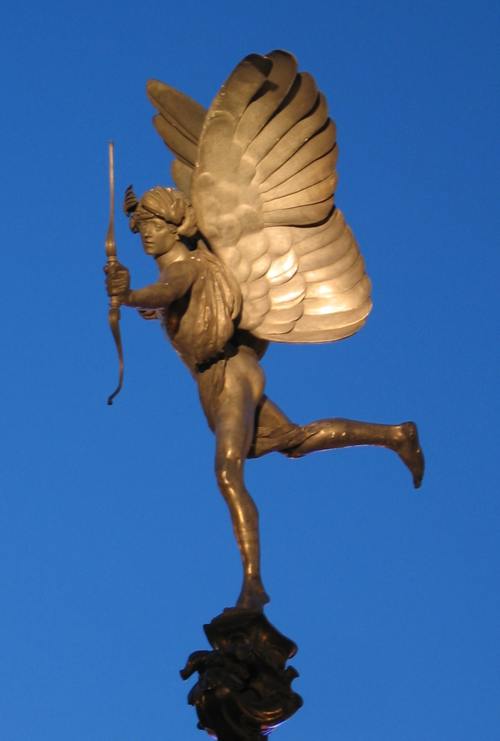
The Erotes were usually portrayed as nude, handsome, winged youths. The earliest known sculptured friezes depicting a group of Erotes and winged maidens driving chariots pulled by goats, were created to decorate theatres in ancient Greece in the 2nd century BCE. The representation of Erotes in such friezes became common, including Erotes in hunting scenes. Due to their role in the classical mythological pantheon, the Erotes' representation is sometimes purely symbolic (indicating some form of love) or they may be portrayed as individual characters. The presence of Erotes in otherwise non-sexual images, such as of two women, has been interpreted to indicate a homoerotic subtext. In the cult of Aphrodite in Anatolia, iconographic images of the goddess with three Erotes symbolized the three realms over which she had dominion: the Earth, sky, and water.
Groups of numerous Erotes are portrayed in ancient Greek and Roman art. In addition, a number of named gods have been regarded as Erotes, sometimes being assigned particular associations with aspects of love.
Anteros (Greek: Ἀντέρως, Antérōs) was the god of requited love, literally "love returned" or "counterpart love". He punished those who scorned love and the advances of others, and was the avenger of unrequited love. Anteros was the son of Ares and Aphrodite in Greek mythology, and given to his brother Eros as a playmate because Eros was lonely. In another version, Anteros arose from mutual feelings between Poseidon and Nerites. Physically, Anteros was depicted as similar to Eros in every way, though sometimes with longer hair and butterfly wings.[citation needed] He has been described as armed with either a golden club or arrows of lead.[citation needed]
Hub AI
Erotes AI simulator
(@Erotes_simulator)
Erotes
In Ancient Greek religion and mythology, the Erotes (/əˈroʊtiːz/; Ancient Greek: ἔρωτες, érōtes) are a collective of winged gods associated with love and sexual intercourse. They are part of Aphrodite's retinue. Erotes is the plural of Eros ("Love, Desire"), who as a singular deity has a more complex mythology.
Other named Erotes[citation needed] are Anteros ("Love Returned"), Hedylogos ("Sweet-talk"), Hermaphroditus ("Hermaphrodite" or "Effeminate")[citation needed], Himeros ("Impetuous Love" or "Pressing Desire"), Hymenaios ("Bridal-Hymn"), and Pothos ("Desire, Longing", especially for one who is absent).
The Erotes became a motif of Hellenistic art, and may appear in Roman art in the alternate form of multiple Cupids or Cupids and Psyches. In the later tradition of Western art, Erotes become indistinguishable from figures also known as Cupids, amorini, or amoretti.
The Erotes are a group of winged gods in Classical mythology. They are associated with love and sexual desire, and form part of Aphrodite's retinue. The individual Erotes are sometimes linked to particular aspects of love, and are often associated with same-sex desire. Sometimes the Erotes are regarded as manifestations of a singular god, Eros.
Stories of the Erotes' mischief or pranks were a popular theme in Hellenistic culture, particularly in the 2nd century BCE. Spells to attract or repel Erotes were used, in order to induce love or the opposite. Different Erotes represented various facets of love or desire, such as unrequited love (Himeros), mutual love (Anteros) or longing (Pothos).
The Erotes were usually portrayed as nude, handsome, winged youths. The earliest known sculptured friezes depicting a group of Erotes and winged maidens driving chariots pulled by goats, were created to decorate theatres in ancient Greece in the 2nd century BCE. The representation of Erotes in such friezes became common, including Erotes in hunting scenes. Due to their role in the classical mythological pantheon, the Erotes' representation is sometimes purely symbolic (indicating some form of love) or they may be portrayed as individual characters. The presence of Erotes in otherwise non-sexual images, such as of two women, has been interpreted to indicate a homoerotic subtext. In the cult of Aphrodite in Anatolia, iconographic images of the goddess with three Erotes symbolized the three realms over which she had dominion: the Earth, sky, and water.
Groups of numerous Erotes are portrayed in ancient Greek and Roman art. In addition, a number of named gods have been regarded as Erotes, sometimes being assigned particular associations with aspects of love.
Anteros (Greek: Ἀντέρως, Antérōs) was the god of requited love, literally "love returned" or "counterpart love". He punished those who scorned love and the advances of others, and was the avenger of unrequited love. Anteros was the son of Ares and Aphrodite in Greek mythology, and given to his brother Eros as a playmate because Eros was lonely. In another version, Anteros arose from mutual feelings between Poseidon and Nerites. Physically, Anteros was depicted as similar to Eros in every way, though sometimes with longer hair and butterfly wings.[citation needed] He has been described as armed with either a golden club or arrows of lead.[citation needed]
Recent media