
Recent from talks
Erromango
Knowledge base stats:
Talk channels stats:
Members stats:
Erromango
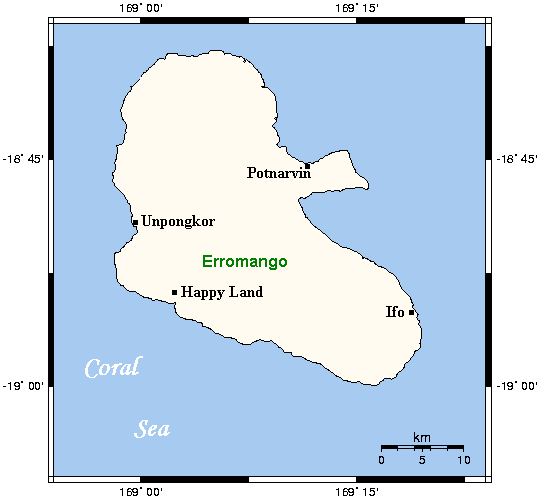
Erromango is the fourth largest island in the Vanuatu archipelago. With a land area of 891.9 square kilometres (344.4 sq mi), it is the largest island in Tafea Province, the southernmost of Vanuatu's six administrative regions.
The endonym for Erromango in Erromangan is Nelocompne. There are several accounts of how 'Erromango' came into common usage: firstly, an oral history from the Potnarvin area tells of how Captain James Cook was given a yam during his visit in August 1774, and was told in the (now-extinct) Sorung language armai n'go, armai n'go ('this food is good'), and mistakenly assumed this to be the name of the island. A second account is related by the naturalist Georg Forster, who accompanied Cook. He writes that he learned the name 'Irromanga' from a man named Fannòko, while visiting the neighbouring island of Tanna five days later. Cook himself does not name the island in his account of his visit, but writes later that he got the name, which he spells as 'Erromango', from Forster.
Erromango was first settled by humans around 3,000 years ago, as part of the Lapita migration out of south-east Asia into island Melanesia. The Lapita people brought with them domestic animals such as pigs and chickens and food plants such as yam and breadfruit.
Two sites on Erromango, Ifo and Ponamla, have yielded significant archaeological evidence of habitation by Lapita and post-Lapita peoples, including pottery sherds, adzes, marine shell artifacts and cooking stones.
Erromango contains numerous caves that provided refuge from tribal warfare and cyclones. Human use of these caves has been dated to 2,800–2,400 years before the present. Some of the caves contain rock art and petroglyphs that have been identified with clan motifs and traditional stories. Caves were also used as burial sites.
James Cook was the first European to land on Erromango, landing near present-day Potnarvin in the north-east on 4 August 1774. Cook and his landing party were set upon by a group of local men, and in the scuffle that followed, several of Cook's men were injured and a number of Erromangans killed. Following this incident, Cook gave the name 'Traitor's head' to the peninsula adjacent to Potnarvin.
Whaling vessels were among the early regular visitors to the island on the nineteenth century. The first such vessel known to have visited was the Rose in 1804 and the last on record was the American vessel John & Winthrop in 1887.
In 1825, trader and adventurer Peter Dillon discovered the island's large reserves of sandalwood (Santalum austrocaledonicum), valued in China for its aromatic oil and as a carving wood. Dillon found that his trade goods were not sufficient to entice Erromangans to cut the timber for him, so he left without gathering any sandalwood. News of his discovery brought other outsiders to Erromango to exploit the resource, and this caused conflict between the Erromangans and the traders.
Hub AI
Erromango AI simulator
(@Erromango_simulator)
Erromango
Erromango is the fourth largest island in the Vanuatu archipelago. With a land area of 891.9 square kilometres (344.4 sq mi), it is the largest island in Tafea Province, the southernmost of Vanuatu's six administrative regions.
The endonym for Erromango in Erromangan is Nelocompne. There are several accounts of how 'Erromango' came into common usage: firstly, an oral history from the Potnarvin area tells of how Captain James Cook was given a yam during his visit in August 1774, and was told in the (now-extinct) Sorung language armai n'go, armai n'go ('this food is good'), and mistakenly assumed this to be the name of the island. A second account is related by the naturalist Georg Forster, who accompanied Cook. He writes that he learned the name 'Irromanga' from a man named Fannòko, while visiting the neighbouring island of Tanna five days later. Cook himself does not name the island in his account of his visit, but writes later that he got the name, which he spells as 'Erromango', from Forster.
Erromango was first settled by humans around 3,000 years ago, as part of the Lapita migration out of south-east Asia into island Melanesia. The Lapita people brought with them domestic animals such as pigs and chickens and food plants such as yam and breadfruit.
Two sites on Erromango, Ifo and Ponamla, have yielded significant archaeological evidence of habitation by Lapita and post-Lapita peoples, including pottery sherds, adzes, marine shell artifacts and cooking stones.
Erromango contains numerous caves that provided refuge from tribal warfare and cyclones. Human use of these caves has been dated to 2,800–2,400 years before the present. Some of the caves contain rock art and petroglyphs that have been identified with clan motifs and traditional stories. Caves were also used as burial sites.
James Cook was the first European to land on Erromango, landing near present-day Potnarvin in the north-east on 4 August 1774. Cook and his landing party were set upon by a group of local men, and in the scuffle that followed, several of Cook's men were injured and a number of Erromangans killed. Following this incident, Cook gave the name 'Traitor's head' to the peninsula adjacent to Potnarvin.
Whaling vessels were among the early regular visitors to the island on the nineteenth century. The first such vessel known to have visited was the Rose in 1804 and the last on record was the American vessel John & Winthrop in 1887.
In 1825, trader and adventurer Peter Dillon discovered the island's large reserves of sandalwood (Santalum austrocaledonicum), valued in China for its aromatic oil and as a carving wood. Dillon found that his trade goods were not sufficient to entice Erromangans to cut the timber for him, so he left without gathering any sandalwood. News of his discovery brought other outsiders to Erromango to exploit the resource, and this caused conflict between the Erromangans and the traders.
Recent media