



Community hub
Recent from talks
Contribute something to knowledge base
Content stats: 0 posts, 0 articles, 0 media, 0 notes
Members stats: 0 subscribers, 0 contributors, 0 moderators, 0 supporters
Subscribers
Supporters
Contributors
Moderators
Hub AI
Propagation of uncertainty AI simulator
(@Propagation of uncertainty_simulator)
Hub AI
Propagation of uncertainty AI simulator
(@Propagation of uncertainty_simulator)
Propagation of uncertainty
In statistics, propagation of uncertainty is the effect of variables' uncertainties on the uncertainty of a function based on them. When the variables are the values of experimental measurements they have uncertainties due to measurement limitations (e.g., instrument precision) which propagate due to the combination of variables in the function.
The uncertainty u can be expressed in a number of ways. It may be defined by the absolute error Δx. Uncertainties can also be defined by the relative error (Δx)/x, which is usually written as a percentage. Most commonly, the uncertainty on a quantity is quantified in terms of the standard deviation, σ, which is the positive square root of the variance. The value of a quantity and its error are then expressed as an interval x ± u. However, the most general way of characterizing uncertainty is by specifying its probability distribution. If the probability distribution of the variable is known or can be assumed, in theory it is possible to get any of its statistics. In particular, it is possible to derive confidence limits to describe the region within which the true value of the variable may be found. For example, the 68% confidence limits for a one-dimensional variable belonging to a normal distribution are approximately ± one standard deviation σ from the central value x, which means that the region x ± σ will cover the true value in roughly 68% of cases.
If the uncertainties are correlated then covariance must be taken into account. Correlation can arise from two different sources. First, the measurement errors may be correlated. Second, when the underlying values are correlated across a population, the uncertainties in the group averages will be correlated.
In a general context where a nonlinear function modifies the uncertain parameters (correlated or not), the standard tools to propagate uncertainty, and infer resulting quantity probability distribution/statistics, are sampling techniques from the Monte Carlo method family. For very large datasets or complex functions, the calculation of the error propagation may be very expensive so that a surrogate model or a parallel computing strategy may be necessary.
In some particular cases, the uncertainty propagation calculation can be done through simplistic algebraic procedures. Some of these scenarios are described below.
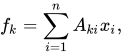
Let be a set of m functions, which are linear combinations of variables with combination coefficients : or in matrix notation,





Also let the variance–covariance matrix of x = (x1, ..., xn) be denoted by and let the mean value be denoted by : is the outer product.


![{\displaystyle {\begin{aligned}{\boldsymbol {\Sigma }}^{x}=\operatorname {E} [(\mathbf {x} -{\boldsymbol {\mu }})\otimes (\mathbf {x} -{\boldsymbol {\mu }})]&={\begin{pmatrix}\sigma _{1}^{2}&\sigma _{12}&\sigma _{13}&\cdots \\\sigma _{21}&\sigma _{2}^{2}&\sigma _{23}&\cdots \\\sigma _{31}&\sigma _{32}&\sigma _{3}^{2}&\cdots \\\vdots &\vdots &\vdots &\ddots \end{pmatrix}}\\[1ex]&={\begin{pmatrix}{\Sigma }_{11}^{x}&{\Sigma }_{12}^{x}&{\Sigma }_{13}^{x}&\cdots \\{\Sigma }_{21}^{x}&{\Sigma }_{22}^{x}&{\Sigma }_{23}^{x}&\cdots \\{\Sigma }_{31}^{x}&{\Sigma }_{32}^{x}&{\Sigma }_{33}^{x}&\cdots \\\vdots &\vdots &\vdots &\ddots \end{pmatrix}}.\end{aligned}}}](https://wikimedia.org/api/rest_v1/media/math/render/svg/ef96443b3a74cb0d40e8488eed779239a706232d)

Then, the variance–covariance matrix of f is given by

![{\displaystyle {\begin{aligned}{\boldsymbol {\Sigma }}^{f}&=\operatorname {E} \left[(\mathbf {f} -\operatorname {E} [\mathbf {f} ])\otimes (\mathbf {f} -\operatorname {E} [\mathbf {f} ])\right]=\operatorname {E} \left[\mathbf {A} (\mathbf {x} -{\boldsymbol {\mu }})\otimes \mathbf {A} (\mathbf {x} -{\boldsymbol {\mu }})\right]\\[1ex]&=\mathbf {A} \operatorname {E} \left[(\mathbf {x} -{\boldsymbol {\mu }})\otimes (\mathbf {x} -{\boldsymbol {\mu }})\right]\mathbf {A} ^{\mathrm {T} }=\mathbf {A} {\boldsymbol {\Sigma }}^{x}\mathbf {A} ^{\mathrm {T} }.\end{aligned}}}](https://wikimedia.org/api/rest_v1/media/math/render/svg/6707679f9d88c2e9ff12f76463e050801b32812d)
Propagation of uncertainty
In statistics, propagation of uncertainty is the effect of variables' uncertainties on the uncertainty of a function based on them. When the variables are the values of experimental measurements they have uncertainties due to measurement limitations (e.g., instrument precision) which propagate due to the combination of variables in the function.
The uncertainty u can be expressed in a number of ways. It may be defined by the absolute error Δx. Uncertainties can also be defined by the relative error (Δx)/x, which is usually written as a percentage. Most commonly, the uncertainty on a quantity is quantified in terms of the standard deviation, σ, which is the positive square root of the variance. The value of a quantity and its error are then expressed as an interval x ± u. However, the most general way of characterizing uncertainty is by specifying its probability distribution. If the probability distribution of the variable is known or can be assumed, in theory it is possible to get any of its statistics. In particular, it is possible to derive confidence limits to describe the region within which the true value of the variable may be found. For example, the 68% confidence limits for a one-dimensional variable belonging to a normal distribution are approximately ± one standard deviation σ from the central value x, which means that the region x ± σ will cover the true value in roughly 68% of cases.
If the uncertainties are correlated then covariance must be taken into account. Correlation can arise from two different sources. First, the measurement errors may be correlated. Second, when the underlying values are correlated across a population, the uncertainties in the group averages will be correlated.
In a general context where a nonlinear function modifies the uncertain parameters (correlated or not), the standard tools to propagate uncertainty, and infer resulting quantity probability distribution/statistics, are sampling techniques from the Monte Carlo method family. For very large datasets or complex functions, the calculation of the error propagation may be very expensive so that a surrogate model or a parallel computing strategy may be necessary.
In some particular cases, the uncertainty propagation calculation can be done through simplistic algebraic procedures. Some of these scenarios are described below.
Let be a set of m functions, which are linear combinations of variables with combination coefficients : or in matrix notation,
Also let the variance–covariance matrix of x = (x1, ..., xn) be denoted by and let the mean value be denoted by : is the outer product.
Then, the variance–covariance matrix of f is given by