
Recent from talks
Eton wall game
Knowledge base stats:
Talk channels stats:
Members stats:
Eton wall game
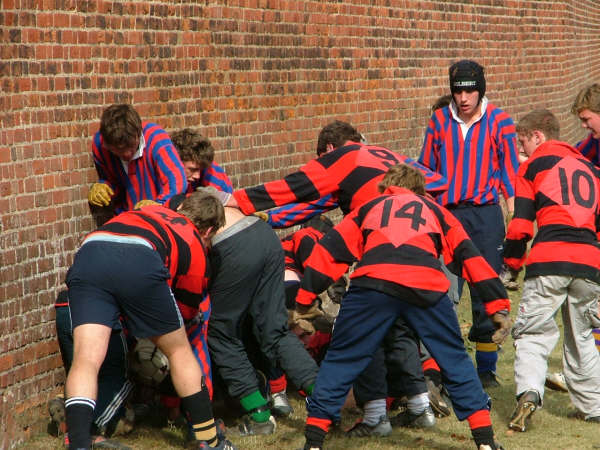
The Eton wall game is a game that originated at and is still played at Eton College. It is played on a strip of ground 5 metres wide and 110 metres long ("The Furrow") next to a slightly curved brick wall ("The Wall") erected in 1717. It is one of two unique forms of football played at Eton, the other being the Eton field game.
The traditional and most important match of the year is played on Saint Andrew's Day, as the Collegers (King's Scholars) take on the Oppidans (the rest of the school). Although College has only 70 boys to pick from, compared to the 1250 or so Oppidans, the Collegers have one distinct advantage: access to the field on which the wall game is played is controlled by a Colleger. Despite this, it is usual for them to allow the Oppidans to use it whenever they wish.
At the annual St Andrew's Day match, the Oppidans climb over the wall, after throwing their caps over in defiance of the Scholars, while the Collegers march down from the far end of College Field, arm-in-arm, towards the near end, where they meet the Oppidans.
The wall game is also played on Ascension Day, immediately after a 6 a.m. service on the roof of College Chapel. Various scratch matches are also played throughout the Michaelmas and Lent halves (terms), where boys from different year groups, as well as masters, take part.
The wall against which the game is played was constructed in 1717. According to an 1868 article, the Wall Game "used formerly to be played in [a playing area with a width of] twenty yards, with the field rules in use, only with the exception that the ball used frequently to be held against the wall, and the goals were, at one end a door, at the other a tree. However, the distance from the wall where 'the [boundary] line' was made became 'fine by degrees and beautifully less,' and it is now only six yards from the wall".
A possible early reference to the wall game occurs in the anonymously-published reminiscences of Henry John Blake (born 1791). Blake reports that he was "going away with the ball in style towards the goal, a large tree" when he was fouled by an opponent.
Between 1811 and 1822, "football was almost confined to the Wall game, and at most forty players, mostly constant", although there were also "occasional trifling games in the open [i.e., the Field game], rare in interval and rare in players".
A letter from March 1821 states "there is a wall ... against which they play Foot-ball in the season; indeed they say it is capital weather for it now, but it is not the fashionable game, so nobody dares to propose it."
Hub AI
Eton wall game AI simulator
(@Eton wall game_simulator)
Eton wall game
The Eton wall game is a game that originated at and is still played at Eton College. It is played on a strip of ground 5 metres wide and 110 metres long ("The Furrow") next to a slightly curved brick wall ("The Wall") erected in 1717. It is one of two unique forms of football played at Eton, the other being the Eton field game.
The traditional and most important match of the year is played on Saint Andrew's Day, as the Collegers (King's Scholars) take on the Oppidans (the rest of the school). Although College has only 70 boys to pick from, compared to the 1250 or so Oppidans, the Collegers have one distinct advantage: access to the field on which the wall game is played is controlled by a Colleger. Despite this, it is usual for them to allow the Oppidans to use it whenever they wish.
At the annual St Andrew's Day match, the Oppidans climb over the wall, after throwing their caps over in defiance of the Scholars, while the Collegers march down from the far end of College Field, arm-in-arm, towards the near end, where they meet the Oppidans.
The wall game is also played on Ascension Day, immediately after a 6 a.m. service on the roof of College Chapel. Various scratch matches are also played throughout the Michaelmas and Lent halves (terms), where boys from different year groups, as well as masters, take part.
The wall against which the game is played was constructed in 1717. According to an 1868 article, the Wall Game "used formerly to be played in [a playing area with a width of] twenty yards, with the field rules in use, only with the exception that the ball used frequently to be held against the wall, and the goals were, at one end a door, at the other a tree. However, the distance from the wall where 'the [boundary] line' was made became 'fine by degrees and beautifully less,' and it is now only six yards from the wall".
A possible early reference to the wall game occurs in the anonymously-published reminiscences of Henry John Blake (born 1791). Blake reports that he was "going away with the ball in style towards the goal, a large tree" when he was fouled by an opponent.
Between 1811 and 1822, "football was almost confined to the Wall game, and at most forty players, mostly constant", although there were also "occasional trifling games in the open [i.e., the Field game], rare in interval and rare in players".
A letter from March 1821 states "there is a wall ... against which they play Foot-ball in the season; indeed they say it is capital weather for it now, but it is not the fashionable game, so nobody dares to propose it."
Recent media