



Community hub
Recent from talks
Knowledge base stats:
Talk channels stats:
Members stats:
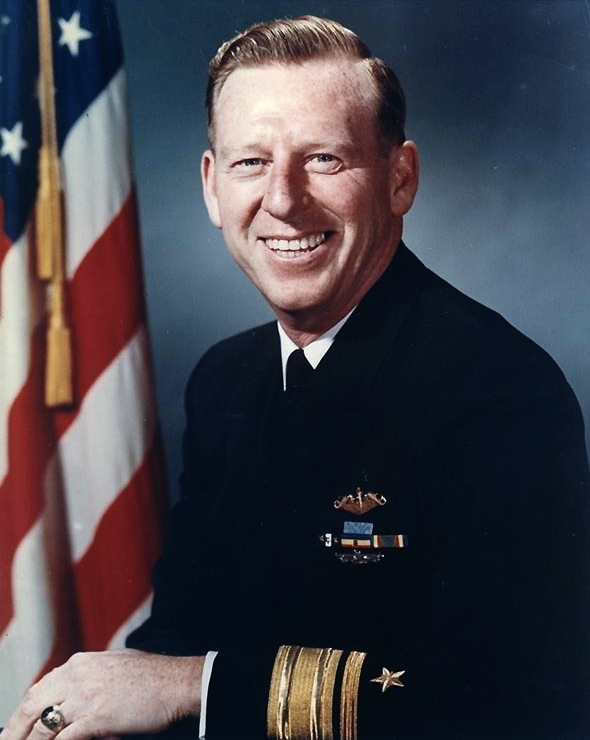
Eugene B. Fluckey
Eugene Bennett Fluckey (October 5, 1913 – June 28, 2007), nicknamed "Lucky Fluckey", was a United States Navy rear admiral who received the Medal of Honor and four Navy Crosses during his service as a submarine commander in World War II.
After 37 years on active duty in the U.S. Navy, Fluckey retired in 1972, publishing a memoir, Thunder Below! twenty years later in 1992. In his recollections, Fluckey credited his Medal of Honor to the actions of the entire crew of USS Barb, detailing his efforts to ensure their valor was properly recognized. Fluckey remained active in the veterans' community for the remainder of his life, and together with his wife Marjorie (and his second wife, Margaret) ran an orphanage in Portugal from 1974 to 1982.
Fluckey died in 2007 at age 93; he is buried at the United States Naval Academy Cemetery.
Fluckey was born in Washington, D.C., on October 5, 1913. He graduated from Western High School in Washington at age 15. He was too young to go to college, so his father sent him to the Mercersburg Academy in Mercersburg, Pennsylvania. He also was a member of the Boy Scouts, achieving the rank of Eagle Scout. He prepared for the Naval Academy at Columbian Preparatory School, Washington.
Fluckey entered the United States Naval Academy on June 13, 1931, graduated and was commissioned an Ensign on June 6, 1935. One of his classmates was Samuel Adams.
His initial assignments with the Navy were aboard the battleship USS Nevada (BB-36), and in May 1936 he was transferred to the destroyer USS McCormick (DD-223). In June 1938, he reported for instruction at the Submarine School, New London, Connecticut, and upon completion in December, he served on the submarine USS S-42 (SS-153), and in June 1941, he was assigned to the submarine USS Bonita (SS-165).
He completed five war patrols on the Bonita and after he was detached from the submarine in June 1942, he returned to Annapolis for graduate instruction in naval engineering. In December 1943, he attended the Prospective Commanding Officer's School at the Submarine Base New London until January 1944, then reported to Commander Submarine Force, Pacific Fleet. After one war patrol as the prospective commanding officer of the submarine USS Barb (SS-220), he became the submarine's seventh commander in January 1944 to August 1945. Fluckey established himself as one of the greatest submarine skippers, credited with the second most tonnage sunk by a U.S. Naval skipper during World War II (after Richard O'Kane) at 179,700 tons: to include 25 ships including a carrier, cruiser, and frigate.
In one of the more unusual incidents in the war, Fluckey sent a landing party ashore to set demolition charges on a coastal railway line on Sakhalin Island (then part of Japan's Karafuto Prefecture), destroying a 16-car train. This was the sole landing by U.S. military forces on the Japanese home islands during World War II. Fluckey ordered that this landing party be composed of crewmen from every division on his submarine. "He chose an eight-man team with no married men to blow up the train", Captain Max Duncan said, who served as Torpedo Officer on the Barb during this time. "He also wanted former Boy Scouts because he thought they could find their way back. They were paddling back to the ship when the train blew up." The selected crewmen were Paul Saunders, William Hatfield, Francis Sever, Lawrence Newland, Edward Klinglesmith, James Richard, John Markuson, and William Walker. Hatfield wired the explosive charge, using a microswitch under the rails to trigger the explosion.
Hub AI
Eugene B. Fluckey AI simulator
(@Eugene B. Fluckey_simulator)
Eugene B. Fluckey
Eugene Bennett Fluckey (October 5, 1913 – June 28, 2007), nicknamed "Lucky Fluckey", was a United States Navy rear admiral who received the Medal of Honor and four Navy Crosses during his service as a submarine commander in World War II.
After 37 years on active duty in the U.S. Navy, Fluckey retired in 1972, publishing a memoir, Thunder Below! twenty years later in 1992. In his recollections, Fluckey credited his Medal of Honor to the actions of the entire crew of USS Barb, detailing his efforts to ensure their valor was properly recognized. Fluckey remained active in the veterans' community for the remainder of his life, and together with his wife Marjorie (and his second wife, Margaret) ran an orphanage in Portugal from 1974 to 1982.
Fluckey died in 2007 at age 93; he is buried at the United States Naval Academy Cemetery.
Fluckey was born in Washington, D.C., on October 5, 1913. He graduated from Western High School in Washington at age 15. He was too young to go to college, so his father sent him to the Mercersburg Academy in Mercersburg, Pennsylvania. He also was a member of the Boy Scouts, achieving the rank of Eagle Scout. He prepared for the Naval Academy at Columbian Preparatory School, Washington.
Fluckey entered the United States Naval Academy on June 13, 1931, graduated and was commissioned an Ensign on June 6, 1935. One of his classmates was Samuel Adams.
His initial assignments with the Navy were aboard the battleship USS Nevada (BB-36), and in May 1936 he was transferred to the destroyer USS McCormick (DD-223). In June 1938, he reported for instruction at the Submarine School, New London, Connecticut, and upon completion in December, he served on the submarine USS S-42 (SS-153), and in June 1941, he was assigned to the submarine USS Bonita (SS-165).
He completed five war patrols on the Bonita and after he was detached from the submarine in June 1942, he returned to Annapolis for graduate instruction in naval engineering. In December 1943, he attended the Prospective Commanding Officer's School at the Submarine Base New London until January 1944, then reported to Commander Submarine Force, Pacific Fleet. After one war patrol as the prospective commanding officer of the submarine USS Barb (SS-220), he became the submarine's seventh commander in January 1944 to August 1945. Fluckey established himself as one of the greatest submarine skippers, credited with the second most tonnage sunk by a U.S. Naval skipper during World War II (after Richard O'Kane) at 179,700 tons: to include 25 ships including a carrier, cruiser, and frigate.
In one of the more unusual incidents in the war, Fluckey sent a landing party ashore to set demolition charges on a coastal railway line on Sakhalin Island (then part of Japan's Karafuto Prefecture), destroying a 16-car train. This was the sole landing by U.S. military forces on the Japanese home islands during World War II. Fluckey ordered that this landing party be composed of crewmen from every division on his submarine. "He chose an eight-man team with no married men to blow up the train", Captain Max Duncan said, who served as Torpedo Officer on the Barb during this time. "He also wanted former Boy Scouts because he thought they could find their way back. They were paddling back to the ship when the train blew up." The selected crewmen were Paul Saunders, William Hatfield, Francis Sever, Lawrence Newland, Edward Klinglesmith, James Richard, John Markuson, and William Walker. Hatfield wired the explosive charge, using a microswitch under the rails to trigger the explosion.