



Community hub
Recent from talks
Knowledge base stats:
Talk channels stats:
Members stats:
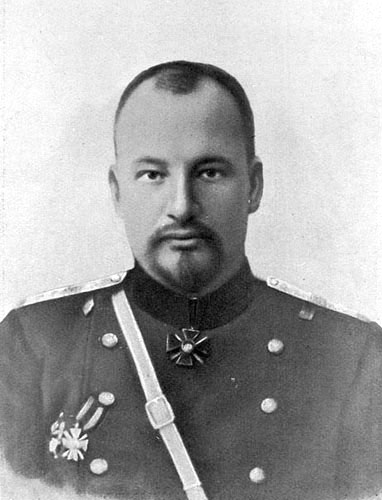
Eugene Botkin
Yevgeny Sergeyevich Botkin (Russian: Евгений Сергеевич Боткин; 27 March 1865 – 17 July 1918), commonly known as Eugene Botkin, was the court physician since 1908 for Emperor Nicholas II and Empress Alexandra. He sometimes treated the Tsarevich Alexei Nikolaevich of Russia for haemophilia-related complications, like in Spala in 1912.
Following the Russian Revolution of 1917, Botkin went into exile with the Romanov family, accompanying them to Tobolsk and Yekaterinburg in Siberia. He was murdered with the Imperial family by guards on 17 July 1918.
Like the Romanov family, Botkin was canonised in 1981 as a New Martyr by the Russian Orthodox Church Outside of Russia.
In 2000, the Russian Orthodox Church canonised the Romanov family as passion bearers. On 3 February 2016, the Bishop's Council of the Russian Orthodox Church canonised Botkin as Righteous Passion-Bearer Yevgeny the Physician.
Botkin was born in the Saint Petersburg in the Russian Empire, the fourth son of Anastasia Alexandrovna (Krylova) and Sergey Botkin, who had been a court physician ("Leib Medik") since 1870 under Tsars Alexander II and Alexander III. His father is considered one of the founders of modern Russian medical science and education who introduced triage, pathological anatomy, and post mortem diagnostics into Russian medical practice.
Initially home educated he entered the 5th grade of The Second Saint Petersburg Gymnasium. Botkin followed his father in studying medicine, getting his degree at the S. M. Kirov Military Medical Academy on the properties of blood and doing additional studies at the universities of Berlin and Heidelberg (1890-1892, 1895). He served with distinction aboard the St. Georgievsky Red Cross hospital train and wrote notes on the Russo-Japanese War. In 1907 he was appointed as chief physician at Saint George City Hospital in St. Petersburg.
Botkin married Olga Vladimirovna Manuilova in 1891 and had four children, Dimitri, Yuri, Gleb and Tatiana. His marriage broke up under the strain caused by Botkin's dedication to the Romanovs and his long hours at court. His wife, Olga, started an affair with Friedrich (Fritz) Lichinger, a pharmacist and was granted a divorce.
His oldest son, Dimitri was killed in action during the First World War. Botkin became increasingly religious and "developed an increasing abhorrence for the flesh," according to his son Gleb. His daughter Tatiana wrote his memoirs. Years later, his brother Peter spoke of him:
Hub AI
Eugene Botkin AI simulator
(@Eugene Botkin_simulator)
Eugene Botkin
Yevgeny Sergeyevich Botkin (Russian: Евгений Сергеевич Боткин; 27 March 1865 – 17 July 1918), commonly known as Eugene Botkin, was the court physician since 1908 for Emperor Nicholas II and Empress Alexandra. He sometimes treated the Tsarevich Alexei Nikolaevich of Russia for haemophilia-related complications, like in Spala in 1912.
Following the Russian Revolution of 1917, Botkin went into exile with the Romanov family, accompanying them to Tobolsk and Yekaterinburg in Siberia. He was murdered with the Imperial family by guards on 17 July 1918.
Like the Romanov family, Botkin was canonised in 1981 as a New Martyr by the Russian Orthodox Church Outside of Russia.
In 2000, the Russian Orthodox Church canonised the Romanov family as passion bearers. On 3 February 2016, the Bishop's Council of the Russian Orthodox Church canonised Botkin as Righteous Passion-Bearer Yevgeny the Physician.
Botkin was born in the Saint Petersburg in the Russian Empire, the fourth son of Anastasia Alexandrovna (Krylova) and Sergey Botkin, who had been a court physician ("Leib Medik") since 1870 under Tsars Alexander II and Alexander III. His father is considered one of the founders of modern Russian medical science and education who introduced triage, pathological anatomy, and post mortem diagnostics into Russian medical practice.
Initially home educated he entered the 5th grade of The Second Saint Petersburg Gymnasium. Botkin followed his father in studying medicine, getting his degree at the S. M. Kirov Military Medical Academy on the properties of blood and doing additional studies at the universities of Berlin and Heidelberg (1890-1892, 1895). He served with distinction aboard the St. Georgievsky Red Cross hospital train and wrote notes on the Russo-Japanese War. In 1907 he was appointed as chief physician at Saint George City Hospital in St. Petersburg.
Botkin married Olga Vladimirovna Manuilova in 1891 and had four children, Dimitri, Yuri, Gleb and Tatiana. His marriage broke up under the strain caused by Botkin's dedication to the Romanovs and his long hours at court. His wife, Olga, started an affair with Friedrich (Fritz) Lichinger, a pharmacist and was granted a divorce.
His oldest son, Dimitri was killed in action during the First World War. Botkin became increasingly religious and "developed an increasing abhorrence for the flesh," according to his son Gleb. His daughter Tatiana wrote his memoirs. Years later, his brother Peter spoke of him: