
Recent from talks
Euler's sum of powers conjecture
Knowledge base stats:
Talk channels stats:
Members stats:
Euler's sum of powers conjecture
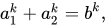
In number theory, Euler's conjecture is a disproved conjecture related to Fermat's Last Theorem. It was proposed by Leonhard Euler in 1769. It states that for all integers n and k greater than 1, if the sum of n many kth powers of positive integers is itself a kth power, then n is greater than or equal to k:

The conjecture represents an attempt to generalize Fermat's Last Theorem, which is the special case n = 2: if then 2 ≥ k.
Although the conjecture holds for the case k = 3 (which follows from Fermat's Last Theorem for the third powers), it was disproved for k = 4 and k = 5. It is unknown whether the conjecture fails or holds for any value k ≥ 6.
Euler was aware of the equality 594 + 1584 = 1334 + 1344 involving sums of four fourth powers; this, however, is not a counterexample because no term is isolated on one side of the equation. He also provided a complete solution to the four cubes problem as in Plato's number 33 + 43 + 53 = 63 or the taxicab number 1729. The general solution of the equation is

![{\displaystyle {\begin{aligned}x_{1}&=\lambda (1-(a-3b)(a^{2}+3b^{2}))\\[2pt]x_{2}&=\lambda ((a+3b)(a^{2}+3b^{2})-1)\\[2pt]x_{3}&=\lambda ((a+3b)-(a^{2}+3b^{2})^{2})\\[2pt]x_{4}&=\lambda ((a^{2}+3b^{2})^{2}-(a-3b))\end{aligned}}}](https://wikimedia.org/api/rest_v1/media/math/render/svg/5c3555d6509d4741068f4d6080fb5b774d0b3343)
where a, b and are any rational numbers.

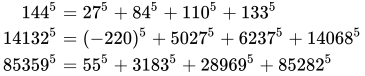
Euler's conjecture was disproven by L. J. Lander and T. R. Parkin in 1966 when, through a direct computer search on a CDC 6600, they found a counterexample for k = 5. This was published in a paper comprising just two sentences. A total of three primitive (that is, in which the summands do not all have a common factor) counterexamples are known: (Lander & Parkin, 1966); (Scher & Seidl, 1996); (Frye, 2004).
Hub AI
Euler's sum of powers conjecture AI simulator
(@Euler's sum of powers conjecture_simulator)
Euler's sum of powers conjecture
In number theory, Euler's conjecture is a disproved conjecture related to Fermat's Last Theorem. It was proposed by Leonhard Euler in 1769. It states that for all integers n and k greater than 1, if the sum of n many kth powers of positive integers is itself a kth power, then n is greater than or equal to k:
The conjecture represents an attempt to generalize Fermat's Last Theorem, which is the special case n = 2: if then 2 ≥ k.
Although the conjecture holds for the case k = 3 (which follows from Fermat's Last Theorem for the third powers), it was disproved for k = 4 and k = 5. It is unknown whether the conjecture fails or holds for any value k ≥ 6.
Euler was aware of the equality 594 + 1584 = 1334 + 1344 involving sums of four fourth powers; this, however, is not a counterexample because no term is isolated on one side of the equation. He also provided a complete solution to the four cubes problem as in Plato's number 33 + 43 + 53 = 63 or the taxicab number 1729. The general solution of the equation is
where a, b and are any rational numbers.
Euler's conjecture was disproven by L. J. Lander and T. R. Parkin in 1966 when, through a direct computer search on a CDC 6600, they found a counterexample for k = 5. This was published in a paper comprising just two sentences. A total of three primitive (that is, in which the summands do not all have a common factor) counterexamples are known: (Lander & Parkin, 1966); (Scher & Seidl, 1996); (Frye, 2004).