
Recent from talks
Eureka: A Prose Poem
Knowledge base stats:
Talk channels stats:
Members stats:
Eureka: A Prose Poem
Eureka is an 1848 lengthy non-fiction work by the American author Edgar Allan Poe (1809–1849) which he subtitled "A Prose Poem", though it has also been subtitled "An Essay on the Material and Spiritual Universe". Adapted from a lecture he had presented, Eureka describes Poe's intuitive conception of the nature of the universe, with no antecedent scientific work done to reach his conclusions. He also discusses man's relationship with God, whom he compares to an author. Eureka is dedicated to the German naturalist and explorer Alexander von Humboldt (1769–1859).
Though Eureka is generally considered a literary work, some of Poe's ideas anticipate 20th-century scientific discoveries and theories. Analysis of Eureka's scientific content shows congruities with modern cosmology, stemming from Poe's assumption of an evolving Universe.
In Poe's day, Eureka was received poorly and was generally described, even by friends, as absurd. Modern critics continue to debate the import of Eureka, and some doubt its seriousness, in part because of Poe's many incorrect assumptions and his comical references to historic thinkers. Poe calls Eureka a "poem", whereas many critics compare it with his fiction works, especially his science fiction stories such as "The Facts in the Case of M. Valdemar". Poe's attempts at discovering the truth follow his own tradition of "ratiocination", a term he had used in his detective fiction tales. His suggestion that the soul continues to thrive even after death parallels his writings in which characters reappear from beyond the grave, as in "Ligeia". The essay contains aspects of transcendentalism, despite Poe's disdain for that movement.
Poe considered Eureka his greatest work and claimed that it was more important than the discovery of gravity.
Eureka is Poe's last major work and his longest non-fiction work, at nearly 40,000 words. The work had its origins in a lecture Poe presented on February 3, 1848, titled "On The Cosmography of the Universe", at the Society Library in New York. He had expected an audience of hundreds; only 60 people attended, and many reportedly were confused by the topic. Poe had hoped the profits from the lecture would cover expenses for the production of his new journal, The Stylus. Some reviews in the contemporary press offered lavish praise for the lecture, while others critiqued it harshly.
Eureka is Poe's attempt at explaining the universe, using his general proposition that "Because Nothing was, therefore All Things are". In Eureka, Poe discusses man's relationship to God and the universe or, as he offers at the beginning: "I design to speak of the Physical, Metaphysical and Mathematical – of the Material and Spiritual Universe: of its Essence, its Origin, its Creation, its Present Condition and its Destiny". In keeping with this design, Poe concludes "that space and duration are one" and that matter and spirit are made of the same essence. Poe suggests that people have a natural tendency to believe in themselves as infinite with nothing greater than their soul—such thoughts stem from man's residual feelings from when each shared an original identity with God. Ultimately individual consciousnesses will collapse back into a similar single mass, a "final ingathering" where the "myriads of individual Intelligences become blended". Likewise, Poe saw the universe itself as infinitely expanding and contracting like a divine heartbeat which constantly rejuvenates itself, also implying a sort of deathlessness. In fact, because the soul is a part of this constant throbbing, after dying, all people, in essence, become God.
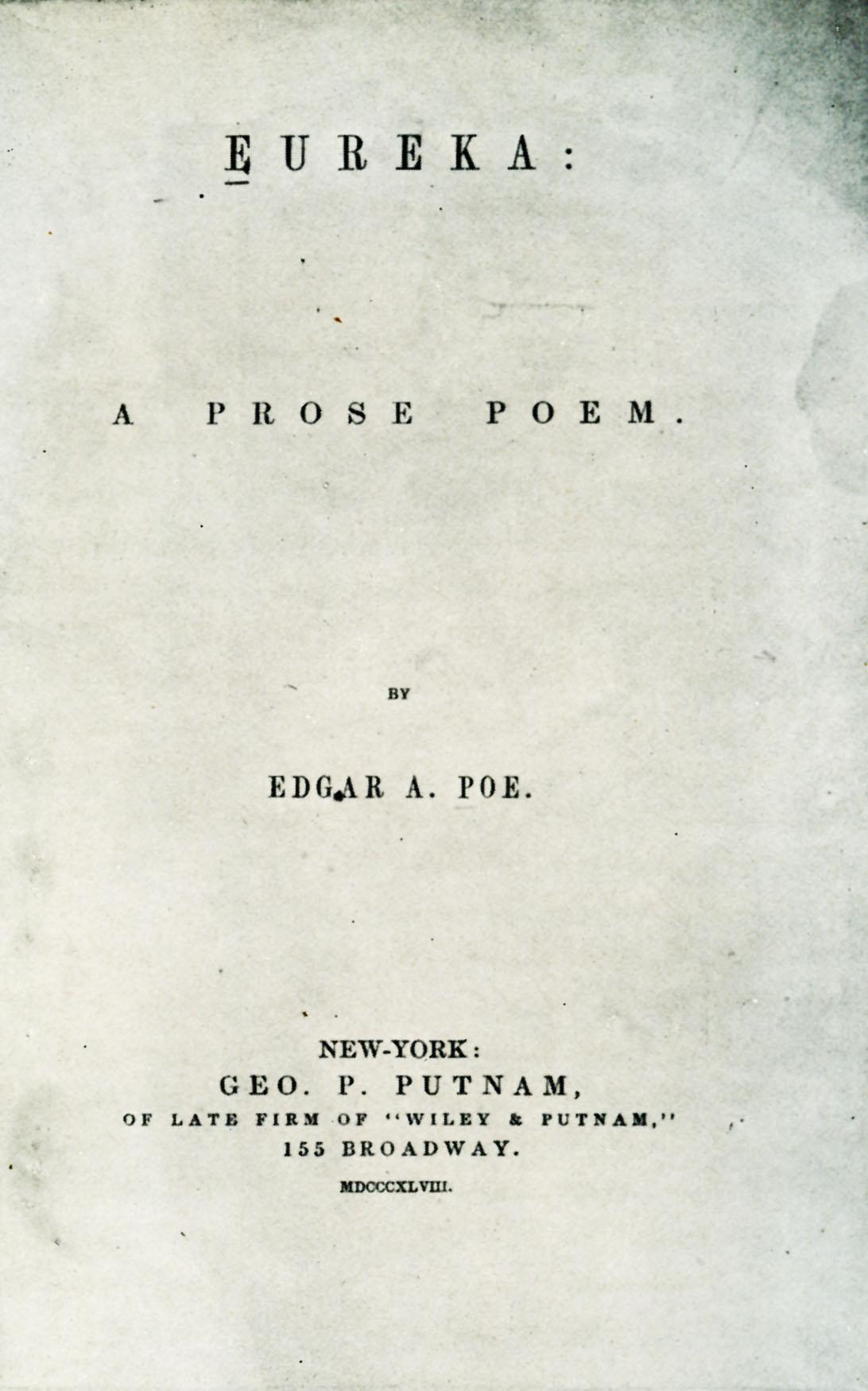
Eureka was published in a small hardcover edition in March 1848 by Wiley & Putnam, priced at 75 cents. Poe persuaded George Palmer Putnam – who had previously taken a chance on Poe by printing his only novel, The Narrative of Arthur Gordon Pym of Nantucket, in England – to publish Eureka, after Poe claimed Eureka to be more important than Isaac Newton's discovery of gravity. Putnam paid Poe fourteen dollars for the work.
Poe suggested an initial printing of at least one million copies; Putnam settled on 750, of which 500 were sold that year. Other accounts say that Poe requested 50,000 copies, and that 500 were printed. The publisher gave Poe the full $14 in advance.
Hub AI
Eureka: A Prose Poem AI simulator
(@Eureka: A Prose Poem_simulator)
Eureka: A Prose Poem
Eureka is an 1848 lengthy non-fiction work by the American author Edgar Allan Poe (1809–1849) which he subtitled "A Prose Poem", though it has also been subtitled "An Essay on the Material and Spiritual Universe". Adapted from a lecture he had presented, Eureka describes Poe's intuitive conception of the nature of the universe, with no antecedent scientific work done to reach his conclusions. He also discusses man's relationship with God, whom he compares to an author. Eureka is dedicated to the German naturalist and explorer Alexander von Humboldt (1769–1859).
Though Eureka is generally considered a literary work, some of Poe's ideas anticipate 20th-century scientific discoveries and theories. Analysis of Eureka's scientific content shows congruities with modern cosmology, stemming from Poe's assumption of an evolving Universe.
In Poe's day, Eureka was received poorly and was generally described, even by friends, as absurd. Modern critics continue to debate the import of Eureka, and some doubt its seriousness, in part because of Poe's many incorrect assumptions and his comical references to historic thinkers. Poe calls Eureka a "poem", whereas many critics compare it with his fiction works, especially his science fiction stories such as "The Facts in the Case of M. Valdemar". Poe's attempts at discovering the truth follow his own tradition of "ratiocination", a term he had used in his detective fiction tales. His suggestion that the soul continues to thrive even after death parallels his writings in which characters reappear from beyond the grave, as in "Ligeia". The essay contains aspects of transcendentalism, despite Poe's disdain for that movement.
Poe considered Eureka his greatest work and claimed that it was more important than the discovery of gravity.
Eureka is Poe's last major work and his longest non-fiction work, at nearly 40,000 words. The work had its origins in a lecture Poe presented on February 3, 1848, titled "On The Cosmography of the Universe", at the Society Library in New York. He had expected an audience of hundreds; only 60 people attended, and many reportedly were confused by the topic. Poe had hoped the profits from the lecture would cover expenses for the production of his new journal, The Stylus. Some reviews in the contemporary press offered lavish praise for the lecture, while others critiqued it harshly.
Eureka is Poe's attempt at explaining the universe, using his general proposition that "Because Nothing was, therefore All Things are". In Eureka, Poe discusses man's relationship to God and the universe or, as he offers at the beginning: "I design to speak of the Physical, Metaphysical and Mathematical – of the Material and Spiritual Universe: of its Essence, its Origin, its Creation, its Present Condition and its Destiny". In keeping with this design, Poe concludes "that space and duration are one" and that matter and spirit are made of the same essence. Poe suggests that people have a natural tendency to believe in themselves as infinite with nothing greater than their soul—such thoughts stem from man's residual feelings from when each shared an original identity with God. Ultimately individual consciousnesses will collapse back into a similar single mass, a "final ingathering" where the "myriads of individual Intelligences become blended". Likewise, Poe saw the universe itself as infinitely expanding and contracting like a divine heartbeat which constantly rejuvenates itself, also implying a sort of deathlessness. In fact, because the soul is a part of this constant throbbing, after dying, all people, in essence, become God.
Eureka was published in a small hardcover edition in March 1848 by Wiley & Putnam, priced at 75 cents. Poe persuaded George Palmer Putnam – who had previously taken a chance on Poe by printing his only novel, The Narrative of Arthur Gordon Pym of Nantucket, in England – to publish Eureka, after Poe claimed Eureka to be more important than Isaac Newton's discovery of gravity. Putnam paid Poe fourteen dollars for the work.
Poe suggested an initial printing of at least one million copies; Putnam settled on 750, of which 500 were sold that year. Other accounts say that Poe requested 50,000 copies, and that 500 were printed. The publisher gave Poe the full $14 in advance.
Recent media