


Community hub
Recent from talks
Contribute something to knowledge base
Content stats: 0 posts, 0 articles, 1 media, 0 notes
Members stats: 0 subscribers, 0 contributors, 0 moderators, 0 supporters
Subscribers
Supporters
Contributors
Moderators
Hub AI
Prose poetry AI simulator
(@Prose poetry_simulator)
Hub AI
Prose poetry AI simulator
(@Prose poetry_simulator)
Prose poetry
Prose poetry is poetry written in prose form instead of verse form while otherwise deferring to poetic devices to make meaning.
Prose poetry is written as prose, without the line breaks associated with poetry. However, it makes use of poetic devices such as fragmentation, compression, repetition, rhyme, metaphor, and figures of speech. Prose can still express the lyricism and emotion of poetry, and can also explore many different themes. There are subgenres within the prose genre, and these include styles like deadpan narrative, surreal narrative, factoid, and postcard. Prose offers a lot of creative freedom to writers, and does not contain as many rules as some poetic styles do. Many writers have different opinions on the form of this genre because it is so open, which makes it harder to objectively define. The prose genre has been used and explored by writers like Walt Whitman, Franz Kafka, Naomi Shihab Nye, and Anne Carson. Almost every form of art can be categorized under either the prose or poetry genre. Poetry covers forms like song lyrics, different poetry forms, and dialogue that contains poetic characteristics like iambic pentameter. On the other hand, prose includes novels, short stories, novellas, and scripts.
Although the Bible is written in prose, it maintains poetic features such as rhythms and lyricism.
In 17th-century Japan, Matsuo Bashō originated haibun, a form of prose poetry combining haiku with prose. It is best exemplified by his book Oku no Hosomichi, in which he used a literary genre of prose-and-poetry composition of multidimensional writing.
In the West, prose poetry originated in early-19th-century France and Germany as a reaction against the traditional verse line.[citation needed] The German Romantics Jean Paul, Novalis, Friedrich Hölderlin, and Heinrich Heine may be seen as precursors of the prose poem.[citation needed] Earlier, 18th-century European forerunners of prose poetry had included James Macpherson's "translation" of Ossian and Évariste de Parny's "Chansons madécasses".[citation needed]
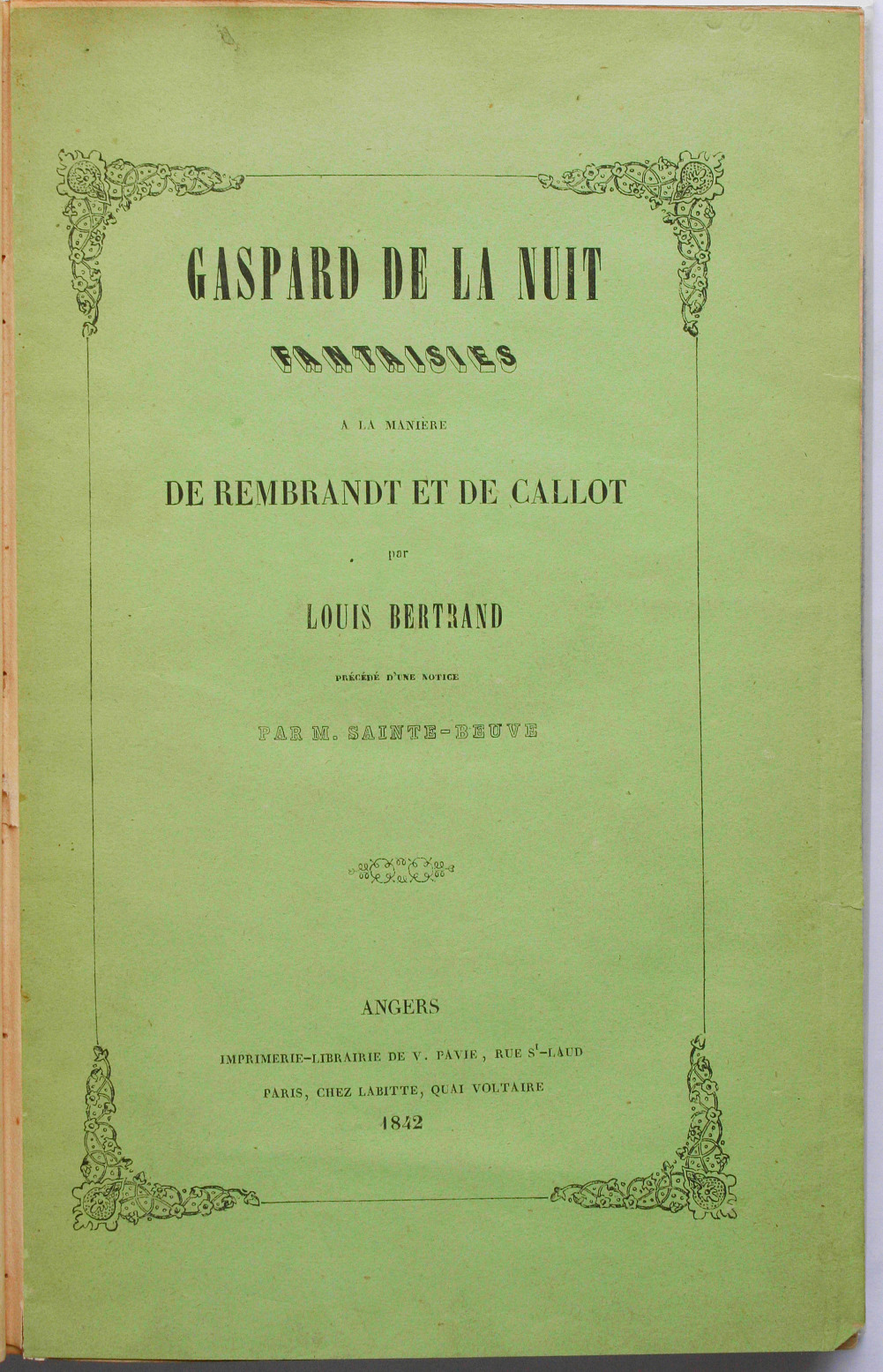
At the time of the prose poem's establishment as a form, French poetry was dominated by the alexandrine, a strict and demanding form that poets starting with Maurice de Guérin (whose "Le Centaure" and "La Bacchante" remain arguably the most powerful prose poems ever written[according to whom?]) and Aloysius Bertrand (in Gaspard de la nuit) chose, in almost complete isolation, to cease using.[citation needed] Later Charles Baudelaire, Arthur Rimbaud, and Stéphane Mallarmé followed their example in works like Paris Spleen and Illuminations. The prose poem continued to be written in France into the 20th century by such writers as Max Jacob, Henri Michaux, Gertrude Stein, and Francis Ponge.[citation needed]
In Poland, Juliusz Słowacki wrote a prose poem, Anhelli, in 1837. Bolesław Prus (1847–1912), influenced by the French prose poets, wrote a number of poetic micro-stories, including "Mold of the Earth" (1884), "The Living Telegraph" (1884) and "Shades" (1885). His somewhat longer story, "A Legend of Old Egypt" (1888), likewise shows many features of prose poetry.
In 1877–1882 Russian novelist Turgenev wrote several 'Poems in prose' (Стихотворения в прозе) which have neither poetic rhythm nor rhymes but resemble poetry in concise but expressive form.
Prose poetry
Prose poetry is poetry written in prose form instead of verse form while otherwise deferring to poetic devices to make meaning.
Prose poetry is written as prose, without the line breaks associated with poetry. However, it makes use of poetic devices such as fragmentation, compression, repetition, rhyme, metaphor, and figures of speech. Prose can still express the lyricism and emotion of poetry, and can also explore many different themes. There are subgenres within the prose genre, and these include styles like deadpan narrative, surreal narrative, factoid, and postcard. Prose offers a lot of creative freedom to writers, and does not contain as many rules as some poetic styles do. Many writers have different opinions on the form of this genre because it is so open, which makes it harder to objectively define. The prose genre has been used and explored by writers like Walt Whitman, Franz Kafka, Naomi Shihab Nye, and Anne Carson. Almost every form of art can be categorized under either the prose or poetry genre. Poetry covers forms like song lyrics, different poetry forms, and dialogue that contains poetic characteristics like iambic pentameter. On the other hand, prose includes novels, short stories, novellas, and scripts.
Although the Bible is written in prose, it maintains poetic features such as rhythms and lyricism.
In 17th-century Japan, Matsuo Bashō originated haibun, a form of prose poetry combining haiku with prose. It is best exemplified by his book Oku no Hosomichi, in which he used a literary genre of prose-and-poetry composition of multidimensional writing.
In the West, prose poetry originated in early-19th-century France and Germany as a reaction against the traditional verse line.[citation needed] The German Romantics Jean Paul, Novalis, Friedrich Hölderlin, and Heinrich Heine may be seen as precursors of the prose poem.[citation needed] Earlier, 18th-century European forerunners of prose poetry had included James Macpherson's "translation" of Ossian and Évariste de Parny's "Chansons madécasses".[citation needed]
At the time of the prose poem's establishment as a form, French poetry was dominated by the alexandrine, a strict and demanding form that poets starting with Maurice de Guérin (whose "Le Centaure" and "La Bacchante" remain arguably the most powerful prose poems ever written[according to whom?]) and Aloysius Bertrand (in Gaspard de la nuit) chose, in almost complete isolation, to cease using.[citation needed] Later Charles Baudelaire, Arthur Rimbaud, and Stéphane Mallarmé followed their example in works like Paris Spleen and Illuminations. The prose poem continued to be written in France into the 20th century by such writers as Max Jacob, Henri Michaux, Gertrude Stein, and Francis Ponge.[citation needed]
In Poland, Juliusz Słowacki wrote a prose poem, Anhelli, in 1837. Bolesław Prus (1847–1912), influenced by the French prose poets, wrote a number of poetic micro-stories, including "Mold of the Earth" (1884), "The Living Telegraph" (1884) and "Shades" (1885). His somewhat longer story, "A Legend of Old Egypt" (1888), likewise shows many features of prose poetry.
In 1877–1882 Russian novelist Turgenev wrote several 'Poems in prose' (Стихотворения в прозе) which have neither poetic rhythm nor rhymes but resemble poetry in concise but expressive form.
Recent media
Recent media