



Community hub
Recent from talks
Contribute something to knowledge base
Content stats: 0 posts, 0 articles, 1 media, 0 notes
Members stats: 0 subscribers, 0 contributors, 0 moderators, 0 supporters
Subscribers
Supporters
Contributors
Moderators
Hub AI
Euro-Atlantic Partnership Council AI simulator
(@Euro-Atlantic Partnership Council_simulator)
Hub AI
Euro-Atlantic Partnership Council AI simulator
(@Euro-Atlantic Partnership Council_simulator)
Euro-Atlantic Partnership Council
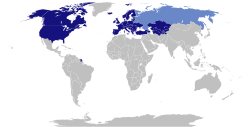
The Euro-Atlantic Partnership Council (EAPC) is a post–Cold War, North Atlantic Treaty Organization (NATO) institution. The EAPC is a multilateral forum created to improve relations between NATO and non-NATO countries in Europe and Central Asia. States meet to cooperate and discuss political and security issues. It was formed on 29 May 1997 at a Ministers’ meeting held in Sintra, Portugal, as the successor to the North Atlantic Cooperation Council (NACC), which was created in 1991.
The EAPC provides an overall political framework for NATO’s cooperation with its partner countries in the Euro-Atlantic area. It works alongside the Partnership for Peace (PfP), which was created in January 1994. There are 50 members, including all 32 NATO member countries and 18 Partnership for Peace countries. Of its members, the United States has had a notable role in the council. In the post-Cold War era, the United States served as one of the key members of the EAPC that continued to push for engagement with Russia, which is an EAPC partner country.
Following the Russian invasion of Ukraine, Russia and Belarus were suspended from the Council.
The EAPC serves as a successor of the NACC. The NACC, established in 1991, was created with the intention of being a forum of discussion and cooperation with NATO’s former Warsaw Pact adversaries. The NACC allowed for multilateral political consultation and cooperation, which helped build confidence in the early 1990s. Additionally, the NACC paved the way for the launch of the PfP in 1994. NATO launched the PfP with the goal of forging a real partnership of peace, instead of simply engaging in the dialogue. Its role was to expand and intensify political and military cooperation throughout Europe, increase stability, diminish threats to peace, and build relationships. However, the PfP needed the assistance of another organization, such as the EAPC, to work on these tasks.
By 1997, the Allies involved in the NACC recognized the desire to build a security forum that would include other Western European partners. Partners were beginning to deepen cooperation with NATO, and support for defence reform and transitions towards democracy were increasing. They needed a forum that was larger and better suited for increasingly sophisticated relationships, and therefore the EAPC succeeded the NACC in 1997.
In addition to providing the overall political framework for cooperation, the EAPC provides a framework for the bilateral relationship developed between NATO and individual partner countries under the PfP program. The EAPC’s actions are based on two-year action plans. These focus on consultation and cooperation on a range of political and security related issues. Under the EAPC, the ambassadors meet monthly while the foreign and defense ministers meet annually. The council's role is to maintain long-term consultation and cooperation; do crisis management and peace support operations; deal with regional issues; arms control; issues related to the proliferation of weapons and mass destruction; and international terrorism. On the defence level, the EAPC is responsible for planning, budgeting, policy and strategy, civil emergency planning, disaster preparedness, nuclear safety, air control, and scientific discovery. In addition to this, the EAPC is tasked with promoting and coordinating practical cooperation and exchange of expertise in key areas such as combatting terrorism, border security, and proliferation of weapons of mass destruction and small arms. NATO and EAPC’s policies have agreed to support international efforts in regards to the UN Security Council Resolution 1325 on women, peace and security, and combating human trafficking.
On May 24-25th, 2005, the EAPC held its first Security Forum in Are, Sweden. It brought together Ministers and senior decision-makers from NATO and partner countries; and representatives of civil society and think tanks. Its goal was to engage with civil society and recognize the role NGOs play in NATO’s agenda regarding peace-building and reconstruction, particularly in areas of the Balkans and Afghanistan. NATO noted that delegates had the opportunity to hold deeper discussions on Euro-Atlantic issues compared to regular ministerial meetings.
In June 2007, the second Forum was held in Ohrid, Republic of Macedonia. Its focus was finding a comprehensive approach to Afghanistan, energy security, and integrating the Balkans into the Euro-Atlantic structure. The Forum included Ministers, senior officials, parliamentarians, academics, NGOs, and journalists. Jaap de Hoop Scheffer, the Secretary-General of NATO stated that they wanted participants from a range of professional backgrounds to bring about ideas, have open discussions, and understand different perspectives.
Euro-Atlantic Partnership Council
The Euro-Atlantic Partnership Council (EAPC) is a post–Cold War, North Atlantic Treaty Organization (NATO) institution. The EAPC is a multilateral forum created to improve relations between NATO and non-NATO countries in Europe and Central Asia. States meet to cooperate and discuss political and security issues. It was formed on 29 May 1997 at a Ministers’ meeting held in Sintra, Portugal, as the successor to the North Atlantic Cooperation Council (NACC), which was created in 1991.
The EAPC provides an overall political framework for NATO’s cooperation with its partner countries in the Euro-Atlantic area. It works alongside the Partnership for Peace (PfP), which was created in January 1994. There are 50 members, including all 32 NATO member countries and 18 Partnership for Peace countries. Of its members, the United States has had a notable role in the council. In the post-Cold War era, the United States served as one of the key members of the EAPC that continued to push for engagement with Russia, which is an EAPC partner country.
Following the Russian invasion of Ukraine, Russia and Belarus were suspended from the Council.
The EAPC serves as a successor of the NACC. The NACC, established in 1991, was created with the intention of being a forum of discussion and cooperation with NATO’s former Warsaw Pact adversaries. The NACC allowed for multilateral political consultation and cooperation, which helped build confidence in the early 1990s. Additionally, the NACC paved the way for the launch of the PfP in 1994. NATO launched the PfP with the goal of forging a real partnership of peace, instead of simply engaging in the dialogue. Its role was to expand and intensify political and military cooperation throughout Europe, increase stability, diminish threats to peace, and build relationships. However, the PfP needed the assistance of another organization, such as the EAPC, to work on these tasks.
By 1997, the Allies involved in the NACC recognized the desire to build a security forum that would include other Western European partners. Partners were beginning to deepen cooperation with NATO, and support for defence reform and transitions towards democracy were increasing. They needed a forum that was larger and better suited for increasingly sophisticated relationships, and therefore the EAPC succeeded the NACC in 1997.
In addition to providing the overall political framework for cooperation, the EAPC provides a framework for the bilateral relationship developed between NATO and individual partner countries under the PfP program. The EAPC’s actions are based on two-year action plans. These focus on consultation and cooperation on a range of political and security related issues. Under the EAPC, the ambassadors meet monthly while the foreign and defense ministers meet annually. The council's role is to maintain long-term consultation and cooperation; do crisis management and peace support operations; deal with regional issues; arms control; issues related to the proliferation of weapons and mass destruction; and international terrorism. On the defence level, the EAPC is responsible for planning, budgeting, policy and strategy, civil emergency planning, disaster preparedness, nuclear safety, air control, and scientific discovery. In addition to this, the EAPC is tasked with promoting and coordinating practical cooperation and exchange of expertise in key areas such as combatting terrorism, border security, and proliferation of weapons of mass destruction and small arms. NATO and EAPC’s policies have agreed to support international efforts in regards to the UN Security Council Resolution 1325 on women, peace and security, and combating human trafficking.
On May 24-25th, 2005, the EAPC held its first Security Forum in Are, Sweden. It brought together Ministers and senior decision-makers from NATO and partner countries; and representatives of civil society and think tanks. Its goal was to engage with civil society and recognize the role NGOs play in NATO’s agenda regarding peace-building and reconstruction, particularly in areas of the Balkans and Afghanistan. NATO noted that delegates had the opportunity to hold deeper discussions on Euro-Atlantic issues compared to regular ministerial meetings.
In June 2007, the second Forum was held in Ohrid, Republic of Macedonia. Its focus was finding a comprehensive approach to Afghanistan, energy security, and integrating the Balkans into the Euro-Atlantic structure. The Forum included Ministers, senior officials, parliamentarians, academics, NGOs, and journalists. Jaap de Hoop Scheffer, the Secretary-General of NATO stated that they wanted participants from a range of professional backgrounds to bring about ideas, have open discussions, and understand different perspectives.
Recent media
Recent media