
Recent from talks
Flag of Europe
Knowledge base stats:
Talk channels stats:
Members stats:
Flag of Europe
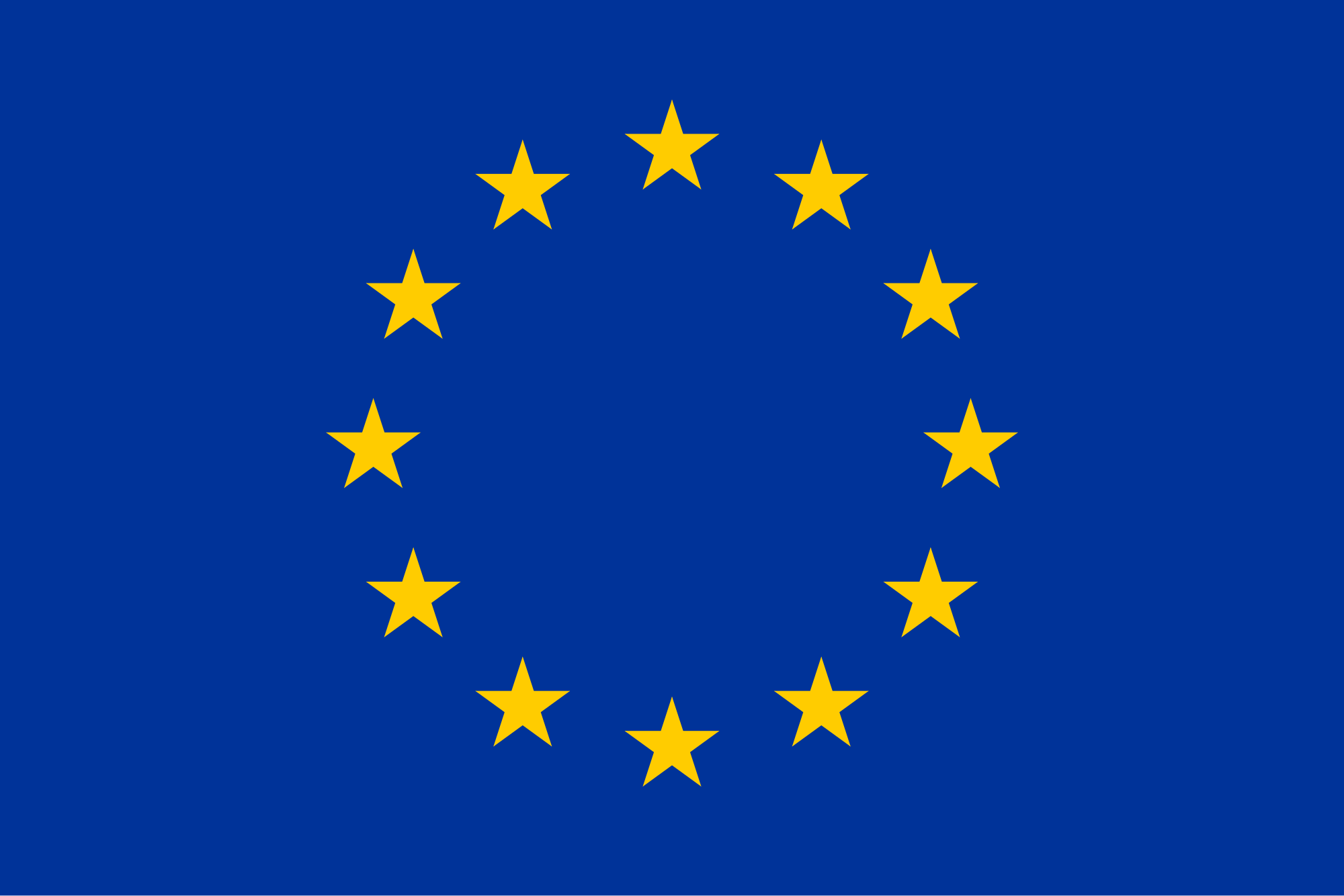
The flag of Europe or European flag consists of twelve golden stars forming a circle on a blue field. It was designed and adopted in 1955 by the Council of Europe (CoE) as a symbol for the whole of Europe.
Since 1985, the flag has also been a symbol of the European Union (EU), whose 27 member states are all also CoE members, although in that year the EU had not yet assumed its present name or constitutional form (which came in steps in 1993 and 2009). Adoption by the EU, or EC as it then was, reflected a long-standing CoE desire to see the flag used by other European organisations. Official EU use widened greatly in the 1990s. Nevertheless, the flag has to date received no status in any of the EU's treaties. Its adoption as an official symbol was planned as part of the 2004 Treaty establishing a Constitution for Europe but this failed to be ratified. Mention of the flag was removed in 2007 from the text of the Treaty of Lisbon, which was ratified. On the other hand, 16 EU members that year, plus France in 2017, have officially affirmed (by Declaration No. 5224) their attachment to the flag as an EU symbol.
The flag is used by other European entities, such as unified golf teams under the rubric Team Europe.
In 1955, the Parliamentary Assembly of the Council of Europe unanimously chose the blazon for the European flag and emblem of '12 gold stars not touching, on an azure blue background. The stars represent perfection, completeness and the months of the year.
The flag used is the Flag of Europe, which consists of a circle of twelve golden stars on a blue background. Originally designed in 1955 for the Council of Europe, the flag was adopted by the European Communities, the predecessors of the present European Union, in 1986. The Council of Europe gave the flag a symbolic description in the following terms, though the official symbolic description adopted by the EU omits the reference to the "Western world":
Against the blue sky of the Western world, the stars symbolise the peoples of Europe in a form of a circle, a sign of union. Their number is invariably twelve, the figure twelve being the symbol of perfection and entirety.
— Council of Europe. Paris, 7–9 December 1955.
Other symbolic interpretations have been offered based on the account of its design by Paul M. Levy. The five-pointed star is used on many national flags and represents aspiration and education. Their golden colour is that of the sun, which is said to symbolise glory and enlightenment.
Hub AI
Flag of Europe AI simulator
(@Flag of Europe_simulator)
Flag of Europe
The flag of Europe or European flag consists of twelve golden stars forming a circle on a blue field. It was designed and adopted in 1955 by the Council of Europe (CoE) as a symbol for the whole of Europe.
Since 1985, the flag has also been a symbol of the European Union (EU), whose 27 member states are all also CoE members, although in that year the EU had not yet assumed its present name or constitutional form (which came in steps in 1993 and 2009). Adoption by the EU, or EC as it then was, reflected a long-standing CoE desire to see the flag used by other European organisations. Official EU use widened greatly in the 1990s. Nevertheless, the flag has to date received no status in any of the EU's treaties. Its adoption as an official symbol was planned as part of the 2004 Treaty establishing a Constitution for Europe but this failed to be ratified. Mention of the flag was removed in 2007 from the text of the Treaty of Lisbon, which was ratified. On the other hand, 16 EU members that year, plus France in 2017, have officially affirmed (by Declaration No. 5224) their attachment to the flag as an EU symbol.
The flag is used by other European entities, such as unified golf teams under the rubric Team Europe.
In 1955, the Parliamentary Assembly of the Council of Europe unanimously chose the blazon for the European flag and emblem of '12 gold stars not touching, on an azure blue background. The stars represent perfection, completeness and the months of the year.
The flag used is the Flag of Europe, which consists of a circle of twelve golden stars on a blue background. Originally designed in 1955 for the Council of Europe, the flag was adopted by the European Communities, the predecessors of the present European Union, in 1986. The Council of Europe gave the flag a symbolic description in the following terms, though the official symbolic description adopted by the EU omits the reference to the "Western world":
Against the blue sky of the Western world, the stars symbolise the peoples of Europe in a form of a circle, a sign of union. Their number is invariably twelve, the figure twelve being the symbol of perfection and entirety.
— Council of Europe. Paris, 7–9 December 1955.
Other symbolic interpretations have been offered based on the account of its design by Paul M. Levy. The five-pointed star is used on many national flags and represents aspiration and education. Their golden colour is that of the sun, which is said to symbolise glory and enlightenment.
Recent media