


Community hub
Recent from talks
Contribute something to knowledge base
Content stats: 0 posts, 0 articles, 1 media, 0 notes
Members stats: 0 subscribers, 0 contributors, 0 moderators, 0 supporters
Subscribers
Supporters
Contributors
Moderators
Hub AI
Free trade areas in Europe AI simulator
(@Free trade areas in Europe_simulator)
Hub AI
Free trade areas in Europe AI simulator
(@Free trade areas in Europe_simulator)
Free trade areas in Europe
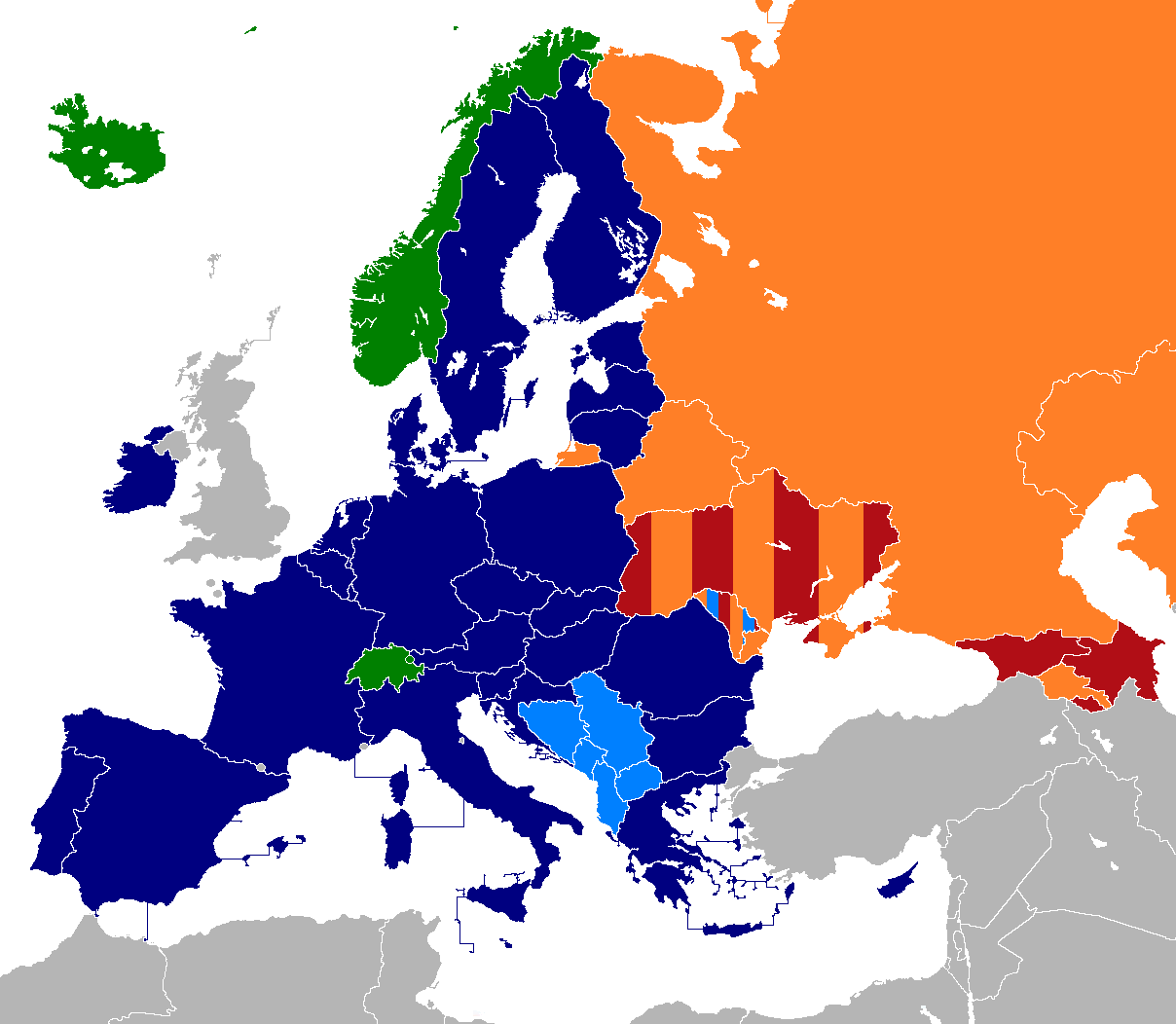
At present, there are six multi-lateral free trade areas in Europe, and one former free trade area in recent history. Note that there are also a number of bilateral free trade agreements between states and between trade blocks; and that some states participate in more than one free trade area.
The European Union (EU) has always operated as more than a free trade area with its predecessor, the European Economic Community (EEC) being founded as a customs union. The EU has free trade agreements to varying levels with most other European countries.
The EU shares its single market with three EFTA members via the European Economic Area agreement, and the remaining EFTA member—Switzerland—via bilateral agreements.
The European Union Customs Union is a customs union which consists of all the member states of the European Union and Turkey, San Marino, Monaco, Andorra and the UK territory of Akrotiri and Dhekelia which are outside of the EU. In addition to allowing for free trade between states, the customs union imposes a common external tariff on all goods entering the area.
The European Free Trade Association (EFTA) was created in 1960 by the outer seven (as a looser alternative to the then-European Communities) but most of its membership has since joined the Communities/EU leaving only four countries (Iceland, Norway, Switzerland and Liechtenstein) still party to the treaty. The United Kingdom is the only former EFTA member which is not currently part of the EU, following its withdrawal in 2020.
Following the fall of the Iron Curtain, two free trade areas were created in Central Europe, the Baltic Free Trade Area (BAFTA) and the Central European Free Trade Agreement (CEFTA), in order to stabilise these countries for membership of the EU. With the 2004 EU enlargement, the original members of both of these have left these agreements and joined the EU.
CEFTA has expanded into southern Europe with members from the Western Balkans and Moldova. All of the new CEFTA countries are prospective members of the EU and hence EFTA is the only free trade area with a long-term future, as there are no immediate plans for these countries to change their present status. However, CEFTA may gain new members in the form of countries neighbouring the present EU.
On 10 October 2000, in Astana, the heads of Belarus, Kazakhstan, Russia, Tajikistan and Kyrgyzstan signed the Treaty on the Establishment of the Eurasian Economic Community (entered into force on 30 May 2001), which called for the creation of a free trade regime among members.
Free trade areas in Europe
At present, there are six multi-lateral free trade areas in Europe, and one former free trade area in recent history. Note that there are also a number of bilateral free trade agreements between states and between trade blocks; and that some states participate in more than one free trade area.
The European Union (EU) has always operated as more than a free trade area with its predecessor, the European Economic Community (EEC) being founded as a customs union. The EU has free trade agreements to varying levels with most other European countries.
The EU shares its single market with three EFTA members via the European Economic Area agreement, and the remaining EFTA member—Switzerland—via bilateral agreements.
The European Union Customs Union is a customs union which consists of all the member states of the European Union and Turkey, San Marino, Monaco, Andorra and the UK territory of Akrotiri and Dhekelia which are outside of the EU. In addition to allowing for free trade between states, the customs union imposes a common external tariff on all goods entering the area.
The European Free Trade Association (EFTA) was created in 1960 by the outer seven (as a looser alternative to the then-European Communities) but most of its membership has since joined the Communities/EU leaving only four countries (Iceland, Norway, Switzerland and Liechtenstein) still party to the treaty. The United Kingdom is the only former EFTA member which is not currently part of the EU, following its withdrawal in 2020.
Following the fall of the Iron Curtain, two free trade areas were created in Central Europe, the Baltic Free Trade Area (BAFTA) and the Central European Free Trade Agreement (CEFTA), in order to stabilise these countries for membership of the EU. With the 2004 EU enlargement, the original members of both of these have left these agreements and joined the EU.
CEFTA has expanded into southern Europe with members from the Western Balkans and Moldova. All of the new CEFTA countries are prospective members of the EU and hence EFTA is the only free trade area with a long-term future, as there are no immediate plans for these countries to change their present status. However, CEFTA may gain new members in the form of countries neighbouring the present EU.
On 10 October 2000, in Astana, the heads of Belarus, Kazakhstan, Russia, Tajikistan and Kyrgyzstan signed the Treaty on the Establishment of the Eurasian Economic Community (entered into force on 30 May 2001), which called for the creation of a free trade regime among members.
Recent media
Recent media