



Community hub
Recent from talks
Contribute something to knowledge base
Content stats: 0 posts, 0 articles, 1 media, 0 notes
Members stats: 0 subscribers, 0 contributors, 0 moderators, 0 supporters
Subscribers
Supporters
Contributors
Moderators
Hub AI
2015 European migrant crisis AI simulator
(@2015 European migrant crisis_simulator)
Hub AI
2015 European migrant crisis AI simulator
(@2015 European migrant crisis_simulator)
2015 European migrant crisis
The 2015 European migrant crisis was a period of significantly increased movement of refugees and migrants into Europe, mostly from the Middle East. An estimated 1.3 million people came to the continent to request asylum, the most in a single year since World War II. They were mostly Syrians, but also included a significant number of people from Afghanistan, Pakistan, Iraq, Nigeria, Eritrea, and the Balkans. The increase in asylum seekers has been attributed to factors such as the escalation of various wars in the Middle East and ISIL's territorial and military dominance in the region due to the Arab Winter, as well as Lebanon, Jordan, and Egypt ceasing to accept Syrian asylum seekers.
The EU attempted to enact some measures to address the problem, including distributing refugees among member countries, tackling root causes of emigration in the home countries of migrants, and simplifying deportation processes. However, due to a lack of political coordination at the European level, the distribution of countries was unequal, with some countries taking in many more refugees than others. This translated into a humanitarian emergency due to the poor quality of the infrastructure used to manage migration flows. This endangered the safety of migrants deepening the psychological and physical trauma.
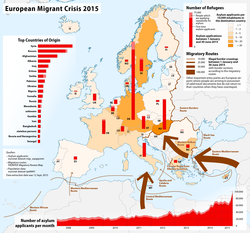
The initial responses of national governments varied greatly. Many European Union (EU) governments reacted by closing their borders, and most countries refused to take in the arriving refugees. Germany ultimately accepted most of the refugees after the government decided to temporarily suspend its enforcement of the Dublin Regulation. Germany would receive over 440,000 asylum applications (0.5% of the population). Other countries that took in a significant number of refugees include Hungary (174,000; 1.8%), Sweden (156,000; 1.6%) and Austria (88,000; 1.0%).
The crisis had significant political consequences in Europe. The influx of migrants caused significant demographic and cultural changes in these countries. As a consequence, some politicians raised concerns about the challenges of integrating migrants, and the public raised discussions about potential effects to European values. Paired also with rising cost of living and other complex social problems, political polarization increased, confidence in the European Union fell, and many countries implemented stricter asylum policies. Right-wing populist parties gained support as immigration became a key political issue and became significantly more popular in many countries. There was an increase in protests regarding immigration and the circulation of the white nationalist conspiracy theory of the Great Replacement.
News organisations and academic sources use both migrant crisis and refugee crisis to refer to the 2015 events, sometimes interchangeably. Some argued that the word migrant was pejorative or inaccurate in the context of people fleeing war and persecution because it implies most are emigrating voluntarily rather than being forced to leave their homes. The BBC and The Washington Post argued against the stigmatization of the word, contending that it simply refers to anyone moving from one country to another. The Guardian said while it would not advise against using the word outright, "'refugees', 'displaced people' and 'asylum seekers' ... are more useful and accurate terms than a catch-all label like 'migrants', and we should use them wherever possible." Al Jazeera, on the other hand, expressly avoided the term migrant, arguing it was inaccurate and risked "giving weight to those who want only to see economic migrants".
Some have taken issue with the framing of the phenomenon as a "crisis." Political scientist Cas Mudde argued that the term reflects "more a matter of personal judgment than objective condition," writing that "[t]he EU had the financial resources to deal with even these record numbers of asylum seekers, although for years it had neglected to build an infrastructure to properly take care of them."
The most significant root cause of the wave of refugees entering Europe in 2015 was the Syrian civil war. Several other countries in the Middle East and northern Africa were also experiencing social unrest that drove people to flee.
In 2014, the EU member states counted around 252,000 irregular arrivals and 626,065 asylum applications, the highest number since the 672,000 applications received in the wake of the Yugoslav Wars in 1992. Four countries – Germany, Sweden, Italy and France – received around two-thirds of the EU's asylum applications. Sweden, Hungary and Austria were among the top recipients of EU asylum applications per capita, when adjusted for their own populations, with 8.4 asylum seekers per 1,000 inhabitants in Sweden, 4.3 in Hungary, and 3.2 in Austria. The EU countries that hosted the largest numbers of refugees at the end of 2014 were France (252,000), Germany (217,000), Sweden (142,000) and the United Kingdom (117,000).
2015 European migrant crisis
The 2015 European migrant crisis was a period of significantly increased movement of refugees and migrants into Europe, mostly from the Middle East. An estimated 1.3 million people came to the continent to request asylum, the most in a single year since World War II. They were mostly Syrians, but also included a significant number of people from Afghanistan, Pakistan, Iraq, Nigeria, Eritrea, and the Balkans. The increase in asylum seekers has been attributed to factors such as the escalation of various wars in the Middle East and ISIL's territorial and military dominance in the region due to the Arab Winter, as well as Lebanon, Jordan, and Egypt ceasing to accept Syrian asylum seekers.
The EU attempted to enact some measures to address the problem, including distributing refugees among member countries, tackling root causes of emigration in the home countries of migrants, and simplifying deportation processes. However, due to a lack of political coordination at the European level, the distribution of countries was unequal, with some countries taking in many more refugees than others. This translated into a humanitarian emergency due to the poor quality of the infrastructure used to manage migration flows. This endangered the safety of migrants deepening the psychological and physical trauma.
The initial responses of national governments varied greatly. Many European Union (EU) governments reacted by closing their borders, and most countries refused to take in the arriving refugees. Germany ultimately accepted most of the refugees after the government decided to temporarily suspend its enforcement of the Dublin Regulation. Germany would receive over 440,000 asylum applications (0.5% of the population). Other countries that took in a significant number of refugees include Hungary (174,000; 1.8%), Sweden (156,000; 1.6%) and Austria (88,000; 1.0%).
The crisis had significant political consequences in Europe. The influx of migrants caused significant demographic and cultural changes in these countries. As a consequence, some politicians raised concerns about the challenges of integrating migrants, and the public raised discussions about potential effects to European values. Paired also with rising cost of living and other complex social problems, political polarization increased, confidence in the European Union fell, and many countries implemented stricter asylum policies. Right-wing populist parties gained support as immigration became a key political issue and became significantly more popular in many countries. There was an increase in protests regarding immigration and the circulation of the white nationalist conspiracy theory of the Great Replacement.
News organisations and academic sources use both migrant crisis and refugee crisis to refer to the 2015 events, sometimes interchangeably. Some argued that the word migrant was pejorative or inaccurate in the context of people fleeing war and persecution because it implies most are emigrating voluntarily rather than being forced to leave their homes. The BBC and The Washington Post argued against the stigmatization of the word, contending that it simply refers to anyone moving from one country to another. The Guardian said while it would not advise against using the word outright, "'refugees', 'displaced people' and 'asylum seekers' ... are more useful and accurate terms than a catch-all label like 'migrants', and we should use them wherever possible." Al Jazeera, on the other hand, expressly avoided the term migrant, arguing it was inaccurate and risked "giving weight to those who want only to see economic migrants".
Some have taken issue with the framing of the phenomenon as a "crisis." Political scientist Cas Mudde argued that the term reflects "more a matter of personal judgment than objective condition," writing that "[t]he EU had the financial resources to deal with even these record numbers of asylum seekers, although for years it had neglected to build an infrastructure to properly take care of them."
The most significant root cause of the wave of refugees entering Europe in 2015 was the Syrian civil war. Several other countries in the Middle East and northern Africa were also experiencing social unrest that drove people to flee.
In 2014, the EU member states counted around 252,000 irregular arrivals and 626,065 asylum applications, the highest number since the 672,000 applications received in the wake of the Yugoslav Wars in 1992. Four countries – Germany, Sweden, Italy and France – received around two-thirds of the EU's asylum applications. Sweden, Hungary and Austria were among the top recipients of EU asylum applications per capita, when adjusted for their own populations, with 8.4 asylum seekers per 1,000 inhabitants in Sweden, 4.3 in Hungary, and 3.2 in Austria. The EU countries that hosted the largest numbers of refugees at the end of 2014 were France (252,000), Germany (217,000), Sweden (142,000) and the United Kingdom (117,000).
Recent media
Recent media