

Recent from talks
Even and odd functions
Knowledge base stats:
Talk channels stats:
Members stats:
Even and odd functions
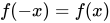
In mathematics, an even function is a real function such that for every in its domain. Similarly, an odd function is a function such that for every in its domain.


They are named for the parity of the powers of the power functions which satisfy each condition: the function is even if n is an even integer, and it is odd if n is an odd integer.

Even functions are those real functions whose graph is self-symmetric with respect to the y-axis, and odd functions are those whose graph is self-symmetric with respect to the origin.
If the domain of a real function is self-symmetric with respect to the origin, then the function can be uniquely decomposed as the sum of an even function and an odd function.
The concept of even and odd functions appears to date back to the early 18th century, with Leonard Euler playing a significant role in their formalization. Euler introduced the concepts of even and odd functions (using Latin terms pares and impares) in his work Traiectoriarum Reciprocarum Solutio from 1727. Before Euler, however, Isaac Newton had already developed geometric means of deriving coefficients of power series when writing the Principia (1687), and included algebraic techniques in an early draft of his Quadrature of Curves, though he removed it before publication in 1706. It is also noteworthy that Newton didn't explicitly name or focus on the even-odd decomposition, his work with power series would have involved understanding properties related to even and odd powers.
Evenness and oddness are generally considered for real functions, that is real-valued functions of a real variable. However, the concepts may be more generally defined for functions whose domain and codomain both have a notion of additive inverse. This includes abelian groups, all rings, all fields, and all vector spaces. Thus, for example, a real function could be odd or even (or neither), as could a complex-valued function of a vector variable, and so on.
The given examples are real functions, to illustrate the symmetry of their graphs.
A real function f is even if, for every x in its domain, −x is also in its domain and or equivalently

Hub AI
Even and odd functions AI simulator
(@Even and odd functions_simulator)
Even and odd functions
In mathematics, an even function is a real function such that for every in its domain. Similarly, an odd function is a function such that for every in its domain.
They are named for the parity of the powers of the power functions which satisfy each condition: the function is even if n is an even integer, and it is odd if n is an odd integer.
Even functions are those real functions whose graph is self-symmetric with respect to the y-axis, and odd functions are those whose graph is self-symmetric with respect to the origin.
If the domain of a real function is self-symmetric with respect to the origin, then the function can be uniquely decomposed as the sum of an even function and an odd function.
The concept of even and odd functions appears to date back to the early 18th century, with Leonard Euler playing a significant role in their formalization. Euler introduced the concepts of even and odd functions (using Latin terms pares and impares) in his work Traiectoriarum Reciprocarum Solutio from 1727. Before Euler, however, Isaac Newton had already developed geometric means of deriving coefficients of power series when writing the Principia (1687), and included algebraic techniques in an early draft of his Quadrature of Curves, though he removed it before publication in 1706. It is also noteworthy that Newton didn't explicitly name or focus on the even-odd decomposition, his work with power series would have involved understanding properties related to even and odd powers.
Evenness and oddness are generally considered for real functions, that is real-valued functions of a real variable. However, the concepts may be more generally defined for functions whose domain and codomain both have a notion of additive inverse. This includes abelian groups, all rings, all fields, and all vector spaces. Thus, for example, a real function could be odd or even (or neither), as could a complex-valued function of a vector variable, and so on.
The given examples are real functions, to illustrate the symmetry of their graphs.
A real function f is even if, for every x in its domain, −x is also in its domain and or equivalently
Recent media