
Recent from talks
Evidence lower bound
Knowledge base stats:
Talk channels stats:
Members stats:
Evidence lower bound
In variational Bayesian methods, the evidence lower bound (often abbreviated ELBO, also sometimes called the variational lower bound or negative variational free energy) is a useful lower bound on the log-likelihood of some observed data.
The ELBO is useful because it provides a guarantee on the worst-case for the log-likelihood of some distribution (e.g. ) which models a set of data. The actual log-likelihood may be higher (indicating an even better fit to the distribution) because the ELBO includes a Kullback-Leibler divergence (KL divergence) term which decreases the ELBO due to an internal part of the model being inaccurate despite good fit of the model overall. Thus improving the ELBO score indicates either improving the likelihood of the model or the fit of a component internal to the model, or both, and the ELBO score makes a good loss function, e.g., for training a deep neural network to improve both the model overall and the internal component. (The internal component is , defined in detail later in this article.)


Let and be random variables, jointly distributed with distribution . For example, is the marginal distribution of , and is the conditional distribution of given . Then, for a sample , and any distribution , the ELBO is defined asThe ELBO can equivalently be written as


![{\displaystyle L(\phi ,\theta ;x):=\mathbb {E} _{z\sim q_{\phi }(\cdot |x)}\left[\ln {\frac {p_{\theta }(x,z)}{q_{\phi }(z|x)}}\right].}](https://wikimedia.org/api/rest_v1/media/math/render/svg/563d2097ea46196c5c8ff7b2c7e8c6532d30195b)
![{\displaystyle {\begin{aligned}L(\phi ,\theta ;x)=&\mathbb {E} _{z\sim q_{\phi }(\cdot |x)}\left[\ln {}p_{\theta }(x,z)\right]+H[q_{\phi }(z|x)]\\=&\mathbb {\ln } {}\,p_{\theta }(x)-D_{KL}(q_{\phi }(z|x)||p_{\theta }(z|x)).\\\end{aligned}}}](https://wikimedia.org/api/rest_v1/media/math/render/svg/37af6d9b7947f36f6beefc7a848de47fdeea2ebc)
In the first line, is the entropy of , which relates the ELBO to the Helmholtz free energy. In the second line, is called the evidence for , and is the Kullback-Leibler divergence between and . Since the Kullback-Leibler divergence is non-negative, forms a lower bound on the evidence (ELBO inequality)
![{\displaystyle H[q_{\phi }(z|x)]}](https://wikimedia.org/api/rest_v1/media/math/render/svg/e213902978ceb5660808f87aff41057a34c016b2)




![{\displaystyle \ln p_{\theta }(x)\geq \mathbb {\mathbb {E} } _{z\sim q_{\phi }(\cdot |x)}\left[\ln {\frac {p_{\theta }(x,z)}{q_{\phi }(z\vert x)}}\right].}](https://wikimedia.org/api/rest_v1/media/math/render/svg/62f8b9df47fc53a1f8df410145d5e5d71a91e887)
Suppose we have an observable random variable , and we want to find its true distribution . This would allow us to generate data by sampling, and estimate probabilities of future events. In general, it is impossible to find exactly, forcing us to search for a good approximation.

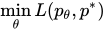
That is, we define a sufficiently large parametric family of distributions, then solve for for some loss function . One possible way to solve this is by considering small variation from to , and solve for . This is a problem in the calculus of variations, thus it is called the variational method.




Since there are not many explicitly parametrized distribution families (all the classical distribution families, such as the normal distribution, the Gumbel distribution, etc, are far too simplistic to model the true distribution), we consider implicitly parametrized probability distributions:
Hub AI
Evidence lower bound AI simulator
(@Evidence lower bound_simulator)
Evidence lower bound
In variational Bayesian methods, the evidence lower bound (often abbreviated ELBO, also sometimes called the variational lower bound or negative variational free energy) is a useful lower bound on the log-likelihood of some observed data.
The ELBO is useful because it provides a guarantee on the worst-case for the log-likelihood of some distribution (e.g. ) which models a set of data. The actual log-likelihood may be higher (indicating an even better fit to the distribution) because the ELBO includes a Kullback-Leibler divergence (KL divergence) term which decreases the ELBO due to an internal part of the model being inaccurate despite good fit of the model overall. Thus improving the ELBO score indicates either improving the likelihood of the model or the fit of a component internal to the model, or both, and the ELBO score makes a good loss function, e.g., for training a deep neural network to improve both the model overall and the internal component. (The internal component is , defined in detail later in this article.)
Let and be random variables, jointly distributed with distribution . For example, is the marginal distribution of , and is the conditional distribution of given . Then, for a sample , and any distribution , the ELBO is defined asThe ELBO can equivalently be written as
In the first line, is the entropy of , which relates the ELBO to the Helmholtz free energy. In the second line, is called the evidence for , and is the Kullback-Leibler divergence between and . Since the Kullback-Leibler divergence is non-negative, forms a lower bound on the evidence (ELBO inequality)
Suppose we have an observable random variable , and we want to find its true distribution . This would allow us to generate data by sampling, and estimate probabilities of future events. In general, it is impossible to find exactly, forcing us to search for a good approximation.
That is, we define a sufficiently large parametric family of distributions, then solve for for some loss function . One possible way to solve this is by considering small variation from to , and solve for . This is a problem in the calculus of variations, thus it is called the variational method.
Since there are not many explicitly parametrized distribution families (all the classical distribution families, such as the normal distribution, the Gumbel distribution, etc, are far too simplistic to model the true distribution), we consider implicitly parametrized probability distributions: