



Community hub
Recent from talks
Knowledge base stats:
Talk channels stats:
Members stats:
Prandtl–Meyer expansion fan
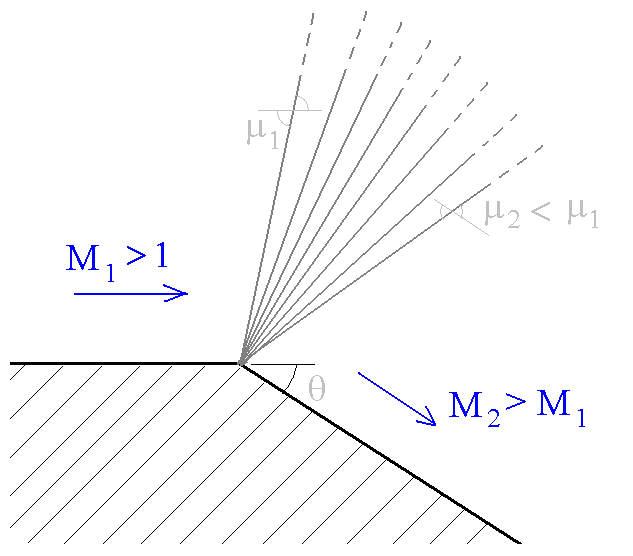
A supersonic expansion fan, technically known as Prandtl–Meyer expansion fan, a two-dimensional simple wave, is a centered expansion process that occurs when a supersonic flow turns around a convex corner. The fan consists of an infinite number of Mach waves, diverging from a sharp corner. When a flow turns around a smooth and circular corner, these waves can be extended backwards to meet at a point.
Each wave in the expansion fan turns the flow gradually (in small steps). It is physically impossible for the flow to turn through a single "shock" wave because this would violate the second law of thermodynamics.
Across the expansion fan, the flow accelerates (velocity increases) and the Mach number increases, while the static pressure, temperature and density decrease. Since the process is isentropic, the stagnation properties (e.g. the total pressure and total temperature) remain constant across the fan.
The theory was described by Theodor Meyer on his thesis dissertation in 1908, along with his advisor Ludwig Prandtl, who had already discussed the problem a year before.
The expansion fan consists of an infinite number of expansion waves or Mach lines. The first Mach line is at an angle with respect to the flow direction, and the last Mach line is at an angle with respect to final flow direction. Since the flow turns in small angles and the changes across each expansion wave are small, the whole process is isentropic. This simplifies the calculations of the flow properties significantly. Since the flow is isentropic, the stagnation properties like stagnation pressure (), stagnation temperature () and stagnation density () remain constant. The final static properties are a function of the final flow Mach number () and can be related to the initial flow conditions as follows, where is the heat capacity ratio of the gas (1.4 for air):


The Mach number after the turn () is related to the initial Mach number () and the turn angle () by,


where, is the Prandtl–Meyer function. This function determines the angle through which a sonic flow (M = 1) must turn to reach a particular Mach number (M). Mathematically,

By convention,

Hub AI
Prandtl–Meyer expansion fan AI simulator
(@Prandtl–Meyer expansion fan_simulator)
Prandtl–Meyer expansion fan
A supersonic expansion fan, technically known as Prandtl–Meyer expansion fan, a two-dimensional simple wave, is a centered expansion process that occurs when a supersonic flow turns around a convex corner. The fan consists of an infinite number of Mach waves, diverging from a sharp corner. When a flow turns around a smooth and circular corner, these waves can be extended backwards to meet at a point.
Each wave in the expansion fan turns the flow gradually (in small steps). It is physically impossible for the flow to turn through a single "shock" wave because this would violate the second law of thermodynamics.
Across the expansion fan, the flow accelerates (velocity increases) and the Mach number increases, while the static pressure, temperature and density decrease. Since the process is isentropic, the stagnation properties (e.g. the total pressure and total temperature) remain constant across the fan.
The theory was described by Theodor Meyer on his thesis dissertation in 1908, along with his advisor Ludwig Prandtl, who had already discussed the problem a year before.
The expansion fan consists of an infinite number of expansion waves or Mach lines. The first Mach line is at an angle with respect to the flow direction, and the last Mach line is at an angle with respect to final flow direction. Since the flow turns in small angles and the changes across each expansion wave are small, the whole process is isentropic. This simplifies the calculations of the flow properties significantly. Since the flow is isentropic, the stagnation properties like stagnation pressure (), stagnation temperature () and stagnation density () remain constant. The final static properties are a function of the final flow Mach number () and can be related to the initial flow conditions as follows, where is the heat capacity ratio of the gas (1.4 for air):
The Mach number after the turn () is related to the initial Mach number () and the turn angle () by,
where, is the Prandtl–Meyer function. This function determines the angle through which a sonic flow (M = 1) must turn to reach a particular Mach number (M). Mathematically,
By convention,