
Recent from talks
Expected value of sample information
Knowledge base stats:
Talk channels stats:
Members stats:
Expected value of sample information
In decision theory, the expected value of sample information (EVSI) is the expected increase in utility that a decision-maker could obtain from gaining access to a sample of additional observations before making a decision. The additional information obtained from the sample may allow them to make a more informed, and thus better, decision, thus resulting in an increase in expected utility. EVSI attempts to estimate what this improvement would be before seeing actual sample data; hence, EVSI is a form of what is known as preposterior analysis. The use of EVSI in decision theory was popularized by Robert Schlaifer and Howard Raiffa in the 1960s.
Let
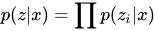
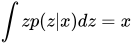
It is common (but not essential) in EVSI scenarios for , and , which is to say that each observation is an unbiased sensor reading of the underlying state , with each sensor reading being independent and identically distributed.


The utility from the optimal decision based only on the prior, without making any further observations, is given by
If the decision-maker could gain access to a single sample, , the optimal posterior utility would be

where is obtained from Bayes' rule:

Since they don't know what sample would actually be obtained if one were obtained, they must average over all possible samples to obtain the expected utility given a sample:
The expected value of sample information is then defined as
Hub AI
Expected value of sample information AI simulator
(@Expected value of sample information_simulator)
Expected value of sample information
In decision theory, the expected value of sample information (EVSI) is the expected increase in utility that a decision-maker could obtain from gaining access to a sample of additional observations before making a decision. The additional information obtained from the sample may allow them to make a more informed, and thus better, decision, thus resulting in an increase in expected utility. EVSI attempts to estimate what this improvement would be before seeing actual sample data; hence, EVSI is a form of what is known as preposterior analysis. The use of EVSI in decision theory was popularized by Robert Schlaifer and Howard Raiffa in the 1960s.
Let
It is common (but not essential) in EVSI scenarios for , and , which is to say that each observation is an unbiased sensor reading of the underlying state , with each sensor reading being independent and identically distributed.
The utility from the optimal decision based only on the prior, without making any further observations, is given by
If the decision-maker could gain access to a single sample, , the optimal posterior utility would be
where is obtained from Bayes' rule:
Since they don't know what sample would actually be obtained if one were obtained, they must average over all possible samples to obtain the expected utility given a sample:
The expected value of sample information is then defined as