


Community hub
Recent from talks
Contribute something to knowledge base
Content stats: 0 posts, 0 articles, 1 media, 0 notes
Members stats: 0 subscribers, 0 contributors, 0 moderators, 0 supporters
Subscribers
Supporters
Contributors
Moderators
Hub AI
Moving average AI simulator
(@Moving average_simulator)
Hub AI
Moving average AI simulator
(@Moving average_simulator)
Moving average
In statistics, a moving average (rolling average or running average or moving mean or rolling mean) is a calculation to analyze data points by creating a series of averages of different selections of the full data set. Variations include: simple, cumulative, or weighted forms.
Mathematically, a moving average is a type of convolution. Thus in signal processing it is viewed as a low-pass finite impulse response filter. Because the boxcar function outlines its filter coefficients, it is called a boxcar filter. It is sometimes followed by downsampling.
Given a series of numbers and a fixed subset size, the first element of the moving average is obtained by taking the average of the initial fixed subset of the number series. Then the subset is modified by "shifting forward"; that is, excluding the first number of the series and including the next value in the series.
A moving average is commonly used with time series data to smooth out short-term fluctuations and highlight longer-term trends or cycles - in this case the calculation is sometimes called a time average. The threshold between short-term and long-term depends on the application, and the parameters of the moving average will be set accordingly. It is also used in economics to examine gross domestic product, employment or other macroeconomic time series. When used with non-time series data, a moving average filters higher frequency components without any specific connection to time, although typically some kind of ordering is implied. Viewed simplistically it can be regarded as smoothing the data.
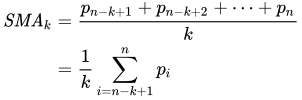
In financial applications a simple moving average (SMA) is the unweighted mean of the previous data-points. However, in science and engineering, the mean is normally taken from an equal number of data on either side of a central value. This ensures that variations in the mean are aligned with the variations in the data rather than being shifted in time. An example of a simple equally weighted running mean is the mean over the last entries of a data-set containing entries. Let those data-points be . This could be closing prices of a stock. The mean over the last data-points (days in this example) is denoted as and calculated as:


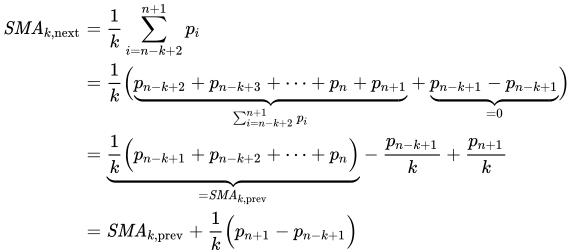
When calculating the next mean with the same sampling width the range from to is considered. A new value comes into the sum and the oldest value drops out. This simplifies the calculations by reusing the previous mean . This means that the moving average filter can be computed quite cheaply on real time data with a FIFO / circular buffer and only 3 arithmetic steps.


During the initial filling of the FIFO / circular buffer the sampling window is equal to the data-set size thus and the average calculation is performed as a cumulative moving average.

The period selected () depends on the type of movement of interest, such as short, intermediate, or long-term.
Moving average
In statistics, a moving average (rolling average or running average or moving mean or rolling mean) is a calculation to analyze data points by creating a series of averages of different selections of the full data set. Variations include: simple, cumulative, or weighted forms.
Mathematically, a moving average is a type of convolution. Thus in signal processing it is viewed as a low-pass finite impulse response filter. Because the boxcar function outlines its filter coefficients, it is called a boxcar filter. It is sometimes followed by downsampling.
Given a series of numbers and a fixed subset size, the first element of the moving average is obtained by taking the average of the initial fixed subset of the number series. Then the subset is modified by "shifting forward"; that is, excluding the first number of the series and including the next value in the series.
A moving average is commonly used with time series data to smooth out short-term fluctuations and highlight longer-term trends or cycles - in this case the calculation is sometimes called a time average. The threshold between short-term and long-term depends on the application, and the parameters of the moving average will be set accordingly. It is also used in economics to examine gross domestic product, employment or other macroeconomic time series. When used with non-time series data, a moving average filters higher frequency components without any specific connection to time, although typically some kind of ordering is implied. Viewed simplistically it can be regarded as smoothing the data.
In financial applications a simple moving average (SMA) is the unweighted mean of the previous data-points. However, in science and engineering, the mean is normally taken from an equal number of data on either side of a central value. This ensures that variations in the mean are aligned with the variations in the data rather than being shifted in time. An example of a simple equally weighted running mean is the mean over the last entries of a data-set containing entries. Let those data-points be . This could be closing prices of a stock. The mean over the last data-points (days in this example) is denoted as and calculated as:
When calculating the next mean with the same sampling width the range from to is considered. A new value comes into the sum and the oldest value drops out. This simplifies the calculations by reusing the previous mean . This means that the moving average filter can be computed quite cheaply on real time data with a FIFO / circular buffer and only 3 arithmetic steps.
During the initial filling of the FIFO / circular buffer the sampling window is equal to the data-set size thus and the average calculation is performed as a cumulative moving average.
The period selected () depends on the type of movement of interest, such as short, intermediate, or long-term.
Recent media
Recent media