



Community hub
Recent from talks
Contribute something to knowledge base
Content stats: 0 posts, 0 articles, 1 media, 0 notes
Members stats: 0 subscribers, 0 contributors, 0 moderators, 0 supporters
Subscribers
Supporters
Contributors
Moderators
Hub AI
Convolution AI simulator
(@Convolution_simulator)
Hub AI
Convolution AI simulator
(@Convolution_simulator)
Convolution
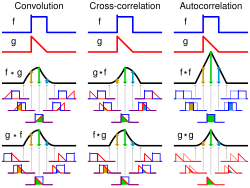
In mathematics (in particular, functional analysis), convolution is a mathematical operation on two functions and that produces a third function , as the integral of the product of the two functions after one is reflected about the y-axis and shifted. The term convolution refers to both the resulting function and to the process of computing it. The integral is evaluated for all values of shift, producing the convolution function. The choice of which function is reflected and shifted before the integral does not change the integral result (see commutativity). Graphically, it expresses how the 'shape' of one function is modified by the other.


Some features of convolution are similar to cross-correlation: for real-valued functions, of a continuous or discrete variable, convolution differs from cross-correlation only in that either or is reflected about the y-axis in convolution; thus it is a cross-correlation of and , or and . For complex-valued functions, the cross-correlation operator is the adjoint of the convolution operator.


Convolution has applications that include probability, statistics, acoustics, spectroscopy, signal processing and image processing, geophysics, engineering, physics, computer vision and differential equations.
The convolution can be defined for functions on Euclidean space and other groups (as algebraic structures).[citation needed] For example, periodic functions, such as the discrete-time Fourier transform, can be defined on a circle and convolved by periodic convolution. (See row 18 at DTFT § Properties.) A discrete convolution can be defined for functions on the set of integers.
Generalizations of convolution have applications in the field of numerical analysis and numerical linear algebra, and in the design and implementation of finite impulse response filters in signal processing.[citation needed]
Computing the inverse of the convolution operation is known as deconvolution.
The convolution of and is written , denoting the operator with the symbol . It is defined as the integral of the product of the two functions after one is reflected about the y-axis and shifted. As such, it is a particular kind of integral transform:

An equivalent definition is (see commutativity):
Convolution
In mathematics (in particular, functional analysis), convolution is a mathematical operation on two functions and that produces a third function , as the integral of the product of the two functions after one is reflected about the y-axis and shifted. The term convolution refers to both the resulting function and to the process of computing it. The integral is evaluated for all values of shift, producing the convolution function. The choice of which function is reflected and shifted before the integral does not change the integral result (see commutativity). Graphically, it expresses how the 'shape' of one function is modified by the other.
Some features of convolution are similar to cross-correlation: for real-valued functions, of a continuous or discrete variable, convolution differs from cross-correlation only in that either or is reflected about the y-axis in convolution; thus it is a cross-correlation of and , or and . For complex-valued functions, the cross-correlation operator is the adjoint of the convolution operator.
Convolution has applications that include probability, statistics, acoustics, spectroscopy, signal processing and image processing, geophysics, engineering, physics, computer vision and differential equations.
The convolution can be defined for functions on Euclidean space and other groups (as algebraic structures).[citation needed] For example, periodic functions, such as the discrete-time Fourier transform, can be defined on a circle and convolved by periodic convolution. (See row 18 at DTFT § Properties.) A discrete convolution can be defined for functions on the set of integers.
Generalizations of convolution have applications in the field of numerical analysis and numerical linear algebra, and in the design and implementation of finite impulse response filters in signal processing.[citation needed]
Computing the inverse of the convolution operation is known as deconvolution.
The convolution of and is written , denoting the operator with the symbol . It is defined as the integral of the product of the two functions after one is reflected about the y-axis and shifted. As such, it is a particular kind of integral transform:
An equivalent definition is (see commutativity):
Recent media
Recent media