
Recent from talks
Express (weaponry)
Knowledge base stats:
Talk channels stats:
Members stats:
Express (weaponry)
An express weapon is a hunting rifle chambered to fire ammunition capable of higher than typical velocities. Early express cartridges used a heavy charge of black powder to propel a lightweight, often hollow point bullet, at high velocities to maximize point blank range. Later the express cartridges were loaded with nitrocellulose-based gunpowder, leading to the Nitro Express cartridges, the first of which was the .450 Nitro Express.
Although the term express entered use in the mid-19th century, it is still in use today, applied to rifles, ammunition, and a type of iron sight. With the widespread adoption of small bore, high velocity rifle cartridges, the meaning of express has shifted in modern usage, and refers to high velocity, large bore rifles and ammunition, typically used for hunting large or dangerous game at close range.
The name originates with a rifle built by James Purdey in 1856 (based on a pattern established a year earlier by William Greener) and named the Express Train, a marketing phrase intended to denote the considerable velocity of the bullet it fired. It was not the first rifle or cartridge of this type, but it was Purdey's use of express imagery that stuck.
Early hunting firearms were typically smoothbore, usually firing a spherical projectile. This meant that a given bore size must fire a given weight of projectile, which put significant limits on the external and terminal ballistics of the gun. The significant arc of the slow round ball limited the maximum point-blank range to very short distances, and the spherical nature of the ball required a large bore diameter to carry a ball large and heavy enough to provide a quick kill on large game. These early smoothbore guns were typically measured by gauge, as most modern shotguns still are, rather than by caliber. Typical gauges used ranged from 12 gauge to 4 gauge; the 4 gauge was for large game, fired a massive ball of 1500 grains weight (97 g).
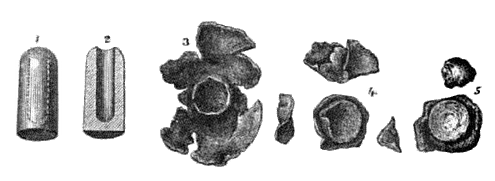
In the 19th century, rifled firearms increasingly gained popularity, and the cylindrical (conical) bullet was introduced. This allowed a wide range of bullet weights to be used with a single bore size; the .450 Black Powder Express, for example, was loaded with bullets ranging from a 270 grain hollow point bullet for small game such as deer, to a 360 grain solid bullet for use on dangerous game, to even heavier hardened bullets for use on elephant. The early black powder express cartridges used paper patched lead bullets, to prevent lead buildup in the bore at the high velocities. These bullets were made of soft lead, and even in solid form they expanded readily and provided great killing power.
Typically the trajectory height would not be greater than 4.5 inches at 150 yards (140 m) and the rifle would have a muzzle velocity of at least 1,750 feet per second (533 m/s). While 1,750 ft/s (533 m/s) is not fast by modern standards, it was relatively fast in the era of black powder and spherical balls. As nitro powders were introduced and became the standard, bores grew smaller, and velocities grew ever larger, until the term express grew to mean something other than just high velocity. William Greener, for example, splits British sporting rifles at the turn of the 20th century into four classes:
Since then, express has gradually changed to denote a large bore diameter combined with high velocity. The 1911 Encyclopaedia Britannica, for example, lists express cartridges ranging from .360 to .577 calibre. The traditional express rifles were break action designs, either single- or double-barrel designs, and express rifles are still made in this form today. With the advent of repeating actions, many bolt-action rifles were chambered in express cartridges, and often the same cartridge will be found in "flanged" and "rimless" form, the flanged for break-open actions, and the rimless for easier feed from a bolt-action rifle's magazine.
Many modern rifle cartridges fire large-calibre, heavy bullets at velocities of well over 2,000 feet per second (600 m/s), and the designation express applies solely to British calibres whereas the word magnum applies to American calibres. With a few exceptions, such the .242 Rimless Nitro Express from the 1920s, and a brief period around 1980 when Remington renamed their .280 Remington cartridge the 7 mm Express Remington, the label express is today used for short range, big game rifles pushing large, fast bullets.
Hub AI
Express (weaponry) AI simulator
(@Express (weaponry)_simulator)
Express (weaponry)
An express weapon is a hunting rifle chambered to fire ammunition capable of higher than typical velocities. Early express cartridges used a heavy charge of black powder to propel a lightweight, often hollow point bullet, at high velocities to maximize point blank range. Later the express cartridges were loaded with nitrocellulose-based gunpowder, leading to the Nitro Express cartridges, the first of which was the .450 Nitro Express.
Although the term express entered use in the mid-19th century, it is still in use today, applied to rifles, ammunition, and a type of iron sight. With the widespread adoption of small bore, high velocity rifle cartridges, the meaning of express has shifted in modern usage, and refers to high velocity, large bore rifles and ammunition, typically used for hunting large or dangerous game at close range.
The name originates with a rifle built by James Purdey in 1856 (based on a pattern established a year earlier by William Greener) and named the Express Train, a marketing phrase intended to denote the considerable velocity of the bullet it fired. It was not the first rifle or cartridge of this type, but it was Purdey's use of express imagery that stuck.
Early hunting firearms were typically smoothbore, usually firing a spherical projectile. This meant that a given bore size must fire a given weight of projectile, which put significant limits on the external and terminal ballistics of the gun. The significant arc of the slow round ball limited the maximum point-blank range to very short distances, and the spherical nature of the ball required a large bore diameter to carry a ball large and heavy enough to provide a quick kill on large game. These early smoothbore guns were typically measured by gauge, as most modern shotguns still are, rather than by caliber. Typical gauges used ranged from 12 gauge to 4 gauge; the 4 gauge was for large game, fired a massive ball of 1500 grains weight (97 g).
In the 19th century, rifled firearms increasingly gained popularity, and the cylindrical (conical) bullet was introduced. This allowed a wide range of bullet weights to be used with a single bore size; the .450 Black Powder Express, for example, was loaded with bullets ranging from a 270 grain hollow point bullet for small game such as deer, to a 360 grain solid bullet for use on dangerous game, to even heavier hardened bullets for use on elephant. The early black powder express cartridges used paper patched lead bullets, to prevent lead buildup in the bore at the high velocities. These bullets were made of soft lead, and even in solid form they expanded readily and provided great killing power.
Typically the trajectory height would not be greater than 4.5 inches at 150 yards (140 m) and the rifle would have a muzzle velocity of at least 1,750 feet per second (533 m/s). While 1,750 ft/s (533 m/s) is not fast by modern standards, it was relatively fast in the era of black powder and spherical balls. As nitro powders were introduced and became the standard, bores grew smaller, and velocities grew ever larger, until the term express grew to mean something other than just high velocity. William Greener, for example, splits British sporting rifles at the turn of the 20th century into four classes:
Since then, express has gradually changed to denote a large bore diameter combined with high velocity. The 1911 Encyclopaedia Britannica, for example, lists express cartridges ranging from .360 to .577 calibre. The traditional express rifles were break action designs, either single- or double-barrel designs, and express rifles are still made in this form today. With the advent of repeating actions, many bolt-action rifles were chambered in express cartridges, and often the same cartridge will be found in "flanged" and "rimless" form, the flanged for break-open actions, and the rimless for easier feed from a bolt-action rifle's magazine.
Many modern rifle cartridges fire large-calibre, heavy bullets at velocities of well over 2,000 feet per second (600 m/s), and the designation express applies solely to British calibres whereas the word magnum applies to American calibres. With a few exceptions, such the .242 Rimless Nitro Express from the 1920s, and a brief period around 1980 when Remington renamed their .280 Remington cartridge the 7 mm Express Remington, the label express is today used for short range, big game rifles pushing large, fast bullets.
Recent media