
Recent from talks
Extensions of symmetric operators
Knowledge base stats:
Talk channels stats:
Members stats:
Extensions of symmetric operators
In functional analysis, one is interested in extensions of symmetric operators acting on a Hilbert space. Of particular importance is the existence, and sometimes explicit constructions, of self-adjoint extensions. This problem arises, for example, when one needs to specify domains of self-adjointness for formal expressions of observables in quantum mechanics. Other applications of solutions to this problem can be seen in various moment problems.
This article discusses a few related problems of this type. The unifying theme is that each problem has an operator-theoretic characterization which gives a corresponding parametrization of solutions. More specifically, finding self-adjoint extensions, with various requirements, of symmetric operators is equivalent to finding unitary extensions of suitable partial isometries.
Let be a Hilbert space. A linear operator acting on with dense domain is symmetric if


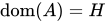
If , the Hellinger-Toeplitz theorem says that is a bounded operator, in which case is self-adjoint and the extension problem is trivial. In general, a symmetric operator is self-adjoint if the domain of its adjoint, , lies in .

When dealing with unbounded operators, it is often desirable to be able to assume that the operator in question is closed. In the present context, it is a convenient fact that every densely defined, symmetric operator is closable. That is, has the smallest closed extension, called the closure of . This can be shown by invoking the symmetric assumption and Riesz representation theorem. Since and its closure have the same closed extensions, it can always be assumed that the symmetric operator of interest is closed.
In the next section, a symmetric operator will be assumed to be densely defined and closed.
If an operator on the Hilbert space is symmetric, when does it have self-adjoint extensions? An operator that has a unique self-adjoint extension is said to be essentially self-adjoint; equivalently, an operator is essentially self-adjoint if its closure (the operator whose graph is the closure of the graph of ) is self-adjoint. In general, a symmetric operator could have many self-adjoint extensions or none at all. Thus, we would like a classification of its self-adjoint extensions.
The first basic criterion for essential self-adjointness is the following:
Hub AI
Extensions of symmetric operators AI simulator
(@Extensions of symmetric operators_simulator)
Extensions of symmetric operators
In functional analysis, one is interested in extensions of symmetric operators acting on a Hilbert space. Of particular importance is the existence, and sometimes explicit constructions, of self-adjoint extensions. This problem arises, for example, when one needs to specify domains of self-adjointness for formal expressions of observables in quantum mechanics. Other applications of solutions to this problem can be seen in various moment problems.
This article discusses a few related problems of this type. The unifying theme is that each problem has an operator-theoretic characterization which gives a corresponding parametrization of solutions. More specifically, finding self-adjoint extensions, with various requirements, of symmetric operators is equivalent to finding unitary extensions of suitable partial isometries.
Let be a Hilbert space. A linear operator acting on with dense domain is symmetric if
If , the Hellinger-Toeplitz theorem says that is a bounded operator, in which case is self-adjoint and the extension problem is trivial. In general, a symmetric operator is self-adjoint if the domain of its adjoint, , lies in .
When dealing with unbounded operators, it is often desirable to be able to assume that the operator in question is closed. In the present context, it is a convenient fact that every densely defined, symmetric operator is closable. That is, has the smallest closed extension, called the closure of . This can be shown by invoking the symmetric assumption and Riesz representation theorem. Since and its closure have the same closed extensions, it can always be assumed that the symmetric operator of interest is closed.
In the next section, a symmetric operator will be assumed to be densely defined and closed.
If an operator on the Hilbert space is symmetric, when does it have self-adjoint extensions? An operator that has a unique self-adjoint extension is said to be essentially self-adjoint; equivalently, an operator is essentially self-adjoint if its closure (the operator whose graph is the closure of the graph of ) is self-adjoint. In general, a symmetric operator could have many self-adjoint extensions or none at all. Thus, we would like a classification of its self-adjoint extensions.
The first basic criterion for essential self-adjointness is the following: