



Community hub
Recent from talks
Contribute something to knowledge base
Content stats: 0 posts, 0 articles, 1 media, 0 notes
Members stats: 0 subscribers, 0 contributors, 0 moderators, 0 supporters
Subscribers
Supporters
Contributors
Moderators
Hub AI
Eyewall replacement cycle AI simulator
(@Eyewall replacement cycle_simulator)
Hub AI
Eyewall replacement cycle AI simulator
(@Eyewall replacement cycle_simulator)
Eyewall replacement cycle
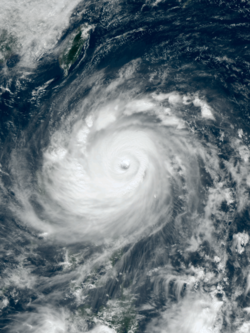
In meteorology, an eyewall replacement cycle, also called a concentric eyewall cycle, is a process whereby some of the outer rainbands of a tropical cyclone with an eye strengthen and organize into a ring of thunderstorms—a new, outer eyewall—that slowly moves inward and robs the original, inner eyewall of its needed moisture and angular momentum. Since the strongest winds are in a tropical cyclone's eyewall, the storm usually weakens during this phase, as the inner wall is "choked" by the outer wall. Eventually the outer eyewall replaces the inner one completely, and the storm may re-intensify.
They naturally occur in intense tropical cyclones with maximum sustained winds greater than 33 m/s (64 kn; 119 km/h; 74 mph), or hurricane-force, and particularly in major hurricanes of Saffir–Simpson category 3 to 5.
The discovery of this process was partially responsible for the end of the U.S. government's hurricane modification experiment Project Stormfury. This project set out to seed clouds outside the eyewall, apparently causing a new eyewall to form and weakening the storm. When it was discovered that this was a natural process due to hurricane dynamics, the project was quickly abandoned.
Almost every intense hurricane undergoes at least one of these cycles during its existence. Recent studies have shown that nearly half of all tropical cyclones, and nearly all cyclones with sustained winds over 204 kilometres per hour (127 mph; 110 kn), undergo eyewall replacement cycles. Hurricane Allen in 1980 went through repeated eyewall replacement cycles, fluctuating between Category 5 and Category 4 status on the Saffir–Simpson scale several times. Typhoon June (1975) was the first reported case of triple eyewalls, and Hurricane Juliette and Iris (2001) were documented cases of such.
The first tropical system to be observed to have concentric eyewalls was Typhoon Sarah by Fortner in 1956, which he described as "an eye within an eye". The storm was observed by a reconnaissance aircraft to have an inner eyewall at 6 kilometres (3.7 mi) and an outer eyewall at 28 kilometres (17 mi). During a subsequent flight 8 hours later, the inner eyewall had disappeared, the outer eyewall had reduced to 16 kilometres (9.9 mi) and the maximum sustained winds and hurricane intensity had decreased. The next hurricane observed to have concentric eyewalls was Hurricane Donna in 1960. Radar from reconnaissance aircraft showed an inner eye that varied from 10 miles (16 km) at low altitude to 13 miles (21 km) near the tropopause. In between the two eyewalls was an area of clear skies that extended vertically from 3,000 feet (910 m) to 25,000 feet (7,600 m). The low-level clouds at around 3,000 feet (910 m) were described as stratocumulus with concentric horizontal rolls. The outer eyewall was reported to reach heights near 45,000 feet (14,000 m) while the inner eyewall only extended to 30,000 feet (9,100 m). 12 hours after identifying concentric eyewalls, the inner eyewall had dissipated.
Hurricane Beulah in 1967 was the first tropical cyclone to have its eyewall replacement cycle observed from beginning to end. Previous observations of concentric eyewalls were from aircraft-based platforms. Beulah was observed from the Puerto Rico land-based radar for 34 hours during which time a double eyewall formed and dissipated. It was noted that Beulah reached maximum intensity immediately prior to undergoing the eyewall replacement cycle, and that it was "probably more than a coincidence." Previous eyewall replacement cycles had been observed to decrease the intensity of the storm, but at this time the dynamics of why it occurred was not known.[citation needed]
As early as 1946 it was known that the introduction of carbon dioxide ice or silver iodide into clouds that contained supercooled water would convert some of the droplets into ice followed by the Bergeron–Findeisen process of growth of the ice particles at the expense of the droplets, the water of which would all end up in large ice particles. The increased rate of precipitation would result in dissipation of the storm. By early 1960, the working theory was that the eyewall of a hurricane was inertially unstable and that the clouds had a large amount of supercooled water. Therefore, seeding the storm outside the eyewall would release more latent heat and cause the eyewall to expand. The expansion of the eyewall would be accompanied with a decrease in the maximum wind speed through conservation of angular momentum.
Project Stormfury was an attempt to weaken tropical cyclones by flying aircraft into them and seeding with silver iodide. The project was run by the United States Government from 1962 to 1983.
Eyewall replacement cycle
In meteorology, an eyewall replacement cycle, also called a concentric eyewall cycle, is a process whereby some of the outer rainbands of a tropical cyclone with an eye strengthen and organize into a ring of thunderstorms—a new, outer eyewall—that slowly moves inward and robs the original, inner eyewall of its needed moisture and angular momentum. Since the strongest winds are in a tropical cyclone's eyewall, the storm usually weakens during this phase, as the inner wall is "choked" by the outer wall. Eventually the outer eyewall replaces the inner one completely, and the storm may re-intensify.
They naturally occur in intense tropical cyclones with maximum sustained winds greater than 33 m/s (64 kn; 119 km/h; 74 mph), or hurricane-force, and particularly in major hurricanes of Saffir–Simpson category 3 to 5.
The discovery of this process was partially responsible for the end of the U.S. government's hurricane modification experiment Project Stormfury. This project set out to seed clouds outside the eyewall, apparently causing a new eyewall to form and weakening the storm. When it was discovered that this was a natural process due to hurricane dynamics, the project was quickly abandoned.
Almost every intense hurricane undergoes at least one of these cycles during its existence. Recent studies have shown that nearly half of all tropical cyclones, and nearly all cyclones with sustained winds over 204 kilometres per hour (127 mph; 110 kn), undergo eyewall replacement cycles. Hurricane Allen in 1980 went through repeated eyewall replacement cycles, fluctuating between Category 5 and Category 4 status on the Saffir–Simpson scale several times. Typhoon June (1975) was the first reported case of triple eyewalls, and Hurricane Juliette and Iris (2001) were documented cases of such.
The first tropical system to be observed to have concentric eyewalls was Typhoon Sarah by Fortner in 1956, which he described as "an eye within an eye". The storm was observed by a reconnaissance aircraft to have an inner eyewall at 6 kilometres (3.7 mi) and an outer eyewall at 28 kilometres (17 mi). During a subsequent flight 8 hours later, the inner eyewall had disappeared, the outer eyewall had reduced to 16 kilometres (9.9 mi) and the maximum sustained winds and hurricane intensity had decreased. The next hurricane observed to have concentric eyewalls was Hurricane Donna in 1960. Radar from reconnaissance aircraft showed an inner eye that varied from 10 miles (16 km) at low altitude to 13 miles (21 km) near the tropopause. In between the two eyewalls was an area of clear skies that extended vertically from 3,000 feet (910 m) to 25,000 feet (7,600 m). The low-level clouds at around 3,000 feet (910 m) were described as stratocumulus with concentric horizontal rolls. The outer eyewall was reported to reach heights near 45,000 feet (14,000 m) while the inner eyewall only extended to 30,000 feet (9,100 m). 12 hours after identifying concentric eyewalls, the inner eyewall had dissipated.
Hurricane Beulah in 1967 was the first tropical cyclone to have its eyewall replacement cycle observed from beginning to end. Previous observations of concentric eyewalls were from aircraft-based platforms. Beulah was observed from the Puerto Rico land-based radar for 34 hours during which time a double eyewall formed and dissipated. It was noted that Beulah reached maximum intensity immediately prior to undergoing the eyewall replacement cycle, and that it was "probably more than a coincidence." Previous eyewall replacement cycles had been observed to decrease the intensity of the storm, but at this time the dynamics of why it occurred was not known.[citation needed]
As early as 1946 it was known that the introduction of carbon dioxide ice or silver iodide into clouds that contained supercooled water would convert some of the droplets into ice followed by the Bergeron–Findeisen process of growth of the ice particles at the expense of the droplets, the water of which would all end up in large ice particles. The increased rate of precipitation would result in dissipation of the storm. By early 1960, the working theory was that the eyewall of a hurricane was inertially unstable and that the clouds had a large amount of supercooled water. Therefore, seeding the storm outside the eyewall would release more latent heat and cause the eyewall to expand. The expansion of the eyewall would be accompanied with a decrease in the maximum wind speed through conservation of angular momentum.
Project Stormfury was an attempt to weaken tropical cyclones by flying aircraft into them and seeding with silver iodide. The project was run by the United States Government from 1962 to 1983.
Recent media
Recent media